
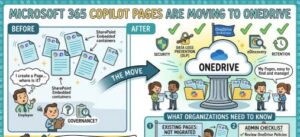
Microsoft is making a significant change to how newly created Microsoft 365 Copilot Pages are stored, bringing them into the familiar world of OneDrive for Business and, with it, a much broader set of governance, compliance, security and lifecycle management tools.
The change is expected to begin rolling out worldwide in mid-August 2026 and should be completed by late September 2026. For organizations operating in GCC, GCC High and DoD environments, the rollout is scheduled to begin in mid-September 2026, with completion expected by early October 2026.
For most users, the transition should happen quietly. Microsoft says no user action is required. However, the change is potentially important for IT administrators, compliance teams and organizations that have built detailed policies around Microsoft 365 data.
The biggest difference is straightforward: newly created Copilot Pages will be stored in users’ OneDrive for Business accounts rather than their current storage location.
That may sound like a technical backend change, but it has practical consequences for how companies manage AI-generated content.
Why Microsoft is moving Copilot Pages to OneDrive
Copilot Pages are designed to turn AI-generated content and collaborative work into persistent pages that users can return to, edit and share. As organizations increasingly use Microsoft 365 Copilot for everyday work, these pages can potentially become part of the company’s broader information environment.
Moving newly created pages into OneDrive for Business gives administrators a more established set of controls for managing that content.
Instead of treating Copilot Pages as a separate type of content with a separate management model, organizations will be able to apply many of the same policies and processes they already use for files stored in OneDrive.
That includes governance, compliance, data protection, retention, lifecycle management, reporting and investigations.
For IT departments, this could make AI-generated content easier to bring under existing enterprise policies.
The change applies to Copilot Pages created through Copilot Chat, the Microsoft 365 Copilot app and newly created Copilot Notebooks.
New Copilot Pages will appear alongside regular OneDrive files
Following the rollout, newly created Copilot Pages will be stored in users’ OneDrive for Business accounts.
This means users can expect these pages to exist alongside familiar OneDrive content such as Word documents, Excel spreadsheets and PowerPoint presentations.
New Copilot Notebooks will also follow the new storage approach. Pages and artifacts created within those new notebooks will appear alongside other OneDrive content.
For users, the change could make AI-generated work feel more integrated into the Microsoft 365 file environment.
For administrators, however, the bigger story is what happens behind the scenes.
Because the new Copilot Pages will be stored in OneDrive, organizations can use existing OneDrive governance and compliance capabilities to manage them.
Compliance teams get more control over AI-generated content
One of the most important aspects of Microsoft’s change is its impact on compliance.
New Copilot Pages will be eligible for several OneDrive for Business compliance capabilities, including standard file path-based eDiscovery.
This can be particularly important for organizations that need to identify, preserve or investigate business information during legal or regulatory processes.
Microsoft also says retention labels with record locking will apply to newly created Copilot Pages.
That means organizations can incorporate these AI-generated pages into established retention and records-management strategies rather than creating an entirely separate process.
The change also brings Information Barriers and Compliance Boundaries into the picture for new Copilot Pages.
For heavily regulated organizations, these controls can be important because AI-generated content may contain the same types of confidential, sensitive or business-critical information found in conventional documents.
The underlying message for administrators is clear: Copilot-generated content should increasingly be considered part of the organization’s broader information governance strategy.
Data Loss Prevention will also apply
Data protection is another major part of the change.
Microsoft says existing Data Loss Prevention (DLP) policies and mitigation workflows for OneDrive for Business can be applied to newly created Copilot Pages.
This could be significant as businesses become more cautious about the information employees enter into or generate with AI tools.
An employee could use Copilot to summarize a project, prepare a business document or organize information from multiple sources. Once that content becomes a persistent Copilot Page, it needs to be managed appropriately.
By placing new pages in OneDrive, organizations can use established DLP policies rather than potentially creating an entirely separate protection framework.
Microsoft also says supported third-party governance solutions that work with OneDrive content can apply to these newly created Copilot Pages.
For organizations already using external governance, compliance or data-management platforms, this could simplify the process of bringing Copilot content into existing oversight systems.
Retention and lifecycle management become part of the picture
The change isn’t limited to compliance and security.
New Copilot Pages will also fall under existing OneDrive retention and lifecycle policies.
This means organizations can manage the lifecycle of these pages using processes they already have in place for OneDrive content.
Microsoft also notes that existing departed-user workflows for OneDrive content will apply.
That could be especially relevant for businesses with large workforces and established employee offboarding procedures. When an employee leaves, organizations often need to determine what happens to the information stored in their Microsoft 365 account.
With newly created Copilot Pages stored in OneDrive, those pages can become part of the existing operational model.
Administrators will have better monitoring and investigation options
Another benefit of the move is visibility.
Microsoft says administrators will be able to use OneDrive storage reporting and administrative investigation capabilities for newly created Copilot Pages.
This gives IT and compliance teams a more familiar way to monitor the content.
Rather than learning an entirely different reporting and investigation process for Copilot Pages, administrators can work with OneDrive’s existing management capabilities.
That could become increasingly valuable as organizations scale their use of Microsoft 365 Copilot.
What happens to existing Copilot Pages?
This is an important distinction: Microsoft is not moving existing Copilot Pages to OneDrive.
Existing Copilot Pages will remain in their current storage location and will not be migrated as part of this change.
In other words, organizations should expect a split between older and newly created content.
Pages created before the change will remain where they are, while pages created after the new storage model takes effect will be stored in OneDrive for Business.
That distinction could be important for administrators updating governance documentation or explaining the change to employees.
Copilot Notebooks have a similar but important distinction
There is also a specific difference involving Copilot Notebooks.
Existing Copilot Notebooks will continue to store newly created pages in SharePoint Embedded.
Only Copilot Notebooks created after the change will store pages in OneDrive for Business.
This means organizations shouldn’t assume that every Copilot Notebook will suddenly move to OneDrive.
The creation date of the notebook matters.
Loop workspaces are not affected
Microsoft has also made clear that Loop workspaces are not part of this change.
Loop workspaces will continue using their existing storage location.
That clarification matters because Microsoft 365 users increasingly encounter Copilot Pages, Copilot Notebooks and Loop content in similar collaborative workflows. Their storage and governance models, however, are not necessarily the same.
No immediate action is required — but administrators should prepare
Microsoft says organizations do not need to take action to enable the change.
The rollout will happen automatically according to Microsoft’s deployment schedule.
Still, “no action required” does not necessarily mean administrators should ignore the change.
Microsoft recommends that administrators review their existing OneDrive for Business DLP, retention and compliance policies.
IT teams should also check whether third-party governance or eDiscovery products are configured to monitor OneDrive content appropriately.
Organizations may also want to update internal documentation covering AI-generated information.
This is particularly relevant for companies that have recently introduced AI governance policies. If employees are told that Copilot-generated information is handled under one set of rules while OneDrive content is handled under another, the change could create confusion.
A short internal communication explaining that newly created Copilot Pages will now be stored in OneDrive could help users understand where their content is going.
What does this mean for Microsoft 365 users?
For everyday users, the change should be relatively simple.
They don’t need to manually move their pages or change their settings. New Copilot Pages will simply be stored in OneDrive for Business after the rollout reaches their organization.
The bigger impact will likely be felt by IT, security, legal and compliance teams.
The move effectively brings Copilot Pages closer to the organization’s existing Microsoft 365 information-management framework.
As businesses use AI more heavily, that integration could become increasingly important.
AI-generated content isn’t always temporary. A Copilot response can evolve into a project summary, meeting record, research document, planning artifact or other piece of business information.
Once that content becomes part of an organization’s working records, companies need to know where it is stored, how long it is retained, who can access it and how it can be discovered or protected.
The bigger Microsoft 365 picture
Microsoft’s Copilot Pages storage change reflects a broader challenge facing enterprises adopting generative AI: AI content needs enterprise-grade governance just like traditional business content.
Storing new Copilot Pages in OneDrive doesn’t solve every AI governance question, but it gives organizations a more familiar foundation for managing this particular type of content.
The combination of OneDrive storage, DLP, retention policies, eDiscovery, Information Barriers, Compliance Boundaries and lifecycle controls gives administrators more opportunities to incorporate Copilot Pages into existing governance strategies.
The rollout is scheduled to begin worldwide in mid-August 2026 and continue through late September. Government cloud environments will follow a separate schedule beginning in mid-September.
For users, the transition should largely happen in the background.
For administrators, however, now is a good time to review OneDrive policies and make sure they reflect the growing role of AI-generated content inside Microsoft 365.
The bottom line: newly created Copilot Pages are moving closer to the standard Microsoft 365 content-management ecosystem. Existing pages won’t be migrated, but new pages will benefit from the governance and compliance controls organizations already use for OneDrive.
As AI becomes a routine part of workplace productivity, changes like this show that the future of AI isn’t only about what Copilot can create. It’s also about how organizations store, protect, govern and manage what AI creates.