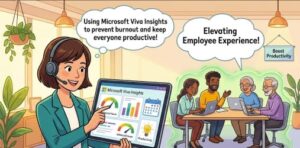
Workplace productivity has changed. It is no longer simply about how many hours employees spend at their desks or how many meetings they attend. Today, productive teams are the ones that can focus, collaborate effectively, manage their workload, and maintain enough energy to do their best work over time.
For managers and team leaders, this creates a difficult balancing act. They are expected to deliver results while also supporting employee wellbeing. When workloads become too heavy, meetings take over the calendar, and employees struggle to disconnect from work, productivity can eventually suffer.
This is where Microsoft Viva Insights can make a meaningful difference.
Viva Insights gives managers and employees data-driven insights that can help them understand work patterns, identify potential productivity challenges, and encourage healthier working habits. Instead of relying entirely on assumptions or occasional employee surveys, managers can use workplace data to identify patterns that may indicate that a team needs a better approach to meetings, focus time, collaboration, or work-life boundaries.
The goal isn’t to monitor employees. It is to use data responsibly to create a workplace where people can work effectively without constantly feeling overwhelmed.
Why Employee Experience Matters for Productivity
Employee experience is closely connected to how people perform at work.
An employee who spends most of the day jumping between meetings may have very little uninterrupted time to complete important tasks. Someone who regularly works late may appear highly committed, but that schedule can eventually lead to fatigue and reduced performance. A team that receives messages throughout the evening may find it difficult to establish healthy boundaries.
These issues can easily become normalized.
Managers may think, “That’s just how busy things are right now.” Employees may think, “Everyone is working this way.” Over time, however, these patterns can contribute to stress, disengagement, and burnout.
A better approach is to look at the way work is actually happening.
This is one of the areas where Microsoft Viva Insights can help. By turning workplace activity patterns into useful insights, managers can have more informed conversations about how their teams work.
The important point is that the data should support better decisions—not become another way to judge employee performance.
Using Data to Spot Early Signs of Burnout
Burnout rarely happens overnight. It often develops gradually.
Long working hours, excessive meetings, insufficient focus time, and difficulty disconnecting from work can all contribute to an unhealthy work pattern. The challenge for managers is that these signs are not always visible.
An employee may continue meeting deadlines while quietly struggling with an unsustainable workload.
Viva Insights can help managers identify broader working patterns that deserve attention. For example, a manager might discover that a team has an unusually high number of meetings or that employees have limited uninterrupted time for focused work.
These insights can lead to useful questions:
- Are we holding meetings that don’t need to exist?
- Are employees getting enough time to concentrate?
- Are priorities clear?
- Are people regularly working outside normal hours?
- Are we creating unnecessary interruptions?
- Can some communication be moved from meetings to asynchronous updates?
The objective isn’t to identify an individual as “burned out.” Instead, managers can look at patterns and consider whether the team’s way of working is contributing to unnecessary pressure.
Reduce Meeting Overload
One of the simplest ways to improve productivity is to make meetings more intentional.
Meetings are essential for collaboration, decision-making, and relationship building. But too many meetings can have the opposite effect. Employees can spend much of their day in calls and then use evenings or early mornings to complete the work they couldn’t finish.
For managers, Viva Insights can provide visibility into meeting patterns and help identify opportunities to improve the team’s calendar.
That might mean shortening recurring meetings from 60 minutes to 30 minutes. It could mean removing a meeting that no longer has a clear purpose. It might also involve encouraging employees to decline meetings when their participation isn’t necessary.
Another useful practice is protecting blocks of focus time.
Instead of filling every available space in an employee’s calendar, managers can encourage periods where employees can concentrate on complex tasks without constant interruptions.
This doesn’t mean eliminating collaboration. It means creating a healthier balance between collaboration and concentration.
Protect Focus Time to Improve Productivity
Modern work requires a surprising amount of mental switching.
An employee might start writing a report, receive a Teams message, join a meeting, respond to an email, return to the report, attend another call, and then discover that half the day has disappeared.
The problem isn’t necessarily a lack of effort. It is fragmented attention.
Managers can use insights about working patterns to encourage better scheduling habits. Protected focus time gives employees an opportunity to work on tasks that require deeper concentration.
For example, a team leader could establish a few meeting-free periods during the week. Employees could then use that time for planning, analysis, writing, development, or other work that requires sustained attention.
When employees have enough uninterrupted time to complete important work, productivity can improve without simply asking people to work longer hours.
That’s an important distinction.
The goal should be better work, not more hours.
Encourage Healthy Work-Life Boundaries
Technology has made it easier than ever to stay connected. Unfortunately, being connected all the time doesn’t necessarily make a team more productive.
If employees feel that they need to respond to messages late at night or during weekends, they may find it difficult to fully disconnect from work.
Managers have a major role in setting expectations.
Viva Insights can help organizations understand working patterns and encourage healthier habits around after-hours work. Managers can use these insights as a starting point for conversations about workload, priorities, and boundaries.
For example, instead of praising an employee for consistently working late, a manager might ask whether there is a workload issue that needs to be addressed.
This small change in mindset can have a significant impact.
Employees should know that taking breaks, using vacation time, and disconnecting after work are not signs of low commitment. They are part of maintaining sustainable performance.
Turn Insights Into Action
Having data is useful, but data alone doesn’t improve employee experience.
The real value comes from what managers do with the information.
Suppose a manager discovers that the team spends a large amount of time in recurring meetings. The next step shouldn’t simply be to acknowledge the statistic. The manager can review the meetings and determine which ones can be shortened, combined, delegated, or removed.
Similarly, if employees appear to have limited focus time, managers can review priorities and calendars to create more space for concentrated work.
A simple improvement cycle can help:
Measure → Understand → Act → Review
First, look at the available insights. Then understand what the patterns might mean. Take a practical action. Finally, review whether the change actually helped.
This approach prevents workplace analytics from becoming another reporting exercise.
Build a Culture of Trust, Not Surveillance
When using workplace data, trust is critical.
Employees need to understand why data is being used and how it will support a healthier workplace. Managers should avoid turning productivity insights into a tool for ranking individuals or monitoring every minute of someone’s working day.
The purpose should be to identify systemic problems.
For example, if an entire team has excessive meeting hours, the answer probably isn’t that every employee needs to “work harder.” The better question is whether the organization has created too many meetings.
Likewise, if employees regularly work after hours, managers should investigate workload, deadlines, staffing, and expectations before making assumptions about individual performance.
Responsible use of data can strengthen the employee experience because employees can see that workplace analytics are being used to remove obstacles rather than create additional pressure.
Managers Can Lead the Change
Technology can provide insights, but managers provide the human element.
A dashboard cannot have a conversation with an employee who feels overwhelmed. A productivity metric cannot replace empathy. And no analytics platform can create a positive culture by itself.
Managers need to combine data with regular conversations.
Ask employees what is getting in their way. Find out which meetings they find useful and which feel unnecessary. Discuss priorities. Encourage people to protect their focus time. Make it clear when employees are expected to be available—and when they are free to disconnect.
These simple management practices can turn workplace data into meaningful improvements.
The Bigger Picture: Sustainable Productivity
The future of productivity isn’t about pushing employees to do more at any cost.
It is about creating conditions where people can consistently do meaningful work.
Microsoft Viva Insights can help managers understand how work is happening across their teams and identify opportunities to improve the employee experience. By paying attention to meeting overload, focus time, work patterns, and boundaries, managers can address potential burnout risks before they become larger problems.
Most importantly, these insights can support a shift in how organizations think about productivity.
Instead of asking, “How busy is everyone?”, managers can ask, “Are we creating the conditions for people to do their best work?”
That is a much more valuable question.
When employees have time to focus, fewer unnecessary meetings, clearer priorities, and healthier boundaries, productivity doesn’t have to come at the expense of wellbeing.
The result is a workplace where people can perform at a high level—and keep doing so over the long term.
Viva Insights isn’t about making employees work harder. It’s about helping managers understand how work happens so they can make work better.
For today’s managers and team leaders, that may be one of the most practical ways to improve both employee experience and sustainable productivity.
Extra posts:
 Elevating Employee Experience with Microsoft Viva Insights
  Unlocking Workplace Productivity with Microsoft Viva Insights Unlocking Employee Engagement with Microsoft Viva Glint
  Unlocking Employee Potential A Complete Guide to Microsoft Viva Suite
  The Best Free Microsoft 365 Add-ons to Boost Your Productivity
  Boost Team Productivity & Communication: How to Use Prompt Coach in Microsoft Teams with Detailed Steps!