
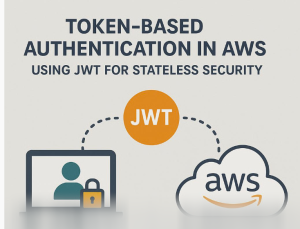
As cloud-native applications grow in complexity, so do the requirements for secure and scalable authentication. Token-based authentication, especially using JSON Web Tokens (JWTs), has emerged as a go-to strategy for implementing stateless, robust access control. While commonly associated with modern web APIs, JWTs are also first-class citizens in AWS ecosystems.
In this blog, we’ll explore how token-based authentication works in AWS, when to use JWTs, and how to integrate them into your architecture for stateless security.
🔐 What is Token-Based Authentication?
In traditional authentication models, sessions are stored on the server. Token-based authentication shifts this responsibility to the client, which holds a token (usually a JWT) issued after a successful login. This token is sent with each request, allowing the server to authenticate and authorize the user without maintaining session state.
💡 Why JWT?
JSON Web Tokens (JWTs) are an open standard (RFC 7519) for securely transmitting information between parties as a JSON object. A JWT typically contains:
- Header – Specifies the algorithm (e.g., HS256, RS256).
- Payload – Includes claims like
sub,iss,exp, and custom data (e.g., roles). - Signature – Verifies the token hasn’t been tampered with.
Benefits of JWT:
- ✅ Stateless: No session storage required.
- 🔐 Secure: Can be signed and encrypted.
- 🌐 Portable: Passed via HTTP headers, cookies, or URLs.
- ⚡ Fast: Lightweight and easy to decode on the fly.
☁️ JWT in AWS: Core Use Cases
1. Amazon Cognito
Amazon Cognito is AWS’s built-in identity provider that supports JWT-based authentication out of the box. After a successful login, Cognito issues:
- ID token (user profile info)
- Access token (authorizes API access)
- Refresh token (for renewing ID/access tokens)
These are JWTs signed using AWS keys and can be validated using JWKS endpoints.
2. Amazon API Gateway
You can protect APIs by enabling JWT authorizers:
- Use Cognito or 3rd-party IdPs (like Auth0, Okta).
- API Gateway validates JWT signature, expiration, and claims.
- You can define IAM roles or Lambda authorizers for advanced logic.
3. AWS Lambda
Lambda functions can be secured with token-based authentication by:
- Parsing JWT tokens manually or with libraries (e.g.,
jsonwebtokenin Node.js orpyjwtin Python). - Verifying token claims, scopes, or user roles.
- Implementing custom authorizers in API Gateway to enforce access control.
4. App Load Balancer + Cognito
With Application Load Balancer (ALB), you can:
- Enable OIDC authentication using Cognito or any OIDC provider.
- Automatically validate JWTs at the ALB layer.
- Forward validated requests to EC2 or container services like ECS/Fargate.
🛠 How to Implement JWT in AWS
Step 1: Set Up Identity Provider
Use Amazon Cognito User Pool or an external OIDC provider:
- Create a User Pool in Cognito.
- Enable app client and configure callback/logout URLs.
Step 2: Authenticate and Retrieve Tokens
Your app will use the hosted UI or SDK (e.g., AWS Amplify or Cognito Auth SDK):
javascriptCopyEditAuth.signIn(username, password).then(user => {
  const idToken = user.signInUserSession.idToken.jwtToken;
});
Step 3: Attach JWT to Requests
Add the Authorization header in API requests:
httpCopyEditGET /api/data HTTP/1.1
Authorization: Bearer eyJraWQiOiJrTUl...
Step 4: Validate JWT in Backend
If you’re not using API Gateway’s built-in auth:
- Use a JWT library to decode and verify the token.
- Fetch the public key from the identity provider’s JWKS endpoint.
Example in Node.js:
javascriptCopyEditconst jwt = require("jsonwebtoken");
jwt.verify(token, publicKey, { algorithms: ["RS256"] });
🔐 Best Practices
- ⏳ Short token expiry – Reduces risk of misuse.
- 🔄 Use refresh tokens – Maintain user sessions without login prompts.
- ⚠️ Validate issuer and audience – Prevent token spoofing.
- 🔐 Use HTTPS only – Tokens are sensitive credentials.
- 🛡️ Scope-based access control – Fine-tune API access using token claims.
✅ When to Use JWT in AWS
Choose JWT when:
- Building stateless APIs with Lambda or API Gateway.
- Securing single-page apps (SPAs) or mobile clients.
- Integrating federated identity providers (e.g., Google, Facebook, Azure AD).
- Using multi-tenant architecture where claims vary by user or tenant.
Avoid JWT when:
- You need instant token revocation (consider OAuth introspection or short TTL).
- Your app uses traditional session-based authentication with tight server control.
JWT-based token authentication is a cornerstone of secure, scalable, cloud-native architectures. With AWS services like Cognito, API Gateway, and Lambda, implementing JWT is both powerful and flexible. By designing around stateless security, your applications can scale independently while maintaining strong access control.
Whether you’re protecting APIs, serverless functions, or web apps, JWT in AWS offers a modern, standards-based solution for identity and access management.
Extra posts:
 Token-Based Authentication in Azure Using JWT for Stateless Security
  🚀 Materialized View Pattern in AWS Precompute for Performance
  Building Resilient Systems with Immutable Infrastructure on AWS
  CQRS on AWS Separating Read and Write Operations for Performance and Scalability
 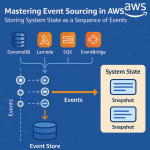 Implementing Event Sourcing in AWS Modeling State as a Sequence of Events Secret Store Pattern in AWS Using Secure Vaults for Credentials and Secrets