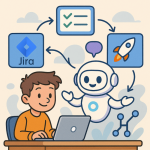
Modern software teams move fast. Between sprint planning, backlog grooming, pull requests, deployments, and stakeholder updates, developers often spend more time discussing work than actually doing it. One of the biggest pain points in Agile workflows is the daily stand-up meeting especially when team members need to manually summarize updates across dozens of tickets in tools like Jira and Azure DevOps.
This is where the idea of a Daily Stand-Up Agent becomes transformative.
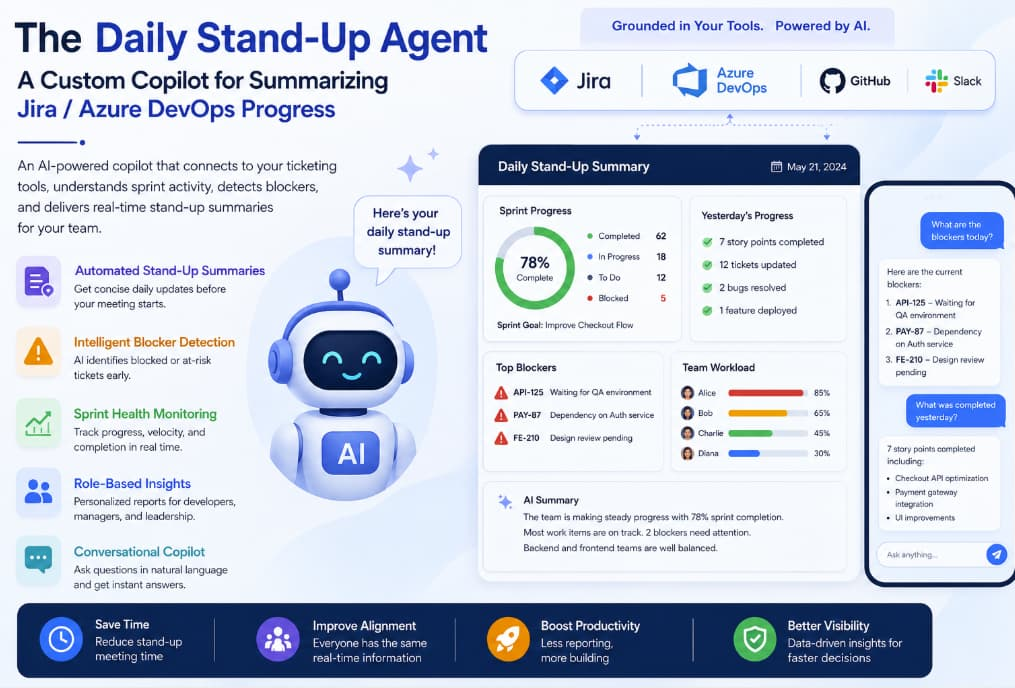
Imagine a custom AI copilot that automatically connects to your ticketing systems, reads sprint activity in real time, analyzes progress, identifies blockers, and generates concise stand-up summaries before the meeting even starts. Instead of asking every engineer to explain ticket-by-ticket updates, the AI delivers a clear snapshot of sprint health, completed work, risks, and next actions.
In this blog, we’ll explore how to build a custom stand-up agent grounded in third-party ticketing data and why it can become one of the most valuable productivity tools for engineering teams.
Why Daily Stand-Ups Need Reinvention
Daily stand-ups were designed to improve communication and alignment. But in many organizations, they become repetitive status meetings filled with fragmented information.
Common challenges include:
- Engineers forgetting updates from the previous day
- Managers manually reviewing Jira tickets before meetings
- Lack of visibility into blockers
- Distributed teams working across time zones
- Sprint data spread across multiple systems
- Delayed reporting and inconsistent summaries
As teams scale, these inefficiencies multiply. A sprint with 100+ active tickets can be difficult to track manually, especially when work items are updated continuously throughout the day.
A custom AI stand-up agent solves this problem by becoming an intelligent layer between your ticketing platform and your team discussions.
What Is a Daily Stand-Up Agent?
A Daily Stand-Up Agent is an AI-powered assistant that integrates with tools like Jira and Azure DevOps to provide:
- Real-time sprint summaries
- Ticket progress updates
- Blocker detection
- Team workload insights
- Completed vs pending work analysis
- Risk identification
- Automated meeting notes
- Natural language stand-up reports
Think of it as a specialized engineering copilot trained specifically on your sprint data and Agile workflows.
Unlike generic AI assistants, this agent is “grounded” in live organizational data. That means its responses are based on actual tickets, comments, pull requests, sprint states, and work item history rather than generalized assumptions.
Core Architecture of the Solution
Building a production-ready stand-up agent requires several interconnected components.
1. Data Connectors
The first layer connects to ticketing systems such as:
- Jira REST APIs
- Azure DevOps Work Item APIs
- Git repositories
- CI/CD systems
- Slack or Microsoft Teams
The connector continuously fetches:
- Ticket status
- Assigned users
- Story points
- Sprint metadata
- Comments and updates
- Pull request activity
- Deployment status
This creates a centralized knowledge layer for the AI agent.
2. Data Grounding Layer
Grounding is one of the most important concepts in enterprise AI.
Without grounding, large language models may hallucinate or provide vague summaries. With grounding, the AI only references validated enterprise data.
The grounding layer performs:
- Ticket normalization
- Context enrichment
- Duplicate resolution
- Sprint mapping
- Dependency tracking
- Historical trend analysis
For example, the system can determine:
- Which tickets moved from “In Progress” to “Done”
- Which tasks are blocked for more than 48 hours
- Which developers are overloaded
- Which sprint goals are at risk
This transforms raw ticket data into structured intelligence.
3. AI Summarization Engine
The summarization engine is the heart of the stand-up agent.
Using modern large language models, the system can generate:
- Executive summaries
- Team-specific updates
- Developer-level reports
- Sprint health snapshots
- Blocker alerts
- Release readiness summaries
Example output:
“The backend team completed 7 story points yesterday, including authentication API enhancements and database indexing improvements. Two tickets remain blocked due to unresolved QA dependencies. Sprint completion is currently tracking at 78% with low delivery risk.”
This level of clarity dramatically reduces meeting overhead.
4. Conversational Copilot Interface
The most effective stand-up agents allow natural language interaction.
Users can ask:
- “What blockers exist in the current sprint?”
- “Which tickets changed status today?”
- “Who has the highest workload?”
- “What was completed yesterday?”
- “Summarize sprint progress for leadership.”
This conversational interface can be embedded into:
- Slack
- Microsoft Teams
- Internal dashboards
- Web portals
- Mobile apps
The result is a real-time engineering intelligence assistant available on demand.
Key Features of a Modern Stand-Up Agent
Automated Daily Summaries
The system generates stand-up notes automatically before meetings begin.
This removes repetitive manual reporting and ensures consistency across teams.
Intelligent Blocker Detection
AI can identify hidden blockers using patterns such as:
- Tickets inactive for several days
- Excessive reopen cycles
- Missing dependencies
- Delayed pull request approvals
- Failed deployments
This helps engineering leaders act proactively rather than reactively.
Sprint Health Monitoring
The agent continuously tracks sprint performance indicators including:
- Completion percentage
- Velocity trends
- Burn-down progress
- Ticket aging
- Delivery confidence
Managers gain real-time visibility without opening multiple dashboards.
Role-Based Insights
Different stakeholders need different levels of detail.
The agent can generate:
- Executive summaries for leadership
- Technical summaries for developers
- Delivery metrics for Scrum Masters
- Risk reports for project managers
This personalization increases adoption across the organization.
Benefits for Engineering Teams
Reduced Meeting Time
Many organizations spend 15–30 minutes daily on stand-ups. AI-generated summaries can reduce meetings significantly by focusing only on blockers and critical updates.
Better Team Alignment
A centralized AI summary ensures everyone receives the same information, reducing confusion and communication gaps.
Faster Decision-Making
Managers can identify risks earlier and make informed decisions using real-time sprint intelligence.
Improved Productivity
Developers spend less time preparing updates and more time building software.
Enhanced Visibility for Remote Teams
Distributed teams across different time zones benefit greatly from asynchronous AI-generated updates.
Real-World Enterprise Use Cases
Software Development Teams
Engineering teams use stand-up agents to automate sprint reporting and improve delivery transparency.
Managed Service Providers
MSPs handling multiple client projects can generate account-specific delivery summaries automatically.
Enterprise Agile Transformation
Large enterprises scaling Agile practices across departments can standardize reporting workflows with AI.
DevOps Organizations
DevOps teams integrate deployment and incident data into sprint summaries for operational visibility.
Challenges to Consider
While stand-up agents are powerful, there are important considerations.
Data Security
The agent accesses sensitive engineering information, so authentication and authorization are critical.
Use:
- OAuth
- Role-based access control
- Encrypted storage
- Secure API gateways
Data Quality
AI summaries are only as good as the underlying ticket data. Poorly maintained Jira tickets lead to inaccurate insights.
Organizations should establish strong Agile hygiene practices.
Prompt Engineering
Enterprise copilots require carefully designed prompts to ensure summaries remain concise, accurate, and actionable.
Prompt templates should define:
- Tone
- Summary length
- Risk priorities
- Reporting format
The Future of AI-Powered Agile Operations
The Daily Stand-Up Agent is only the beginning.
Future enterprise copilots will evolve into autonomous Agile assistants capable of:
- Predicting sprint delays
- Recommending resource allocation
- Identifying engineering bottlenecks
- Automating retrospectives
- Suggesting backlog prioritization
- Generating release notes automatically
As AI becomes deeply integrated into software delivery pipelines, teams will move from reactive project management to proactive engineering intelligence.
Organizations that adopt these systems early will gain significant operational advantages in speed, collaboration, and delivery quality.
A custom Daily Stand-Up Agent grounded in Jira and Azure DevOps data can dramatically improve Agile collaboration. By combining real-time ticket intelligence with AI-powered summarization, organizations can eliminate repetitive reporting, detect blockers earlier, and gain deeper visibility into sprint execution.
The real value is not just automation — it’s clarity.
When teams spend less time gathering information and more time acting on it, productivity improves naturally. Engineering leaders gain confidence, developers regain focus, and stand-up meetings finally become what they were meant to be: fast, efficient, and valuable.
As enterprise AI adoption accelerates, custom copilots like the Daily Stand-Up Agent will become a standard part of modern software development operations.