In modern software development, teams move fast. New frameworks appear every year, cloud providers release endless services, and engineering decisions become more complex with every sprint. Yet one problem continues to haunt development teams across startups and enterprises alike:
Nobody remembers why a technical decision was made.
Six months later, someone asks:
- “Why did we choose microservices?”
- “Why are we using PostgreSQL instead of MongoDB?”
- “Who decided to deploy on Kubernetes?”
- “Why was this authentication provider selected?”
And the answer is usually buried in Slack threads, forgotten meetings, or someone’s memory.
This is exactly where Architecture Decision Records (ADRs) become powerful. And now, with AI, creating ADRs is easier, faster, and more consistent than ever before.
In this article, we’ll explore what ADRs are, why engineering teams struggle to maintain them, and how AI can simplify the entire process without adding documentation overhead.
What Is an Architecture Decision Record (ADR)?
An Architecture Decision Record is a short document that captures an important technical decision made by a software team.
It explains:
- What decision was made
- Why it was made
- What alternatives were considered
- What consequences the decision creates
Think of ADRs as the “memory system” of your engineering organization.
Instead of relying on verbal discussions or scattered notes, ADRs create a permanent historical record of architectural thinking.
A simple ADR usually includes:
- Title
- Status
- Context
- Decision
- Consequences
Here’s a basic example:
ADR Example
Title: Use PostgreSQL as Primary Database
Status: Accepted
Context:
The platform requires strong transactional consistency, relational modeling, and advanced querying support.
Decision:
The engineering team selected PostgreSQL over MongoDB and MySQL.
Consequences:
- Easier relational data management
- Strong SQL ecosystem
- Slightly higher scaling complexity compared to NoSQL solutions
Simple, right?
The challenge is not understanding ADRs.
The challenge is actually writing them consistently.
Why Most Teams Avoid ADRs
Even experienced engineering teams struggle to maintain ADR documentation.
Why?
Because developers often see documentation as:
- Time-consuming
- Repetitive
- Low priority
- Difficult to maintain
- Easy to postpone
During fast-moving projects, shipping features usually wins over writing architectural documentation.
As a result:
- Knowledge becomes tribal
- Onboarding gets harder
- Technical debt increases
- Teams repeat old debates
- Decision-making loses transparency
Ironically, teams usually realize the importance of ADRs only after scaling problems appear.
The Traditional ADR Process Is Painful
Creating ADRs manually often involves:
- Opening templates
- Writing technical context
- Summarizing meetings
- Explaining trade-offs
- Formatting markdown
- Storing files properly
For busy engineers, this feels like extra administrative work.
And if the process is difficult, adoption drops quickly.
This is where AI changes the game.
How AI Makes ADR Creation Easy
AI dramatically reduces the friction involved in creating Architecture Decision Records.
Instead of writing everything manually, developers can now generate ADR drafts in seconds using AI tools.
For example, a prompt like:
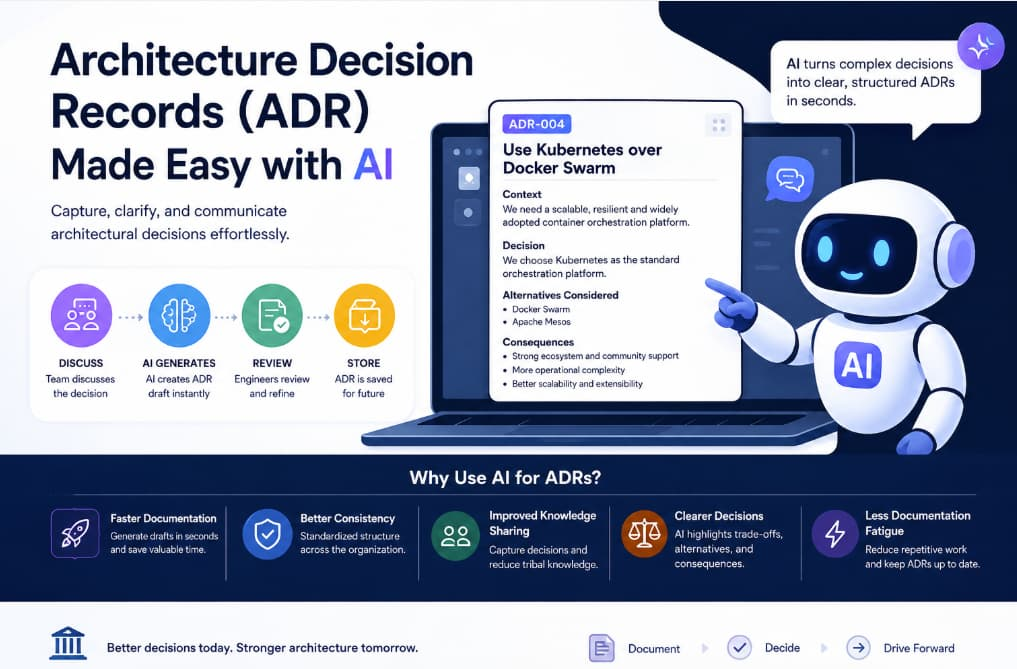
“Generate an ADR for choosing Kubernetes over Docker Swarm for container orchestration.”
can instantly produce a structured draft including:
- Context
- Decision rationale
- Alternatives
- Trade-offs
- Consequences
This transforms ADR writing from a 30-minute task into a 2-minute review process.
That’s a major productivity shift.
Benefits of Using AI for ADRs
1. Faster Documentation
AI removes the blank-page problem.
Developers no longer need to think about formatting or structure from scratch.
The AI generates the initial framework, allowing engineers to focus on accuracy instead of writing mechanics.
2. Better Consistency
One major issue with ADRs is inconsistency across teams.
Some ADRs become too detailed. Others are too vague.
AI can standardize:
- Tone
- Structure
- Sections
- Terminology
- Formatting
This creates cleaner engineering documentation across the organization.
3. Improved Knowledge Sharing
AI-generated ADRs make it easier for teams to document decisions regularly.
When documentation becomes easy, more decisions get recorded.
That means:
- Better onboarding
- Easier audits
- Faster troubleshooting
- Reduced dependency on individual engineers
4. Easier Technical Reviews
AI can summarize trade-offs clearly and objectively.
For example, when evaluating:
- SQL vs NoSQL
- Monolith vs Microservices
- REST vs GraphQL
- AWS vs Azure
AI can quickly generate comparison summaries that help technical reviewers understand the reasoning.
5. Reduced Documentation Fatigue
Nobody enjoys repetitive documentation tasks.
AI reduces the mental effort involved in:
- Writing boilerplate
- Structuring decisions
- Rephrasing technical explanations
- Formatting markdown
This encourages teams to maintain ADRs continuously instead of abandoning them.
Real-World Use Cases for AI-Powered ADRs
AI-assisted ADR generation works especially well in modern DevOps and cloud-native environments.
Common examples include:
Infrastructure Decisions
- Choosing Kubernetes
- Selecting cloud providers
- CDN architecture
- Load balancing strategies
Backend Architecture
- Monolith vs microservices
- Event-driven systems
- Message queues
- API gateways
Database Decisions
- PostgreSQL vs MongoDB
- Redis caching strategies
- Data partitioning methods
Security Decisions
- Authentication providers
- Encryption standards
- IAM strategies
Frontend Architecture
- React vs Angular
- SSR vs CSR
- State management approaches
AI can generate first drafts for all these scenarios rapidly.
Best Practices for AI-Generated ADRs
AI is powerful, but it should not replace engineering judgment.
The best approach is:
Use AI for Drafting
Let AI generate:
- Structure
- Initial context
- Trade-offs
- Formatting
Use Humans for Validation
Engineers should still:
- Verify technical accuracy
- Confirm assumptions
- Add organization-specific details
- Validate consequences
AI should assist decision documentation, not automate architecture thinking blindly.
Common Mistakes to Avoid
1. Blindly Accepting AI Output
AI can hallucinate technical details or oversimplify trade-offs.
Always review generated ADRs carefully.
2. Creating Overly Long ADRs
Good ADRs are concise.
The goal is clarity, not writing a technical novel.
3. Documenting Every Tiny Decision
Not every decision needs an ADR.
Focus on:
- High-impact architecture choices
- Long-term technical consequences
- Cross-team decisions
4. Ignoring Updates
Architecture evolves.
ADRs should reflect:
- Deprecated decisions
- Replaced technologies
- New constraints
AI can also help update outdated ADRs quickly.
Popular AI Tools for ADR Generation
Several AI-powered workflows are becoming popular among engineering teams.
These include:
- ChatGPT
- GitHub Copilot
- Internal engineering assistants
- Documentation automation platforms
- AI-enhanced developer portals
Teams often integrate AI directly into:
- VS Code
- Confluence
- Notion
- Git repositories
- CI/CD workflows
This makes ADR generation part of the normal development lifecycle.
The Future of ADRs with AI
We’re moving toward a future where architectural documentation becomes partially automated.
Imagine this workflow:
- Engineers discuss architecture in Slack or meetings
- AI summarizes the discussion
- AI generates an ADR draft automatically
- Engineers review and approve it
- The ADR gets stored in the repository
This creates living architectural documentation with minimal effort.
As AI improves, ADR generation may become a standard part of software delivery pipelines.
Teams that adopt this early will likely see:
- Better technical alignment
- Stronger knowledge retention
- Faster onboarding
- Improved engineering governance
Architecture Decision Records are incredibly valuable, but historically difficult to maintain consistently.
AI changes that equation.
By reducing documentation friction, AI helps engineering teams capture critical technical decisions without slowing down development.
The result is better transparency, stronger collaboration, and a more maintainable engineering culture.
The key is not replacing architects or engineers.
The key is giving them tools that make documentation effortless.
Because the best technical decision is not just the one you make today.
It’s the one your team still understands two years from now.