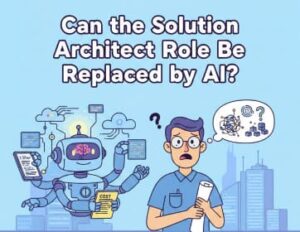
Every few years, a new wave of technology sparks the same anxious question: Is this the moment certain jobs disappear?
With the rapid rise of generative AI and automation tools, many professionals are now asking whether the Solution Architect role is next on the list.
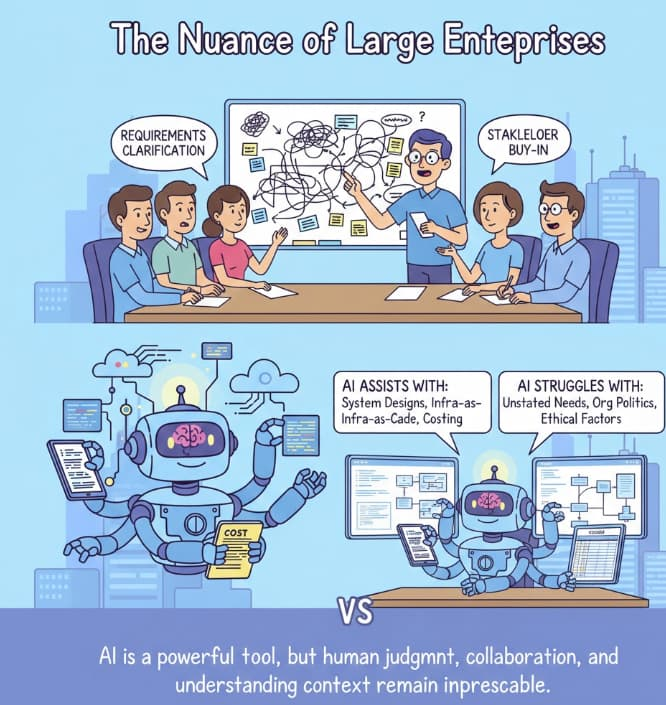
It’s a fair question. AI can generate system designs, recommend cloud architectures, write infrastructure-as-code scripts, and even simulate cost scenarios. At first glance, it seems like a large portion of architectural work could be automated.
But when you look closer especially inside large enterprises the story becomes more nuanced.
The short answer? AI will transform the Solution Architect role. It won’t replace it.
Let’s explore why.
What a Solution Architect Really Does
In enterprise environments built on platforms like Microsoft Azure, Amazon Web Services, Google Cloud Platform, or collaboration ecosystems such as Microsoft 365, the Solution Architect operates at the intersection of business strategy and technical execution.
This role isn’t just about drawing boxes and arrows in architecture diagrams.
A strong Solution Architect:
- Translates vague business goals into concrete technical designs
- Balances scalability, cost, security, and performance
- Navigates legacy systems and technical debt
- Aligns engineering teams, security officers, finance departments, and executives
- Anticipates risks before they become outages
- Makes trade-offs under tight deadlines
Most importantly, they own the decision.
That last point matters more than people think.
AI can suggest. A Solution Architect signs off.
Where AI Is Already Changing the Game
It would be unrealistic to pretend AI isn’t reshaping architecture work. In fact, in several areas, AI is already incredibly effective.
1. Architecture Drafting
Ask an AI tool to design a high-availability web application on Azure, and you’ll receive a reference architecture aligned with best practices. It can generate diagrams, recommend load balancers, suggest database redundancy models, and outline backup strategies in seconds.
What once took hours now takes minutes.
2. Documentation and RFP Responses
Large enterprises spend enormous time producing documentation solution overviews, design justifications, compliance narratives, proposal responses. AI dramatically accelerates this process.
This doesn’t eliminate the architect’s input, but it reduces repetitive writing.
3. Cost Estimation
Cloud pricing models are complex. AI driven estimations can simulate consumption patterns and project cost implications quickly. Architects can test multiple scenarios without manually recalculating everything.
4. Best Practice Validation
AI models trained on cloud design principles can flag obvious issues missing redundancy, weak security patterns, inefficient scaling models.
In many ways, AI acts like a very fast junior architect with access to a massive knowledge base.
But speed and knowledge are not the same as judgment.
Where AI Struggles and Why That Matters
The reason AI won’t fully replace Solution Architects lies in the messy reality of enterprise environments.
1. Architecture Is Political
In theory, architecture decisions are purely technical.
In reality, they are rarely so simple.
Consider this common scenario:
- Security demands strict access controls.
- Finance wants aggressive cost reduction.
- Engineering wants rapid deployment.
- Legal requires compliance certainty.
These priorities conflict.
A Solution Architect navigates these tensions through negotiation, persuasion, and compromise. They understand which stakeholder carries more influence and when to escalate decisions.
AI does not read power dynamics in executive meetings.
2. Context Is Often Unwritten
Enterprises carry historical baggage:
- “We tried that in 2019 and it failed.”
- “That vendor relationship is politically sensitive.”
- “This system can’t be touched during fiscal year close.”
Much of this context lives in conversations, not documentation.
AI works best when data is explicit and structured. Architecture decisions often depend on subtle organizational memory.
3. Accountability Cannot Be Automated
If a system goes down due to architectural flaws, leadership asks:
“Why was this decision made?”
Enterprises assign accountability to individuals, not algorithms.
A Solution Architect stands behind their decisions. That human accountability is central to enterprise governance, especially in regulated industries.
AI can recommend an architecture, but it does not assume legal or operational responsibility.
4. Ambiguity Is the Norm
Enterprise requirements rarely arrive cleanly defined.
They sound more like this:
“We need something scalable but affordable, secure but user-friendly, modern but compatible with our legacy systems and it must launch in three months.”
That isn’t a technical brief. It’s a strategic tension.
Solution Architects are valued because they operate effectively in ambiguity. They extract clarity from unclear objectives and define boundaries where none exist.
AI thrives on defined inputs. Architecture often begins with undefined problems.
The More Likely Future: Augmented Architects
Rather than replacement, what we’re seeing is augmentation.
AI will:
- Reduce time spent drafting documents
- Generate architecture variations instantly
- Simulate cost and performance trade-offs
- Surface compliance gaps early
- Automate parts of governance reviews
This shifts the architect’s value upward.
Less time producing artifacts.
More time making strategic decisions.
The role becomes less mechanical and more advisory.
In fact, AI may increase expectations for architects. If drafting takes minutes instead of hours, stakeholders will demand faster turnaround and deeper analysis.
The human layer becomes more critical, not less.
Will Junior Roles Be Affected?
This is where the impact may be more visible.
Entry-level architecture roles that focus heavily on:
- Diagram generation
- Template-based solutions
- Repetitive design patterns
may shrink.
But even here, the need for contextual validation remains.
Someone must ask:
- Does this design align with our risk appetite?
- Does it fit our governance model?
- Does it match our budget constraints?
AI can assist. It cannot contextualize enterprise strategy independently.
The Skills That Will Matter More
If AI becomes embedded in architecture workflows, the most valuable Solution Architects will likely strengthen skills that machines struggle to replicate:
- Business acumen
- Financial modeling insight
- Risk assessment judgment
- Stakeholder communication
- Negotiation and influence
- Governance design
In other words, the role shifts from technical drafting to strategic leadership.
Architects who rely solely on memorized patterns may struggle.
Architects who think systemically and communicate clearly will thrive.
A Pattern We’ve Seen Before
This fear isn’t new.
When cloud computing emerged, many predicted the end of infrastructure engineers. Instead, their role evolved.
When automation expanded in DevOps, some assumed operations teams would disappear. They didn’t they became more strategic.
Technology tends to eliminate repetitive tasks, not high-context decision-making roles.
Solution Architecture is deeply contextual.
That makes it resistant to full automation.
Replacement vs Evolution
So, can AI replace the Solution Architect role?
In highly complex enterprise environments : no.
Can it replace parts of the work? Absolutely.
And that distinction matters.
AI will likely:
- Compress project timelines
- Increase design iteration speed
- Reduce documentation burden
- Raise the performance bar
But it will not eliminate the need for human judgment, accountability, and organizational navigation.
If anything, AI will expose weak architects those who rely only on templates and static patterns.
At the same time, it will empower strong architects to operate at a higher strategic level.
The role won’t disappear.
It will mature.
And those who embrace AI as a tool rather than fear it as a replacement will define what the next generation of Solution Architects looks like.
Extra posts:
 The Role of a Software Architect in Modern Teams
  The Evolving Blueprint: What’s Next for the Software Architect Role?
  The Core Responsibilities of a Solution Architect
  Supercharging Solution Architecture with GitHub Copilot Prompts Every Architect Should Know
  Microsoft 365 Copilot and the Future of Visual Agent Is It Deprecated or Replaced?
  How Amazon Q Helps Solution Architects in Their Day-to-Day Tasks