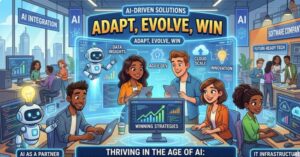
Artificial intelligence is no longer a distant promise it is here, embedded in products, workflows, and decision-making processes across industries. For software companies and IT teams, this shift can feel both exciting and unsettling. Automation is accelerating, coding is being augmented, and traditional roles are rapidly evolving. The real question is not whether AI will change the landscape it already has but how organizations can adapt to remain relevant, competitive, and innovative.
The good news is that AI is not here to replace software teams; it is here to redefine their value. Those who embrace this transformation strategically will not only survive but thrive.
1. Shift from Coding to Problem Solving
One of the most profound changes AI brings is the automation of routine coding tasks. Tools can now generate boilerplate code, suggest fixes, and even build entire components. This doesn’t eliminate the need for developers—it elevates their role.
Software engineers must move beyond simply writing code and focus on solving complex business problems. Understanding user needs, designing scalable systems, and making architectural decisions will become far more valuable than memorizing syntax.
Teams that succeed will prioritize:
- Systems thinking over isolated coding
- Business context alongside technical execution
- Creativity and innovation instead of repetition
In short, coding becomes a tool—not the core identity.
2. Embrace AI as a Collaborator, Not a Threat
AI should be treated like a powerful team member rather than a competitor. Organizations that resist AI adoption risk falling behind those who integrate it into daily workflows.
AI can assist in:
- Code generation and refactoring
- Automated testing and debugging
- Documentation and knowledge sharing
- Predictive analytics and monitoring
The key is learning how to work with AI effectively. This means training teams to write better prompts, validate outputs, and understand the limitations of AI systems.
Think of AI as a junior developer that works fast—but still needs guidance.
3. Invest Heavily in Upskilling
The half-life of technical skills is shrinking. What was relevant five years ago may already be outdated today. In an AI-driven world, continuous learning is not optional—it is survival.
Companies should invest in:
- AI and machine learning fundamentals for all engineers
- Data literacy across teams
- Cloud-native and distributed systems expertise
- Cybersecurity awareness in AI-integrated systems
Equally important are soft skills: communication, adaptability, and critical thinking. These human capabilities cannot be automated and will differentiate top performers.
Upskilling should not be a one-time initiative—it must be embedded into company culture.
4. Redefine Roles Within IT Teams
AI will reshape job roles, but it will also create new ones. Traditional job descriptions will evolve into hybrid positions that combine technical, analytical, and strategic responsibilities.
Emerging roles include:
- AI product managers
- Prompt engineers
- AI ethics and governance specialists
- Data reliability engineers
Rather than resisting this shift, companies should proactively redesign roles to align with future needs. Encourage employees to transition into these new areas and provide clear pathways for growth.
5. Build AI-First Products and Services
Survival is not just about internal transformation—it’s also about what you deliver to customers.
Software companies should rethink their offerings with an AI-first mindset:
- Can your product become smarter with data?
- Can it automate user workflows?
- Can it provide predictive insights instead of reactive outputs?
Customers are increasingly expecting intelligent features as standard. Companies that fail to embed AI into their products risk becoming obsolete.
However, adding AI just for the sake of it is not enough. Focus on meaningful enhancements that genuinely improve user experience.
6. Strengthen Data Strategy
AI is only as powerful as the data behind it. Without high-quality, well-structured data, even the most advanced models will fail.
Organizations must treat data as a core asset by:
- Ensuring data quality and consistency
- Building scalable data pipelines
- Establishing governance and compliance frameworks
- Protecting user privacy and security
A strong data foundation enables better AI outcomes and builds trust with users.
7. Prioritize Ethics and Responsible AI
As AI becomes more integrated into systems, ethical considerations become critical. Bias, transparency, and accountability are no longer optional concerns—they are business risks.
Companies should:
- Audit AI systems for bias and fairness
- Be transparent about how AI decisions are made
- Establish clear accountability for AI-driven outcomes
- Create ethical guidelines for development and deployment
Responsible AI is not just about compliance—it is about building long-term trust with customers and stakeholders.
8. Maintain Human Oversight
Despite its capabilities, AI is not infallible. It can make mistakes, produce incorrect outputs, or misinterpret context.
Human oversight remains essential:
- Review AI-generated code before deployment
- Validate critical decisions
- Monitor system performance continuously
The most effective systems are not fully automated—they are human-AI collaborations.
9. Foster a Culture of Experimentation
AI is evolving rapidly, and no organization has all the answers. The companies that succeed will be those that experiment, learn, and adapt quickly.
Encourage teams to:
- Prototype AI-driven features
- Test new tools and workflows
- Learn from failures without fear
Innovation thrives in environments where experimentation is safe and supported.
10. Focus on Value, Not Just Efficiency
AI can dramatically improve efficiency—but efficiency alone is not a competitive advantage if everyone has access to the same tools.
The real differentiator is value creation. Ask:
- Are we solving bigger problems?
- Are we delivering better user experiences?
- Are we enabling new capabilities that were previously impossible?
Efficiency is the baseline. Innovation is the goal.
he rise of AI is not the end of software companies or IT teams—it is a turning point. Those who cling to old models will struggle, but those who adapt will unlock unprecedented opportunities.
Success in the AI era requires a mindset shift:
- From execution to strategy
- From coding to problem-solving
- From resistance to collaboration
AI will change how software is built, but it will not replace the need for human insight, creativity, and leadership. In fact, these qualities will become more important than ever.
The future belongs to teams that are not just technically skilled, but also adaptable, curious, and forward-thinking. Embrace AI, evolve with it, and you won’t just survive—you’ll lead.
Extra posts:
 Win More Bids How to Use GitHub Copilot to Write Winning RFP Responses Faster
  Microsoft Teams Group chat software
  The Role of a Software Architect in Modern Teams
  Architecture Decision Records (ADRs) A Lightweight Governance Model for Modern Software Teams
  The New Age of PC Copilots Windows 11
  Revolutionizing Software Engineering The Power of AI Tools