
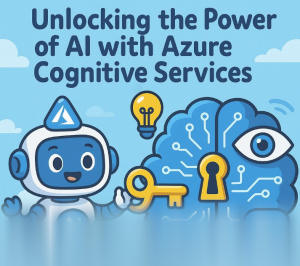
Artificial Intelligence (AI) is no longer just a futuristic concept—it’s now a core part of how businesses enhance customer experiences, streamline operations, and gain insights from their data. Microsoft’s Azure Cognitive Services offers one of the most accessible ways to integrate powerful AI capabilities into applications without needing deep expertise in machine learning or data science.
In this post, we’ll explore what Azure Cognitive Services are, the different categories they cover, and how organizations can leverage them for real-world use cases.
What Are Azure Cognitive Services?
Azure Cognitive Services is a collection of pre-built AI services provided by Microsoft through the Azure cloud platform. Instead of building AI models from scratch, developers can use these ready-to-deploy APIs and SDKs to add intelligence to apps, websites, and systems.
The goal is simple: democratize AI by making it accessible to everyone—from startups to large enterprises—without the need for advanced AI skills.
Key Categories of Azure Cognitive Services
Azure Cognitive Services are grouped into major categories, each focused on a specific type of human-like intelligence:
1. Vision
These services allow applications to analyze and interpret visual data.
- Computer Vision: Extract information from images, such as detecting objects, faces, or handwriting.
- Face API: Recognize and identify people by their facial features.
- Form Recognizer: Automate data extraction from forms and receipts.
Use Case: Retailers can analyze in-store CCTV footage to understand customer behavior or automate checkout processes.
2. Speech
Enable speech-to-text and text-to-speech capabilities, along with language understanding.
- Speech-to-Text: Convert spoken words into written text.
- Text-to-Speech: Generate lifelike voices from text input.
- Speaker Recognition: Identify who is speaking.
Use Case: Call centers can transcribe calls in real-time for quality monitoring and training purposes.
3. Language
Empower apps with natural language processing (NLP).
- Text Analytics: Detect sentiment, key phrases, and named entities.
- Translator: Translate text into more than 100 languages.
- Language Understanding (LUIS): Build natural language interfaces for apps, bots, and IoT devices.
Use Case: A multinational company can use real-time translation tools to break down language barriers in customer support.
4. Decision
These services provide AI-driven decision-making.
- Personalizer: Deliver personalized content and experiences.
- Anomaly Detector: Identify irregularities in time-series data.
- Content Moderator: Filter and detect offensive or inappropriate content.
Use Case: Financial institutions can use anomaly detection to identify fraudulent transactions.
Why Choose Azure Cognitive Services?
- Ease of Use: No machine learning expertise required—just plug and play through APIs.
- Scalability: Built on Microsoft Azure, the services scale to handle enterprise workloads.
- Security & Compliance: Meets enterprise-grade standards for data security and compliance.
- Integration: Works seamlessly with other Azure tools, including Azure Machine Learning, Bot Services, and Power Platform.
Real-World Applications
- Healthcare: AI-driven diagnostics, medical transcription, and patient chatbots.
- Retail: Personalized recommendations and inventory monitoring.
- Banking: Fraud detection and multilingual customer support.
- Education: Real-time translation and automated grading tools.
Azure Cognitive Services lowers the barrier to entry for AI adoption. Whether you want to enhance your customer experience, automate processes, or derive insights from unstructured data, these services provide the building blocks to infuse intelligence into your applications.
By leveraging Vision, Speech, Language, and Decision services, organizations can stay competitive in the digital age and unlock new opportunities with AI.
Extra posts:
 Unlocking the Power of Conversational AI with Azure Bot Service
  Extracting Information from PDFs and Storing in a Database Using Azure AI Services
  Unlocking the Power of the Azure Well-Architected Tool with AI A Game-Changer for Solution Architects
  Unlocking the Power of Feature Engineering with Microsoft AI
  Enhancing Copilot Bots with Azure OpenAI Services Unlocking Innovation with Azure AI Foundry Agent Service