
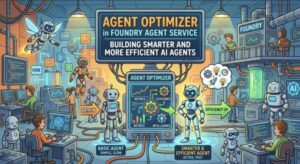
Artificial intelligence is moving beyond simple question-and-answer systems. Today, AI agents are becoming powerful digital assistants capable of understanding goals, making decisions, using tools, and completing complex workflows. However, building an AI agent is only one part of the journey. The real challenge is improving its performance, making it more accurate, efficient, and reliable.
This is where Agent Optimizer in Foundry Agent Service becomes important. Agent optimization helps developers improve AI agents by analyzing their behavior, identifying areas for improvement, and creating better-performing agent experiences. Instead of manually adjusting every part of an agent, optimization provides a smarter approach to continuously improve how agents work.
As businesses adopt AI-powered solutions, optimizing agents is becoming a key requirement. A well-optimized AI agent can save time, reduce errors, improve user experiences, and deliver better results across different industries.
What Is Foundry Agent Service?
Foundry Agent Service is an environment designed to help developers create, manage, and deploy AI agents. It provides the tools needed to build agents that can interact with users, access information, connect with business systems, and perform automated tasks.
Modern AI agents are expected to do much more than generate text. They need to understand context, follow instructions, choose the right actions, and complete tasks successfully. This requires a strong foundation where developers can test, monitor, and improve agent behavior.
Foundry Agent Service supports this process by providing a structured way to develop intelligent agents and improve their capabilities over time.
Understanding Agent Optimizer
An Agent Optimizer is a system that helps improve an AI agent’s performance. It evaluates how an agent responds, how efficiently it completes tasks, and whether it achieves the intended goals.
Think of an Agent Optimizer as a performance coach for AI. A human coach studies performance, identifies weaknesses, and suggests improvements. Similarly, an Agent Optimizer studies an AI agent’s workflow and helps refine its actions.
The purpose is not only to make an agent faster but also to make it smarter and more dependable.
An Agent Optimizer can help improve:
- Response quality
- Task completion accuracy
- Decision-making processes
- Tool usage
- Workflow efficiency
- User satisfaction
Why Agent Optimization Matters in AI Development
Creating an AI agent without optimization can lead to several challenges. An agent may provide inconsistent answers, use unnecessary steps, or fail when handling complicated tasks.
For example, imagine an AI support agent designed to help customers. If the agent takes too many steps before answering a simple question, users may have a poor experience. If it cannot understand different types of requests, it may fail to solve problems effectively.
Agent optimization helps solve these challenges by continuously improving the agent’s behavior.
For organizations, this means:
- Better productivity
- Lower operational costs
- Improved customer experiences
- More reliable automation
- Faster AI adoption
How Agent Optimizer Works in Foundry Agent Service
Agent optimization generally involves several important processes.
1. Evaluating Agent Performance
The first step is understanding how the agent currently performs. The optimizer reviews agent interactions, responses, and outcomes.
Developers can identify questions such as:
- Did the agent complete the task correctly?
- Did it use the right tools?
- Was the response helpful?
- Could the process be shorter?
This evaluation creates a foundation for improvement.
2. Improving Agent Instructions
AI agents depend heavily on instructions and prompts. Small changes in instructions can significantly affect results.
An Agent Optimizer can help refine these instructions so the agent understands its role, objectives, and limitations more clearly.
Better instructions can lead to:
- More accurate responses
- Better reasoning
- Fewer mistakes
- More consistent behavior
3. Optimizing Workflows
Many AI agents complete tasks through multiple steps. The way these steps are organized affects performance.
Optimization helps agents discover better workflows by improving how they:
- Gather information
- Select tools
- Process requests
- Complete actions
A more efficient workflow allows the agent to deliver results faster.
4. Learning From Feedback
Feedback is one of the most valuable parts of optimization. When users interact with AI agents, their feedback provides important information.
The optimizer can use this information to understand what works and what needs improvement.
Over time, the agent becomes more aligned with user expectations.
Benefits of Using Agent Optimizer
Enhanced Accuracy
One of the biggest advantages of optimization is improved accuracy. Agents can learn from previous mistakes and adjust their behavior.
This is especially important for business applications where incorrect information can create problems.
Better User Experience
Users expect AI assistants to be fast, helpful, and easy to communicate with. An optimized agent can understand requests better and provide more relevant answers.
A smoother interaction builds trust between users and AI systems.
Increased Efficiency
Optimization helps reduce unnecessary actions. Instead of following complicated processes, agents can find simpler and faster solutions.
This allows organizations to automate more tasks while using fewer resources.
Scalability
As companies expand their AI usage, they need systems that can handle more users and more complex tasks.
Optimized agents are easier to scale because their performance improves over time.
Real-World Applications of Agent Optimizer
Agent optimization can support many industries.
Customer Service
AI customer assistants can become better at handling questions, solving issues, and routing complex requests.
Healthcare Support
AI agents can help organize information, assist professionals, and improve communication workflows.
Business Operations
Companies can use optimized agents for scheduling, reporting, document processing, and internal support.
Software Development
AI coding agents can improve their ability to generate code, identify problems, and support developers.
The Future of Agent Optimization
The future of AI will likely involve teams of specialized agents working together. Some agents may handle research, others may manage communication, and others may complete technical tasks.
In this future, optimization will become essential. Agents will need to coordinate, improve their strategies, and adapt to changing requirements.
Agent Optimizer technology will help transform AI agents from basic tools into intelligent systems capable of continuous improvement.

Agent Optimizer in Foundry Agent Service represents an important step toward creating smarter AI solutions. Building an AI agent is no longer just about making it work; it is about making it perform better over time.
Through performance analysis, workflow improvements, better instructions, and continuous learning, Agent Optimizer helps developers create AI agents that are more accurate, efficient, and valuable.
As AI becomes a bigger part of everyday business and technology, optimized agents will play a major role in shaping the future of intelligent automation.
Extra posts:
 Unlocking Innovation with Azure AI Foundry Agent Service
  Service Mesh Architecture Pattern in Azure Handling Service-to-Service Communication, Security, and Observability
  The Architecture of Copilot Agents: Building Intelligent Assistants for the Modern Era
  Software Architecture Frameworks and Artificial Intelligence Building Smarter Systems
  The Future of SharePoint AI, Agents, and Smarter Collaboration (2025 Update)
  Governance of AI Agents with Microsoft Entra & Agent 365