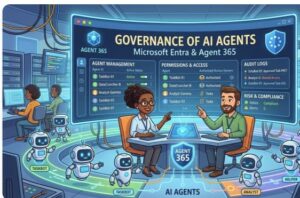
As organizations accelerate their adoption of AI-driven automation, the emergence of autonomous and semi-autonomous AI agents is reshaping how work gets done. These agents capable of making decisions, executing workflows, and interacting with enterprise systems introduce a new layer of complexity in identity, access, compliance, and lifecycle management.
From a solution architecture perspective, the challenge is no longer just what AI can do, but how it is governed. This is where Microsoft Entra and Agent 365 come into play as foundational pillars for secure, compliant, and scalable AI agent governance.
In this blog, I’ll break down how to architect governance for AI agents using these platforms, with a focus on identity, access control, monitoring, and lifecycle management.
Why Governance for AI Agents Matters
AI agents are not traditional applications. They:
- Act autonomously or semi-autonomously
- Interact with multiple APIs and systems
- Can trigger real-world actions (financial, operational, customer-facing)
- Continuously learn and adapt
Without governance, this creates risks such as:
- Unauthorized access to sensitive data
- Lack of accountability for agent actions
- Compliance violations
- Shadow AI deployments
A robust governance model ensures that AI agents operate within defined boundaries, much like human users and service principals.
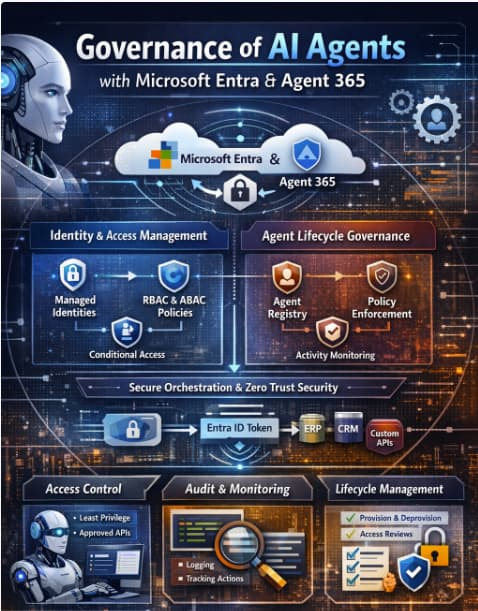
Microsoft Entra as the Identity Backbone
Microsoft Entra provides a unified identity and access management layer that is critical for governing AI agents.
1. Treat AI Agents as First-Class Identities
In a modern architecture, every AI agent should be represented as an identity object. This can be implemented using:
- Service principals
- Managed identities
- Workload identities
This allows agents to authenticate securely using OAuth 2.0 and OpenID Connect.
Key Design Principle:
Never allow anonymous or shared credentials for AI agents.
2. Managed Identities for Secure Execution
For agents running in Azure services (e.g., Functions, Kubernetes, or App Services), Managed Identities eliminate the need for credential storage.
Benefits:
- Automatic credential rotation
- Tight integration with Entra ID
- Reduced attack surface
Example Flow:
- AI agent hosted in Azure Function
- Uses system-assigned managed identity
- Requests token from Entra
- Accesses downstream APIs (e.g., Graph, storage, or custom APIs)
Role-Based and Attribute-Based Access Control
3. Fine-Grained Authorization
Using Entra, you can enforce:
- RBAC (Role-Based Access Control)
- ABAC (Attribute-Based Access Control)
For AI agents, RBAC alone is often insufficient. You need context-aware policies.
Example:
An AI agent processing invoices:
- Can read documents from storage
- Can write to ERP system
- Cannot access HR or payroll data
4. Conditional Access for AI Agents
Conditional Access is traditionally user-focused, but can be extended to workloads.
Advanced Controls:
- Restrict agent access based on:
- Network location
- Device compliance (for hybrid scenarios)
- Risk signals
Architectural Insight:
Treat high-risk AI agents like privileged identities and enforce stricter policies.
Agent 365: Orchestration and Governance Layer
Agent 365 complements Entra by providing orchestration and lifecycle governance for AI agents.
5. Centralized Agent Registry
A key capability is maintaining a catalog of AI agents:
- Agent identity
- Purpose and scope
- Permissions
- Owner and accountability
This acts as a “CMDB for AI agents.”
6. Policy Enforcement
Agent 365 enables:
- Execution policies
- Data access constraints
- API usage governance
Example Policy:
- Agent can only call approved APIs
- Data classification rules enforced at runtime
- Logging required for all decision-making actions
Observability and Auditability
7. End-to-End Logging
Every action performed by an AI agent must be traceable.
Recommended Approach:
- Integrate with centralized logging (e.g., SIEM)
- Capture:
- Authentication events
- API calls
- Decisions made by the agent
8. Correlation IDs for Agent Actions
Assign a unique correlation ID per agent workflow. This allows:
- End-to-end traceability
- Root cause analysis
- Compliance audits
Lifecycle Management of AI Agents
9. Provisioning and Deprovisioning
AI agents should follow a lifecycle similar to human users:
- Provisioning:
- Identity creation in Entra
- Role assignment
- Policy attachment
- Deprovisioning:
- Disable identity
- Revoke tokens
- Archive logs
10. Periodic Access Reviews
Use access reviews to ensure agents still require their permissions.
Best Practice:
- Quarterly review of all AI agent permissions
- Automatic alerts for over-privileged agents
Security Architecture Considerations
11. Least Privilege Principle
Always assign the minimum permissions required.
Anti-Pattern:
- Granting broad API access “just in case”
12. Zero Trust for AI Agents
Adopt a Zero Trust model:
- Verify explicitly
- Assume breach
- Enforce least privilege
AI agents should authenticate and authorize for every request.
Integration Patterns
13. API Gateway Enforcement
Place an API gateway between AI agents and backend systems.
Benefits:
- Centralized policy enforcement
- Rate limiting
- Threat protection
14. Token-Based Access Flow
Typical secure interaction:
- Agent requests token from Entra
- Token includes scopes/roles
- API validates token
- Access granted based on policy
Governance Challenges and Mitigation
Challenge 1: Shadow AI Agents
Solution: Enforce registration via Agent 365
Challenge 2: Over-Privileged Agents
Solution: Automated access reviews + least privilege
Challenge 3: Lack of Visibility
Solution: Centralized logging + observability
Future Outlook
As AI agents become more autonomous, governance will evolve toward:
- Policy-driven autonomous systems
- AI-to-AI identity federation
- Real-time risk scoring for agents
- Continuous compliance enforcement
Organizations that invest early in governance frameworks will scale AI adoption more safely and efficiently.
Governance of AI agents is not optional—it is foundational. By leveraging Microsoft Entra for identity and access control, and Agent 365 for orchestration and lifecycle management, organizations can build a secure and scalable AI ecosystem.
From a solution architect’s lens, the key is to treat AI agents as digital identities with responsibilities, constraints, and accountability not just pieces of code.
Extra posts:
 Microsoft Launches Agent 365 to Bring Control, Security, and Visibility to the Age of AI Agents
  What Is Microsoft 365 Agent Builder? A Beginner’s Guide
  From Chaos to Clarity Governance Tips for Organizations Rolling Out Microsoft 365 Copilot
  Governance for Generative AI: Enforcing Data Loss Prevention (DLP) with Microsoft 365 Copilot
  Microsoft 365 E7 and Agent 365 Are Now Generally Available: The Future of AI-Powered Work Has Arrived
  10 Best Practices for Designing Effective Microsoft 365 Agents