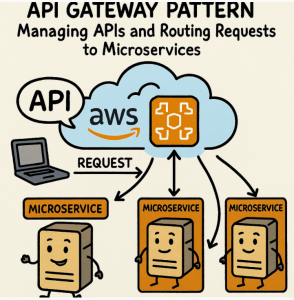
Modern applications are increasingly built using microservices — small, independent services that each handle a specific business capability. While this architecture offers scalability and agility, it also introduces complexity:
- How do clients communicate with multiple services without knowing all their locations?
- How do you enforce security, throttling, and monitoring consistently?
- How do you transform and aggregate responses across services?
The solution: the API Gateway pattern. In AWS, this pattern is effectively implemented using Amazon API Gateway.
What is the API Gateway Pattern?
The API Gateway acts as a single entry point for all clients. Instead of calling microservices directly, clients send requests to the gateway, which:
- Routes the request to the appropriate backend service.
- Applies policies like authentication, throttling, and logging.
- Transforms requests or responses as needed.
- Aggregates results from multiple services into one response.
It’s the traffic controller, security guard, and translator rolled into one.
Why Use API Gateway in AWS?
Amazon API Gateway is a fully managed service that simplifies building and managing APIs. It supports both RESTful APIs and HTTP APIs (for lower latency and cost), and offers deep integration with AWS services.
Key benefits include:
- Centralized API management — One place to define, deploy, and version APIs.
- Security — Integrates with AWS IAM, Amazon Cognito, and custom authorizers.
- Traffic control — Rate limiting, throttling, and request quotas.
- Monitoring — Built-in logging via Amazon CloudWatch.
- Transformation — Modify payloads with mapping templates.
How the API Gateway Pattern Works in AWS
1. Clients Send Requests to the Gateway
Clients (web apps, mobile apps, partner integrations) send requests to the API Gateway endpoint.
Example:
https://api.mycompany.com/orders
2. Gateway Routes to the Right Service
You define routes and integrations in API Gateway to connect endpoints with backend microservices. Backends can be:
- AWS Lambda functions
- Amazon ECS or EKS services
- Amazon EC2 instances
- Any HTTP endpoint
Example mapping:
GET /orders→ Orders Lambda functionPOST /customers→ Customer microservice in ECS
3. Apply Policies and Security
Before requests hit the backend, API Gateway can:
- Authenticate using Amazon Cognito or JWT tokens.
- Authorize with IAM policies or custom authorizers.
- Throttle requests to prevent overload.
Example (Lambda authorizer flow):
- API Gateway receives request.
- Authorizer Lambda validates JWT token.
- If valid, request proceeds to backend service.
4. Transform Requests and Responses
Using Velocity Template Language (VTL) mapping templates, API Gateway can reshape incoming or outgoing data. This is helpful when backend services have different formats than clients expect.
Example:
#set($inputRoot = $input.path('$'))
{
  "orderId": "$inputRoot.id",
  "customerName": "$inputRoot.customer.name"
}
5. Monitor and Troubleshoot
All requests and responses can be logged to Amazon CloudWatch, enabling:
- Latency tracking
- Error analysis
- Traffic trends
Typical AWS API Gateway + Microservices Architecture
- Client request → Amazon API Gateway
- Authentication & validation
- Routing to correct microservice (Lambda, ECS, etc.)
- Aggregation/transformation (if needed)
- Response to client
[ Clients ] → [ Amazon API Gateway ] → [ Microservices ]
Best Practices
- Use stages (dev, test, prod) to separate environments.
- Enable caching in API Gateway for frequently accessed data.
- Integrate WAF (AWS Web Application Firewall) for additional security.
- Version your APIs to handle backward compatibility.
- Keep transformations lightweight to avoid latency overhead.
The API Gateway pattern on AWS provides a unified, secure, and scalable way to manage APIs for your microservices. By leveraging Amazon API Gateway, you centralize request routing, security, and monitoring — freeing each microservice to focus on its core functionality.
Think of it like a smart receptionist: every visitor (client) talks to one person, who knows exactly where to send them, keeps the logs, and ensures only authorized guests get through.
Extra posts:
 API Gateway Pattern in Azure Managing APIs and Routing Requests to Microservices
  🚀 Materialized View Pattern in AWS Precompute for Performance
  Secret Store Pattern in AWS Using Secure Vaults for Credentials and Secrets
  Tracing the Cloud Thread Distributed Tracing Patterns for Microservices in AWS
  Riding in Tandem Unlocking the Sidecar Pattern in Azure Microservices Building Resilient Systems with Immutable Infrastructure on AWS