
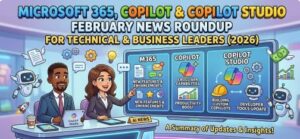
February News Roundup for Technical and Business Leaders (2026)
February 2026 was a significant month for enterprise AI across Microsoft 365, Microsoft Copilot, and Microsoft Copilot Studio.
From large-scale enterprise deployments to governance updates and expanded model flexibility, Microsoft continues transitioning from AI experimentation to enterprise AI at scale.
Here’s your strategic and technical breakdown of what mattered most this month.
📣 Major Microsoft News in February 2026
1️⃣ PwC Deploys Microsoft 365 Copilot Globally
PwC completed a global rollout of Microsoft 365 with Copilot to more than 360,000 employees across 130+ countries. The firm reported significant productivity gains and operational efficiencies, with estimated savings reaching $150 million.
Business impact:
- Accelerated internal collaboration
- Reduced administrative workload
- Improved knowledge sharing at scale
Strategic takeaway:
Enterprise AI adoption is no longer limited to pilots. Global professional services firms are operationalizing AI across their workforce.
2️⃣ Excel Enhancements Strengthen Copilot’s Analytical Power
Microsoft introduced new enhancements to Excel that significantly improve Copilot’s data reasoning capabilities within spreadsheets.
These updates enhance:
- Context-aware formula generation
- Data trend analysis
- Structured reporting outputs
For finance, operations, and analytics teams, Copilot inside Excel is becoming a practical assistant for real-time business insights rather than just a drafting tool.
3️⃣ Expanded Model Choice in Copilot Studio
A major development this month: Microsoft Copilot Studio now supports additional third-party models, including xAI’s Grok 4.1 Fast.
This expansion provides:
- Greater flexibility in reasoning performance
- Faster response options
- More customization for enterprise agents
Technical significance:
Organizations can now choose models based on workload requirements rather than being limited to a single AI engine.
4️⃣ Industry AI Acceleration at Mobile World Congress
At Mobile World Congress 2026, Microsoft showcased how its unified AI platform supports telecom providers in driving measurable AI ROI.
The message was clear:
- AI must produce operational efficiency
- Security and compliance must be embedded
- Industry-specific use cases drive value
This reinforces Microsoft’s strategy of positioning Copilot as industry-ready infrastructure rather than a general-purpose assistant.
5️⃣ Strategic Enterprise Partnerships
Wesfarmers announced a multi-year strategic AI partnership with Microsoft to accelerate innovation across retail, industrial, and healthcare operations.
These partnerships signal continued enterprise investment in AI transformation initiatives powered by Microsoft’s ecosystem.
🔐 Governance & Security: Strengthened Controls
February also delivered important governance updates across Microsoft 365.
🔹 Expanded Data Controls
Microsoft introduced enhanced controls allowing administrators to restrict Copilot’s access to sensitive files across storage environments, strengthening alignment with compliance policies.
🔹 AI Metadata & Watermarking
Copilot-generated content now includes expanded metadata tracking to help organizations trace AI-produced artifacts—supporting auditability and regulatory compliance.
🔹 Privacy Bug Addressed
Microsoft confirmed and resolved an issue where Copilot summarized certain confidential emails despite sensitivity protections. The fix reinforces the importance of layered governance and continuous monitoring.
Key takeaway:
Enterprise AI must operate within strict security frameworks. Microsoft continues to prioritize governance as a core feature—not an add-on.
🤖 Copilot: Moving from Assistant to Agent
February updates reinforce Copilot’s evolution toward AI agents capable of multi-step reasoning and task orchestration.
Examples include:
- Meeting recap → proposal draft → presentation creation
- Data analysis → executive summary → action plan
Inside Microsoft Teams, Copilot improvements include:
- More structured meeting summaries
- Decision tracking
- Task extraction and workflow continuity
The shift toward task orchestration represents a key step toward enterprise AI automation.
🛠️ Copilot Studio: Enterprise Custom AI at Scale
Copilot Studio continues maturing into a full enterprise AI development environment.
February highlights include:
- Expanded model flexibility
- Improved monitoring and analytics
- Deeper integration with Microsoft Power Platform
- Lifecycle management improvements
For technical leaders, this means:
- Custom AI agents can be built without rebuilding infrastructure
- Governance policies can be embedded from day one
- Performance and usage can be measured systematically
Custom AI is rapidly becoming mainstream within enterprise IT strategies.
📊 Strategic Themes Emerging in February
Across Microsoft’s announcements and enterprise deployments, three clear themes stand out:
1️⃣ AI at Enterprise Scale
Major global organizations are deploying Copilot broadly—not experimentally.
2️⃣ Governance Is Foundational
Security, compliance, and metadata transparency are embedded into AI experiences.
3️⃣ AI Agents Are the Next Phase
Copilot Studio is enabling domain-specific agents tailored to business workflows.
📌 What This Means for Leaders
For Business Leaders:
- AI is now delivering measurable ROI
- Enterprise adoption is accelerating globally
- Governance investments protect long-term value
For Technical Leaders:
- Strengthen AI governance architecture
- Build domain-specific copilots using Copilot Studio
- Monitor usage, compliance, and performance continuously
February 2026 represents a clear inflection point. Microsoft’s ecosystem—spanning Microsoft 365, Copilot, and Copilot Studio—is transitioning from productivity enhancement to enterprise AI infrastructure.
With expanding model choice, large-scale deployments, enhanced governance, and agent-based workflows, Microsoft is positioning its platform as the operational backbone for enterprise AI transformation.
Extra posts:
 Microsoft 365, Copilot, and Copilot Studio: January News Roundup
  Microsoft 365 E7 and Agent 365 Are Now Generally Available: The Future of AI-Powered Work Has Arrived
  Microsoft Makes Copilot Easier to Try: Free 30-Day Microsoft 365 Copilot Trial Arrives for SMBs Without Payment Details
  The ‘Digital Twin’ Employee Creating Hyper-Personalized Copilot Prompts with Copilot Studio
 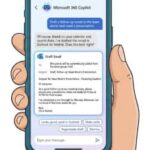 Microsoft 365 Copilot Gets an Outlook Upgrade: Draft Emails Right Inside Copilot Chat on Mobile
  Microsoft 365 Copilot: Meet Microsoft Scout, the Always-On Personal Agent Changing How Work Gets Done