
In today’s hypercompetitive and fast-evolving insurance landscape, data is the most valuable asset. Insurers no longer rely solely on actuarial tables and historical assumptions; instead, they harness real-time insights from vast volumes of structured and unstructured data. This transformation requires a modern, data-driven insurance software architecture—one that’s scalable, intelligent, and future-proof.
This blog explores the key components, design principles, and best practices for building a robust, data-driven insurance software architecture.
Why Go Data-Driven in Insurance?
Insurance is inherently data-centric. From underwriting and pricing to fraud detection and customer engagement, every function depends on data accuracy, speed, and insights. A data-driven architecture empowers insurers to:
- Improve risk assessment using predictive analytics.
- Personalize products based on customer behavior and lifestyle.
- Detect fraud in real-time through anomaly detection.
- Streamline operations with intelligent automation.
- Enhance decision-making with real-time dashboards and reports.
Core Architectural Principles
Designing a data-driven insurance platform involves aligning business goals with modern architectural practices:
1. Modular Microservices Architecture
Break down functionality into discrete, independently deployable services (claims, underwriting, policy, billing). This promotes agility and scalability.
2. Event-Driven Design
Use an event-driven model for reacting to business changes in real-time. Events like “Policy Issued” or “Claim Submitted” are broadcast across services, enabling automation and rapid response.
3. API-First Approach
Expose all core functionalities via secure APIs (REST or GraphQL) to support integrations with partners, mobile apps, and third-party services.
4. Cloud-Native Infrastructure
Deploy on cloud platforms (Azure, AWS, GCP) for elasticity, high availability, and disaster recovery.
Key Components of Data-Driven Insurance Architecture
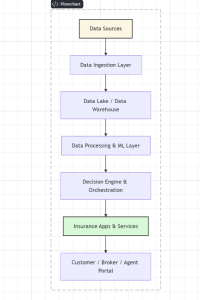
Here’s a typical stack broken down by layers:
1. Data Ingestion Layer
- Sources: Telematics, IoT devices, CRM, social media, external APIs, claims systems.
- Tools: Kafka, Azure Event Hub, AWS Kinesis for real-time data streaming.
2. Data Storage Layer
- Structured: Azure SQL, Amazon RDS for transactional data.
- Unstructured: Data lakes (e.g., Azure Data Lake, Amazon S3) for images, PDFs, logs.
- Big Data Warehousing: Snowflake, Azure Synapse, Google BigQuery.
3. Data Processing & Analytics Layer
- ETL/ELT: Apache Spark, Azure Data Factory.
- Analytics: Power BI, Tableau, Looker.
- Machine Learning Models: Azure ML, Amazon SageMaker, Google Vertex AI.
- Risk models: Real-time underwriting, claims forecasting, churn prediction.
4. Decision & Orchestration Layer
- Business rules engine (Drools, OpenRules)
- Workflow orchestrators (Camunda, Azure Logic Apps)
5. Application Layer
- Claims Management
- Underwriting Portal
- Agent & Broker Interfaces
- Customer Self-Service Portal (mobile/web)
6. Security & Compliance
- Data encryption (at rest and in transit)
- Access controls & IAM
- GDPR/CCPA compliance
- Audit logging and monitoring
Real-Time Use Case Scenarios
🔍 Dynamic Pricing
Using IoT data from cars or wearables, insurers can adjust premiums in real time based on risk profiles and behavior.
🧠 AI-Driven Claims
Claims can be automatically approved or escalated by evaluating photos, NLP from claim descriptions, and cross-referencing past fraud patterns.
🗣️ Omnichannel Experience
Customer data is unified across web, mobile, chatbot, and call center—creating a seamless support journey.
Challenges to Address
- Data Silos: Break down legacy barriers through data integration platforms and APIs.
- Data Quality: Invest in cleansing, validation, and standardization.
- Privacy & Compliance: Prioritize transparent data handling and secure processing.
- Legacy Systems: Adopt an incremental modernization strategy using APIs and wrappers.
Reference Architecture Diagram (Mermaid)

Recommended Tech Stack (Cloud-Neutral)
| Layer | Tools |
|---|---|
| Ingestion | Apache Kafka, Azure Event Hub, AWS Kinesis |
| Storage | Azure Data Lake, Snowflake, BigQuery |
| Processing | Apache Spark, Databricks, Airflow |
| Analytics | Power BI, Tableau, Superset |
| ML | Azure ML, SageMaker, DataRobot |
| API | GraphQL, REST, Kong API Gateway |
| Security | Azure Sentinel, AWS GuardDuty, Vault |
A modern, data-driven insurance architecture is not just a tech upgrade—it’s a strategic enabler. It empowers insurers to innovate rapidly, optimize decisions, and deliver personalized, responsive service at scale. By adopting a modular, cloud-native, analytics-powered architecture, you position your insurance platform for the next decade of growth.
Extra posts:
 The Architecture of Copilot Agents: Building Intelligent Assistants for the Modern Era
  Software Architecture Frameworks and Artificial Intelligence Building Smarter Systems
  Architecture Decision Records (ADRs) A Lightweight Governance Model for Modern Software Teams
  Event-Driven Architectures for Agentic Systems: Building Responsive, Intelligent, and Scalable AI
  Unleashing the Power of Microsoft Fabric and AI A New Era of Data-Driven Intelligence
  Unlocking the Power of SharePoint Embedded A Modern Approach to Content Management