As software systems evolve toward greater autonomy, the rise of agentic systems systems composed of intelligent agents capable of making decisions and acting independently has created new architectural challenges. Traditional request-response models often fall short when dealing with dynamic, real-time decision-making environments. This is where Event-Driven Architecture (EDA) becomes not just useful, but essential.
In this article, we’ll explore how event-driven architectures power agentic systems, why they are a natural fit, and how you can design systems that are scalable, responsive, and resilient.
What Are Agentic Systems?
Agentic systems consist of autonomous or semi-autonomous agents that perceive their environment, make decisions, and take actions to achieve specific goals. These agents can range from AI-powered assistants and recommendation engines to complex multi-agent ecosystems used in finance, logistics, or robotics.
What makes these systems unique is:
- Continuous interaction with changing environments
- Decentralized decision-making
- Need for real-time responsiveness
- High levels of concurrency
To support these characteristics, the underlying architecture must be flexible and reactive—qualities that align perfectly with event-driven design.
Understanding Event-Driven Architecture
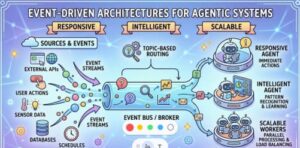
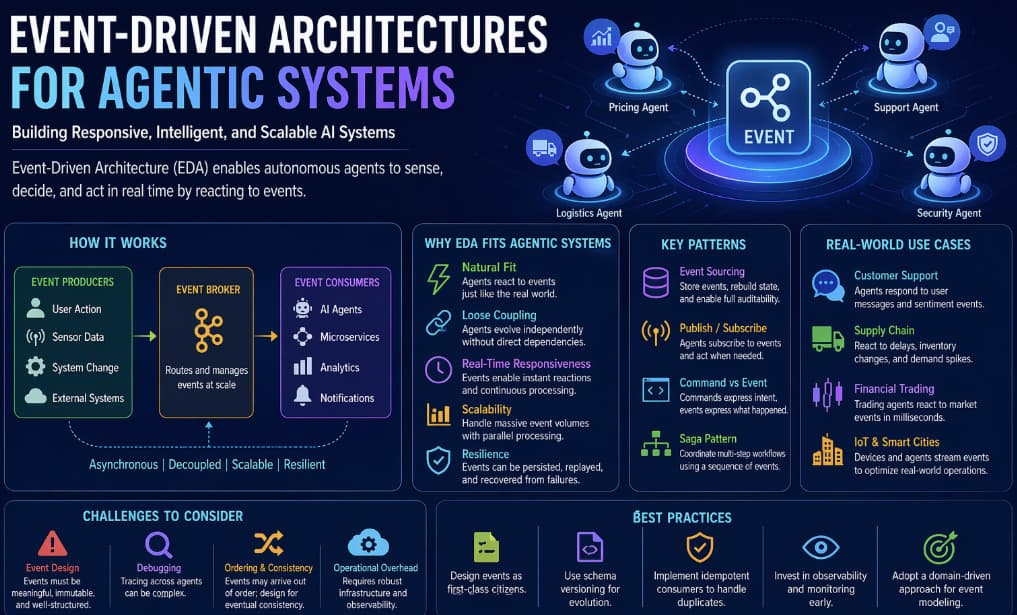
Event-Driven Architecture revolves around the production, detection, and reaction to events. An event is simply a change in state like a user clicking a button, a sensor detecting motion, or an AI agent completing a task.
EDA typically consists of:
- Event Producers – generate events
- Event Brokers – route events (e.g., message queues, streams)
- Event Consumers – react to events
Instead of tightly coupled services calling each other directly, components communicate asynchronously via events. This decoupling is what gives EDA its power.
Why Event-Driven Architecture Fits Agentic Systems
1. Natural Alignment with Autonomous Behavior
Agentic systems are inherently reactive. Agents observe signals, process them, and act accordingly. Events mirror this pattern perfectly. Each event becomes a trigger for agent behavior.
For example:
- A pricing agent reacts to market fluctuation events
- A customer support agent responds to user query events
- A logistics agent adapts to delivery delay events
2. Loose Coupling and Flexibility
Agents in a system often evolve independently. With EDA:
- New agents can be added without modifying existing ones
- Agents don’t need to know about each other directly
- Systems can scale horizontally
This is critical for environments where agents are frequently updated or replaced.
3. Real-Time Responsiveness
Agentic systems often operate in time-sensitive contexts. Event streaming platforms allow:
- Immediate reaction to changes
- Continuous data flow processing
- Reduced latency in decision-making
This makes EDA ideal for applications like fraud detection, autonomous vehicles, or trading systems.
4. Scalability Under Load
Event-driven systems can handle massive volumes of events:
- Events can be partitioned and processed in parallel
- Consumers can scale independently
- Backpressure mechanisms prevent overload
For multi-agent systems handling thousands (or millions) of interactions, this scalability is essential.
5. Fault Tolerance and Resilience
EDA improves system robustness:
- Events can be persisted and replayed
- Failures in one component don’t crash the entire system
- Systems can recover gracefully
This is especially important in agentic environments where continuous operation is critical.
Core Design Patterns for Agentic Event-Driven Systems
Event Sourcing
Instead of storing the current state, systems store a sequence of events. Agents reconstruct state by replaying events.
Benefits:
- Full audit trail
- Easier debugging
- Time-travel capabilities
Publish-Subscribe (Pub/Sub)
Agents subscribe to relevant events and act when they occur.
Example:
- A recommendation agent subscribes to “user activity” events
- A monitoring agent subscribes to “system anomaly” events
Command vs Event Separation
Commands represent intent (“update price”), while events represent facts (“price updated”).
This separation:
- Improves clarity
- Reduces coupling
- Enables better system observability
Saga Pattern for Distributed Coordination
In multi-agent workflows, coordination is complex. The Saga pattern manages distributed transactions using a sequence of events.
Each step:
- Triggers the next action
- Emits compensating events in case of failure
Challenges and Considerations
While EDA is powerful, it introduces complexity.
1. Event Design
Poorly designed events can lead to confusion. Events should be:
- Immutable
- Meaningful
- Well-structured
2. Debugging Difficulty
Tracing flows across multiple agents can be hard. Solutions include:
- Distributed tracing
- Observability tools
- Centralized logging
3. Event Ordering and Consistency
In distributed systems:
- Events may arrive out of order
- Systems must handle eventual consistency
Designing for this is critical in agentic systems where decisions depend on sequence.
4. Overhead of Infrastructure
EDA requires:
- Message brokers
- Monitoring systems
- Schema management
This adds operational complexity.
Real-World Use Cases
Autonomous Customer Support Systems
Agents process events like user messages, sentiment signals, and resolution outcomes to dynamically adapt responses.
Smart Supply Chains
Agents respond to events like shipment delays, inventory changes, and demand spikes.
Financial Trading Systems
Trading agents react to market events in milliseconds, executing strategies in real time.
IoT and Smart Cities
Devices and agents communicate through event streams to manage traffic, energy, and public services.
Best Practices
- Design events as first-class citizens
- Use schema versioning to handle evolution
- Implement idempotent consumers to avoid duplicate effects
- Invest in observability early
- Adopt a domain-driven approach for event modeling
The Future of Agentic Architectures
As AI systems become more autonomous, we are moving toward ecosystems of interacting agents rather than monolithic models. Event-driven architecture provides the backbone for this transformation.
With advances in:
- Streaming platforms
- Edge computing
- Real-time AI inference
We can expect agentic systems to become more adaptive, collaborative, and intelligent.
Event-Driven Architecture is not just a technical choice it’s a foundational paradigm for building modern agentic systems. By embracing events as the primary mode of communication, organizations can build systems that are responsive, scalable, and resilient.
As agent-based AI continues to evolve, EDA will play a central role in enabling systems that don’t just react but anticipate, adapt, and act in real time.