
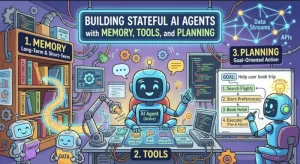
An AI agent that forgets a user’s last instruction, repeats a completed task, or calls the wrong API isn’t just inconvenient. It’s a system design problem. A language model can generate impressive responses, but production workflows demand more than good text generation. They require continuity, access to external systems, and the ability to choose and execute the right steps toward a goal.
That’s where stateful AI agents come in.
By combining persistent memory, tool integration, and structured planning, developers can build agents that maintain context across interactions, take meaningful actions, and adapt when a workflow changes. These capabilities are particularly valuable for IT support, software development, enterprise automation, customer service, and other applications where tasks extend beyond a single prompt.
The challenge is not simply adding memory or connecting an API. It’s designing an architecture that manages state reliably, controls actions, and recovers gracefully when something goes wrong.
What Makes an AI Agent Stateful?
A stateless AI interaction treats each request largely as an independent operation. The model receives a prompt, generates a response, and relies on the application to supply any relevant context again.
A stateful AI agent maintains information about an ongoing interaction or task. That information can include conversation history, user preferences, completed actions, pending operations, tool results, and decisions made earlier in the workflow.
Consider an IT support agent investigating a failed application deployment. A basic chatbot might explain common deployment errors. A stateful agent could remember the affected service, record which diagnostic commands have already run, retain the results, and continue troubleshooting after the user provides another detail.
The distinction matters because state is what connects individual model calls into a coherent workflow.
A useful stateful architecture typically manages three categories of information:
- Conversation state: Recent messages, user intent, and relevant interaction history.
- Task state: The current objective, completed steps, outstanding actions, and execution status.
- Long-term memory: Durable facts, preferences, or knowledge that remain useful across sessions.
These categories serve different purposes. Keeping them separate makes the system easier to debug, secure, and scale.
1. Design a Memory System That Preserves the Right Context
Memory is one of the most misunderstood parts of agent architecture. Storing every message indefinitely does not automatically make an agent smarter. It can increase token costs, introduce irrelevant context, and make retrieval less reliable.
The goal is to retain information that improves future decisions.
Short-term memory for active tasks
Short-term memory holds the context needed to complete the current conversation or workflow. It may include recent messages, tool outputs, intermediate reasoning summaries, and the current task status.
For example, a code-review agent might track the repository under review, the files already inspected, identified defects, and outstanding checks. It doesn’t need to rediscover this information every time the workflow advances.
A practical implementation stores a structured state object alongside the conversation history. The application can update this object after each meaningful action rather than relying entirely on the model to reconstruct progress from raw messages.
Long-term memory for reusable knowledge
Long-term memory retains information that may be useful across sessions. Examples include a user’s preferred programming language, an application’s architecture, or recurring troubleshooting patterns.
Depending on the data, developers can use a relational database, a document store, or a vector database that supports semantic retrieval.
Vector search is useful when users refer to information indirectly. A query about “the authentication issue we fixed last week” may retrieve a stored incident note even when the wording differs from the original record.
However, semantic similarity alone is not enough. Production systems should consider metadata filters, timestamps, access permissions, and freshness when retrieving memories.
Practical memory design
A reliable memory pipeline follows a deliberate process:
- Capture: Identify useful facts, decisions, and task updates.
- Validate: Check whether the information is trustworthy, current, and appropriate to store.
- Persist: Save it with relevant metadata, such as user, task, timestamp, and source.
- Retrieve: Load only the information relevant to the current objective.
- Update or expire: Correct outdated facts and remove information that no longer needs to be retained.
The key principle is simple: memory should improve the next decision, not merely preserve the previous conversation.
2. Connect Tools So the Agent Can Take Action
Memory gives an agent continuity. Tools give it the ability to interact with the world outside the language model.
Common integrations include REST APIs, SQL databases, internal search services, ticketing platforms, cloud management interfaces, and code execution environments.
Suppose an operations agent receives a request to investigate a server alert. It might use a monitoring API to retrieve metrics, query a log platform for errors, and create an incident ticket containing the findings.
The model decides which available operation is relevant, but the surrounding application should control how that operation executes.
Define tools with explicit contracts
Every tool should have a clear name, purpose, input schema, output format, and failure behavior. Typed parameters and schema validation help prevent malformed requests from reaching downstream services.
For example, a ticket-creation tool might accept:
title: A concise incident summary.description: Diagnostic findings and relevant evidence.severity: A value from an approved set.service_id: The identifier of the affected service.
The application validates these fields before calling the ticketing API. If the service identifier is invalid, the tool should return a structured error the agent can interpret.
Tool descriptions also matter. If two tools perform similar operations, their descriptions should explain when each one is appropriate.
Separate decision-making from execution
An agent should not receive unrestricted access to every system simply because it can generate tool calls.
Use least-privilege credentials, explicit authorization checks, timeouts, rate limits, and audit logs. Read-only tools can often operate with fewer restrictions, while destructive actions require stronger controls.
For sensitive operations, introduce a human approval step before the action executes. Deleting a cloud resource, changing production permissions, or issuing a refund should not depend solely on a model-generated decision.
The model proposes an action; the application enforces the rules. This separation is fundamental to building dependable AI agents.
3. Add Planning to Coordinate Multi-Step Workflows
A tool-enabled agent can perform individual actions, but complex tasks require coordination. Planning helps the agent break a goal into manageable steps, track dependencies, and determine what to do next.
Imagine an agent asked to prepare a deployment readiness report. It may need to inspect recent code changes, run automated tests, retrieve deployment configuration, check service health, and summarize any blockers.
A useful plan could look like this:
- Identify the target application and deployment environment.
- Retrieve the latest code changes and configuration.
- Run the required validation checks.
- Collect test results and operational metrics.
- Evaluate the evidence against readiness criteria.
- Generate a report with outstanding risks.
Not every step needs to run sequentially. Independent checks can execute in parallel, while dependent operations must wait for their prerequisites.
Choose the right planning pattern
Different workflows call for different levels of planning.
- Fixed workflow: Use predefined steps when the process is predictable, such as validating a standard deployment.
- Dynamic planning: Let the agent select subsequent actions based on tool results when troubleshooting requires adaptation.
- Hierarchical planning: Break a broad objective into smaller subgoals when the task spans multiple systems or teams.
Fixed workflows are generally easier to test and govern. Dynamic planning offers flexibility but introduces more uncertainty. Many production systems combine both: the application defines boundaries and required checkpoints, while the agent chooses among permitted actions within those boundaries.
Keep the plan in application state
Do not treat a plan as a disposable paragraph in the conversation. Represent it as structured data containing the task identifier, step status, dependencies, outputs, and retry information.
A step might have a status of pending, running, completed, or failed. After each tool call, the application updates the corresponding state and supplies the latest information to the agent.
This makes interrupted workflows easier to resume and helps prevent completed operations from running again unnecessarily.
4. Build the Agent Around a Controlled Execution Loop
Memory, tools, and planning work best when connected through a predictable execution loop.
A typical implementation follows this sequence:
- Receive a user request and load the relevant state.
- Retrieve memories associated with the task or user.
- Ask the model to select an allowed action or determine the next step.
- Validate the proposed action against tool schemas and policy rules.
- Execute the tool and capture its result.
- Update task state, memory, and execution history.
- Evaluate whether the goal is complete or another step is required.
- Return a response, request clarification, or pause for approval.
The loop should include clear termination conditions. Without them, an agent can repeatedly call tools, revisit failed steps, or consume resources without making progress.
Set limits on execution steps, retries, elapsed time, and token usage. When a tool fails, distinguish between transient failures, invalid inputs, authorization problems, and conditions requiring human intervention.
For operations that create or modify external resources, use idempotency keys or equivalent safeguards where supported. This reduces the risk of duplicate actions when a request times out after the underlying operation has already succeeded.
5. Choose an Architecture That Matches the Workload
There is no single storage or orchestration technology that fits every stateful agent. Choose components based on the workload, data requirements, and operational constraints.
| Component | Common implementation choices | Primary responsibility |
|---|---|---|
| Working state | Application state object, Redis, relational database | Track active tasks and execution progress |
| Persistent memory | PostgreSQL, document database, vector database | Store and retrieve durable information |
| Tool integration | REST APIs, SDKs, function calling | Execute approved external operations |
| Planning and orchestration | Custom state machine, workflow engine, agent framework | Coordinate steps, dependencies, and recovery |
| Observability | Structured logs, traces, metrics | Diagnose failures and measure performance |
A lightweight application may keep working state in a database and use a simple orchestration loop. A more complex enterprise agent may need durable workflow execution, versioned state, distributed tracing, and explicit recovery policies.
The important distinction is between model context and application state. Model context is the information supplied to the language model for a particular invocation. Application state is the authoritative record of what the workflow has done, what it knows, and what remains to be completed.
Treating these as separate concerns makes the system easier to operate and recover.
6. Address Security, Reliability, and Evaluation Early
A technically capable agent can still fail in production if it cannot be trusted to handle data and actions correctly.
Start with a few practical safeguards:
- Protect memory: Enforce access controls at retrieval time. A user should never receive another user’s stored information simply because a vector search finds it relevant.
- Treat retrieved content as untrusted: Documents, web pages, tickets, and tool outputs may contain malicious instructions. Retrieved content should not override system policies or authorization checks.
- Limit tool permissions: Give each integration only the access it needs.
- Make workflows observable: Record tool names, execution status, latency, retry counts, and relevant state transitions. Avoid logging secrets or unnecessary personal information.
- Test complete workflows: Measure task completion, tool-call accuracy, retrieval relevance, policy violations, and recovery after failures.
Testing should include more than successful demonstrations. Simulate unavailable APIs, stale memory, malformed tool arguments, interrupted sessions, and conflicting instructions. Verify that the agent can recover safely or stop with a clear explanation.
Practical Takeaway: Start With One Stateful Workflow
Building stateful AI agents is primarily an exercise in system design. The language model provides flexible decision-making, but memory management, tool execution, planning, and recovery determine whether the overall system behaves reliably.
Start with one bounded workflow, such as investigating an IT incident or preparing a deployment report. Define the task state, choose what information deserves persistent memory, expose a small set of validated tools, and implement a controlled execution loop.
Then test failure scenarios before expanding the agent’s permissions or responsibilities.
Once the workflow works consistently, add capabilities incrementally. Improve memory retrieval, introduce parallel execution where dependencies allow it, and use evaluation results to guide changes.
The next step is not to build the most autonomous agent possible. It’s to build an agent that can explain its progress, resume interrupted work, use tools within clear boundaries, and complete a measurable task reliably. That is the foundation for stateful AI systems that deliver practical value in production.
Extra posts:
 How Copilot Agents Think: Goals, Memory, Tools, and Autonomy
  The Architecture of Copilot Agents: Building Intelligent Assistants for the Modern Era
  Building Resilient Cloud Architectures with Azure’s Agentic Agents: Migration, Observability, and Optimization
  Microsoft Copilot Is Getting a Major Upgrade: New AI Agents, Code Tools and Smarter Office Workflows Arrive
  Agent Optimizer in Foundry Agent Service: Building Smarter and More Efficient AI Agents
  The Difference Between Declarative Agents and Autonomous Agents in Copilot Studio