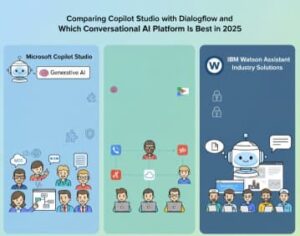
Conversational AI continues to evolve at incredible speed, with businesses relying on chatbots and virtual agents to automate support, streamline workflows, and deliver personalized user experiences. As organizations look for more intelligent, scalable solutions, three major platforms often dominate the conversation: Microsoft Copilot Studio, Google Dialogflow, and IBM Watson Assistant.
Each platform brings its own strengths, ecosystem integrations, and AI capabilities. But choosing the right one can be challenging—especially when your business depends on productivity, automation, and accurate natural-language interactions.
This blog breaks down the key differences between Copilot Studio, Dialogflow, and IBM Watson Assistan. Whether you’re building customer support bots, internal automation agents, or fully integrated enterprise AI systems, this guide will help you make an informed decision.
What Is Microsoft Copilot Studio?
Formerly known as Power Virtual Agents, Copilot Studio is part of the Microsoft Copilot ecosystem, offering a low-code platform designed for building conversational bots and business automations.
The standout feature of Copilot Studio in 2025 is its deep integration with Microsoft 365, Teams, Power Platform, and Azure OpenAI Service. With built-in large language model (LLM) capabilities, it allows users to create sophisticated AI copilots with minimal configuration.
Strengths of Copilot Studio
- Low-code builder: Ideal for non-technical users.
- Microsoft ecosystem integration: Great for organizations using Office 365, Teams, Dynamics 365, and Azure.
- Generative AI capabilities: Uses advanced LLMs for more natural, context-aware conversation flows.
- Enterprise security and governance: Suited for regulated industries.
Ideal For:
Businesses already using Microsoft tools and wanting AI agents tightly integrated with enterprise workflows.
What Is Google Dialog flow?
Dialogflow, powered by Google Cloud, is one of the earliest and most widely used conversational AI platforms. Known for its strong NLP capabilities, Dialogflow ES and CX allow developers to build conversational flows for chatbots, IVR systems, and cross-platform virtual agents.
Where Dialogflow particularly shines is in its advanced conversation orchestration, support for multilingual bots, and robust API-based development approach.
Strengths of Dialogflow
- Advanced NLP: Excellent accuracy for intent classification.
- Dialogflow CX: Offers visual flow builders for complex, multi-turn conversations.
- Google Cloud ecosystem: Integrates well with Vertex AI and Search Generative Experience (SGE) tools.
- Omnichannel support: Integrates with mobile apps, websites, telephony, and third-party messaging platforms.
Ideal For:
Developers or businesses needing flexible, scalable conversational flows with customizable logic.
What Is IBM Watson Assistant?
IBM Watson Assistant has long been popular in enterprise settings, known for its reliability, hybrid deployment options, and strong support for industries with strict compliance needs.
Watson Assistant offers AI-powered conversation flows, intent training, and integrations with IBM Watson Discovery for knowledge retrieval. It also provides tools for voice agents and customer service automation.
Strengths of Watson Assistant
- Enterprise-grade security: Excellent for healthcare, banking, insurance, and government.
- Hybrid cloud deployment: AWS, Azure, IBM Cloud, or on-premise options.
- Watson Discovery integration: Useful for document-heavy industries.
- Voice agent capabilities: Built-in telephony integrations.
Ideal For:
Large enterprises needing strong AI with strict data governance and multi-cloud flexibility.
Copilot Studio vs Dialogflow vs IBM Watson Assistant: A Feature-by-Feature Comparison
Below is a direct comparison across the features most businesses care about in 2025.
1. Ease of Use
Copilot Studio:
Extremely user-friendly, especially for non-tech users. Its natural language authoring lets you “describe” what you want the bot to do.
Dialogflow:
More developer-oriented. CX’s visual builder helps, but still requires structured planning.
Watson Assistant:
Moderately easy, but often requires skilled configuration for complex deployments.
Winner for Ease of Use: Copilot Studio
2. Generative AI Capabilities
Copilot Studio:
Deep LLM integration using Azure OpenAI models. Supports natural conversation, rewrite suggestions, semantic memory, and intelligent routing.
Dialogflow:
Uses Google’s generative AI models through Vertex AI. Strong, but requires more setup.
Watson Assistant:
IBM Watsonx.ai adds generative AI capabilities, though these are still maturing compared to Microsoft and Google offerings.
Winner for Generative AI: Copilot Studio (leading in 2025)
3. Integration Ecosystem
Copilot Studio:
- Best choice if your business runs on Microsoft 365, Teams, or Power Platform.
- Built-in access to Power Automate for workflow automation.
Dialogflow:
- Connects seamlessly with Google Cloud, Firebase, and third-party APIs.
- Strong for mobile apps and consumer-facing platforms.
Watson Assistant:
- Great with IBM Cloud and enterprise systems like SAP or Oracle.
- Hybrid deployment makes it flexible.
Winner for Ecosystem Integration:
Depends on your stack:
- Microsoft users → Copilot Studio
- Google Cloud developers → Dialogflow
- Hybrid/multi-cloud enterprises → Watson Assistant
4. Pricing
Pricing varies by usage, interactions, and hosting, but here’s the general trend:
- Copilot Studio: Cost-effective for Microsoft 365 businesses; predictable pricing.
- Dialogflow: Pay-as-you-go; can become expensive with high volumes.
- Watson Assistant: Often higher priced due to enterprise features.
Most Budget-Friendly: Copilot Studio
5. Best-Fit Use Cases
| Platform | Best Use Cases |
|---|---|
| Copilot Studio | Enterprise productivity, Microsoft ecosystem automation, internal copilots |
| Dialogflow | Consumer chatbots, omnichannel experiences, mobile apps and websites |
| Watson Assistant | Regulated industries, enterprise customer service, hybrid environments |
Which Should You Choose?
- Choose Copilot Studio if your organization uses Microsoft tools and wants powerful generative AI with low-code simplicity.
- Choose Dialogflow if you want flexible, scalable conversation design with strong multilingual NLP for consumer apps.
- Choose Watson Assistant if you’re in a highly regulated industry or need hybrid/on-premise control.
In 2025, all three platforms are strong contenders—but Copilot Studio has become the leader for enterprises focused on productivity, automation, and ease of use, thanks to its LLM-powered enhancements and tight integration with the existing Microsoft ecosystem.
Extra posts:
 How Microsoft Copilot Studio Fits Into the Power Platform Ecosystem
  Comparing Copilot in Microsoft 365 vs. GitHub Copilot: Key Differences
  The Evolution of Conversational AI in Microsoft’s Ecosystem
  How to Activate and Use the Scrum Assistant Agent in GitHub Copilot
  The ‘Digital Twin’ Employee Creating Hyper-Personalized Copilot Prompts with Copilot Studio
  Azure AI Studio / Azure AI Foundry A Powerful Platform for Generative AI