
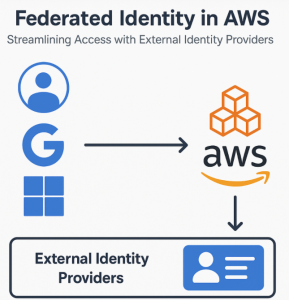
In today’s cloud-native world, securing user access while simplifying authentication workflows is critical. Whether you’re managing employees, partners, or customers, juggling multiple identity systems can lead to inefficiencies, security risks, and a poor user experience.
That’s where the Federated Identity pattern comes into play—especially powerful when implemented in Amazon Web Services (AWS) using standards like OAuth and SAML.
In this post, we’ll break down the concept of federated identity in AWS, how it works with external identity providers, and why it matters in a modern enterprise architecture.
🔐 What Is Federated Identity?
Federated Identity allows users to access AWS resources using credentials from an external identity provider (IdP)—such as Google, Okta, Azure AD, or even your own SAML/OAuth-based IdP.
This means users don’t need to have AWS-specific credentials. Instead, they authenticate with their existing credentials, and AWS trusts the IdP to assert the user’s identity.
🧭 How Federated Identity Works in AWS
Federated identity in AWS typically relies on two main components:
- AWS Identity and Access Management (IAM)
- AWS Security Token Service (STS)
Here’s a high-level workflow:
- User logs in to an external identity provider (via SAML or OAuth).
- The IdP issues a token/assertion that proves the user’s identity.
- The token is sent to AWS STS, which validates it and issues temporary AWS credentials (access key, secret key, session token).
- The user accesses AWS resources using these temporary credentials.
🌐 Supported Identity Providers and Protocols
AWS supports the following identity federation protocols:
| Protocol | Common Use Cases |
|---|---|
| SAML 2.0 | Enterprise SSO (e.g., Okta, AD FS, Azure AD) |
| OIDC (OAuth 2.0 + OpenID Connect) | Web/mobile apps, social IdPs (e.g., Google, Facebook) |
| Custom identity brokers | When advanced token validation and mapping are required |
You can integrate external IdPs via:
- IAM Identity Providers
- Amazon Cognito
- AWS IAM Identity Center (formerly AWS SSO)
✅ Real-World Scenarios
1. Enterprise SSO with SAML
Your employees log in to AWS Management Console using their Azure AD or Okta credentials. You configure a SAML IdP in IAM, define roles with trust policies, and map SAML attributes to AWS IAM roles.
2. Web App Sign-In with OAuth/OIDC
You’re building a customer-facing app. Users sign in using Google or Facebook via Amazon Cognito, which handles the OAuth 2.0/OIDC flow and issues AWS credentials through a user pool + identity pool.
3. Temporary Access to AWS APIs
You use an internal identity broker that validates users against LDAP or another system and then calls STS AssumeRoleWithWebIdentity or AssumeRoleWithSAML to grant access.
⚙️ Example: SAML Federation with Azure AD
To enable SAML-based federation between Azure AD and AWS:
- Register AWS as an enterprise application in Azure AD.
- Download the SAML metadata from Azure AD and configure it as a SAML provider in AWS IAM.
- Create IAM roles with trust policies that allow access from the SAML provider.
- Map users/groups in Azure AD to IAM roles via SAML assertions.
When users access AWS through Azure AD, they’re automatically signed in with appropriate role-based permissions.
🔧 Example: OAuth/OIDC Federation with Google via Cognito
With Amazon Cognito, you can allow end users to log in using Google:
- Create a Cognito user pool and enable Google as an identity provider using OAuth 2.0 credentials.
- Set up an identity pool to allow authenticated users to access AWS services.
- Map user roles in Cognito based on their authentication status (authenticated vs. unauthenticated).
This is a great pattern for mobile and web apps that require secure, federated logins.
💡 Benefits of Federated Identity in AWS
🔐 Stronger Security
- No long-term AWS credentials are issued.
- Temporary credentials reduce the risk of credential leakage.
- Integrates seamlessly with MFA and conditional access via IdPs.
🚀 Simplified User Access
- Users authenticate with systems they already know.
- Reduces password fatigue and improves productivity.
🧩 Seamless Integration
- Works with existing IdPs like Azure AD, Okta, Google, and custom brokers.
- Easily extendable for both workforce and customer identity scenarios.
⚙️ Fine-Grained Access Control
- Use SAML/OIDC attributes to control access to specific AWS roles and resources.
🧭 Best Practices
- Use short-lived credentials with STS to minimize attack surface.
- Enable MFA through the IdP for added security.
- Audit access via CloudTrail and AWS IAM Access Analyzer.
- Apply least privilege when mapping roles and policies.
- Use AWS IAM Identity Center for simplified, centralized management of enterprise access.
The Federated Identity pattern is a foundational component for building secure, scalable, and user-friendly authentication experiences in AWS. Whether you’re providing enterprise access via SAML, or enabling customer sign-ins via OAuth, AWS offers flexible tools like IAM, STS, and Cognito to make integration seamless.
By embracing federated identity, you reduce friction for users, centralize access control, and strengthen your security posture—all critical for success in the cloud.
Extra posts:
 Federated Identity in Azure Seamless Access with External Identity Providers
  Microsoft Entra Suite The Future of Identity and Access Security
  🚀 Materialized View Pattern in AWS Precompute for Performance
  Building Resilient Systems with Immutable Infrastructure on AWS
  Token-Based Authentication in AWS Using JWT for Stateless Security
  Implementing Event Sourcing in AWS Modeling State as a Sequence of Events