
Agentic AI has quickly moved from buzzword to business tool but not every implementation delivers real value. Many organizations experiment with AI agents only to find themselves drowning in complexity without measurable return. The difference between hype and impact comes down to one thing: practical workflows that save time, reduce manual effort, and produce clear ROI.
This article breaks down five real-world agentic AI workflows that are already proving their worth. These aren’t futuristic concepts they’re operational systems companies are using today to automate repetitive work, accelerate decision-making, and free up human teams for higher-value tasks.
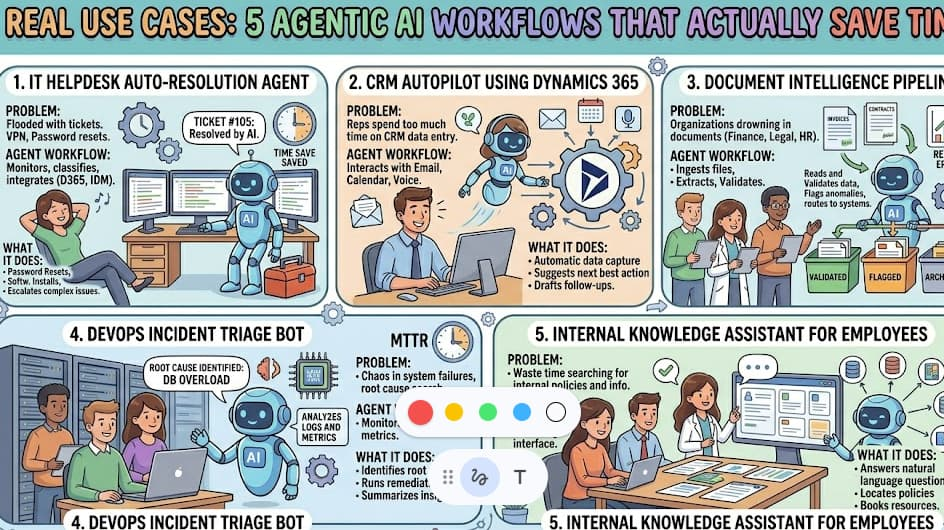
1. IT Helpdesk Auto-Resolution Agent
The problem:
IT helpdesks are flooded with repetitive tickets password resets, VPN issues, software installs, access requests. These requests are predictable but still consume valuable human time.
The agentic workflow:
An AI helpdesk agent monitors incoming tickets, classifies them, and decides whether it can resolve them autonomously. It integrates with identity systems, device management tools, and knowledge bases to execute actions directly.
What it actually does:
- Reads incoming tickets and extracts intent
- Matches the issue to known resolution workflows
- Executes actions (reset password, unlock account, reinstall software)
- Confirms resolution with the user
- Escalates only when necessary
Why it saves time:
Instead of human agents handling every ticket, the AI resolves up to 60–80% of common issues instantly. That reduces backlog, shortens response times, and allows IT staff to focus on complex problems.
ROI impact:
- Faster resolution times (minutes instead of hours)
- Reduced staffing pressure
- Improved employee satisfaction due to instant support
2. CRM Autopilot Using Dynamics 365
The problem:
Sales teams spend too much time updating CRM systems logging calls, entering notes, tracking follow-ups—rather than actually selling.
The agentic workflow:
A CRM autopilot agent integrates with email, calendar, and communication tools to automatically capture and update customer interactions inside the CRM system.
What it actually does:
- Extracts key details from emails and meeting transcripts
- Updates customer records automatically
- Generates follow-up reminders
- Suggests next best actions based on deal stage
- Drafts personalized outreach messages
Why it saves time:
Sales reps no longer need to manually input data after every interaction. The system keeps the CRM updated in real time, reducing administrative overhead significantly.
ROI impact:
- More selling time per rep (often 20–30% increase)
- Better data quality in CRM
- Higher conversion rates due to consistent follow-ups
3. Document Intelligence Pipeline
The problem:
Organizations process thousands of documents—contracts, invoices, forms—often requiring manual review and data entry.
The agentic workflow:
An AI-driven document pipeline ingests files, extracts structured data, validates it, and routes it to the appropriate systems or teams.
What it actually does:
- Reads PDFs, scans, and images
- Extracts key fields (names, dates, totals, clauses)
- Validates data against business rules
- Flags anomalies or missing information
- Automatically files or forwards documents
Why it saves time:
Manual data entry and document review are drastically reduced. What once took hours per batch can be completed in minutes.
ROI impact:
- Reduced operational costs
- Faster processing cycles
- Lower error rates compared to manual entry
Where it shines most:
- Finance (invoice processing)
- Legal (contract analysis)
- HR (employee onboarding documents)
4. DevOps Incident Triage Bot
The problem:
When systems fail, DevOps teams scramble to identify the root cause. Incident triage is often chaotic, time-sensitive, and resource-intensive.
The agentic workflow:
An AI triage agent monitors logs, alerts, and system metrics. When an incident occurs, it gathers context, analyzes patterns, and suggests or even executes remediation steps.
What it actually does:
- Aggregates logs and monitoring data
- Identifies likely root causes using historical patterns
- Suggests fixes or runs predefined scripts
- Notifies the right engineers with summarized insights
- Documents the incident automatically
Why it saves time:
Instead of engineers digging through logs manually, the agent provides a clear starting point—or even resolves the issue outright.
ROI impact:
- Reduced mean time to resolution (MTTR)
- Less downtime
- Lower operational stress on engineering teams
5. Internal Knowledge Assistant for Employees
The problem:
Employees waste time searching for internal information—policies, procedures, documentation—spread across multiple systems.
The agentic workflow:
An internal AI assistant acts as a centralized knowledge interface, answering questions and performing tasks across company systems.
What it actually does:
- Understands natural language queries
- Retrieves accurate answers from internal sources
- Executes simple actions (e.g., submitting requests, booking resources)
- Learns from usage patterns to improve responses
Why it saves time:
Instead of navigating multiple tools or waiting for responses, employees get instant answers and support.
ROI impact:
- Increased productivity across departments
- Reduced dependency on support teams
- Faster onboarding for new employees
What Makes These Workflows Actually Work?
Not all AI agents deliver results. The successful ones share a few key characteristics:
1. Clear scope
Each workflow targets a specific, high-frequency problem. Broad, undefined agents tend to fail.
2. System integration
The agent doesn’t just “suggest”—it acts. Integration with existing tools (CRM, IT systems, cloud infrastructure) is critical.
3. Human fallback
When confidence is low, the system escalates. This ensures reliability without blocking workflows.
4. Measurable outcomes
Time saved, tickets resolved, deals closed—these workflows are tied directly to business metrics.
Agentic AI isn’t about replacing people—it’s about removing the repetitive work that slows them down. The workflows above succeed because they focus on practical automation, not abstract intelligence.
If you’re considering implementing agentic AI, start small. Pick one high-volume process, define clear success metrics, and build an agent that can act—not just assist. The ROI becomes obvious when time savings translate into real operational efficiency.
The future of work isn’t just AI-powered—it’s agent-driven. And the companies that adopt these workflows early are already seeing the difference where it matters most: time, cost, and productivity.
Extra posts:
 10 Real-World Copilot Studio Use Cases That Save Teams Hundreds of Hours
  Designing Safe Agentic Workflows with Microsoft Copilot
  Common Mistakes Orgs Make When Adopting Agentic AI
  How Agile Teams Can Save 10+ Hours a Week Using Copilot in Windows 11
  Data Boundaries and Permissions in an Agentic Copilot World
  Save Hours Every Week with Power Automate Workflows in Microsoft 365