
You know the file exists. You can open it in OneDrive or SharePoint, but when you ask Microsoft Copilot to find it, summarize it, or answer a question about it, Copilot acts as if the document does not exist.
That usually does not mean the file is missing.
Microsoft 365 Copilot works within the permissions and discovery boundaries of your Microsoft 365 environment. If a document is outside Copilot’s searchable scope, unavailable to your account, affected by a SharePoint or OneDrive configuration, or subject to information-protection controls, Copilot may not be able to retrieve it.
The good news is that you can troubleshoot this systematically.
Start by confirming that the file is actually searchable
Before changing Copilot settings, search for the file directly in OneDrive or Microsoft 365.
Microsoft recommends using the OneDrive website as a starting point when looking for missing files. Search by more than the exact filename: try a distinctive phrase from the document, a project name, a date, or another term that should appear in the file.
For example, instead of asking Copilot:
Find Project Phoenix.
Try searching Microsoft 365 for:
Phoenix migrationPhoenix architecturePhoenix Q3- A unique phrase from the document
- The document’s filename or file type
If Microsoft Search cannot find the document either, the problem is probably not specific to Copilot.
Check these basics:
- Correct account: Make sure you are signed into the Microsoft 365 account that has access to the file.
- Correct storage location: Determine whether the file is in OneDrive, a SharePoint document library, Teams-backed SharePoint storage, or another connected source.
- File still exists: Confirm that it has not been moved, renamed, deleted, or placed in another library.
- Access permissions: Open the file directly and verify that your account can access it.
This first test separates a Copilot retrieval problem from a basic file-access or search problem.
Check your OneDrive and SharePoint permissions
Copilot does not provide a back door into company data.
Microsoft 365 Copilot retrieves organizational information according to the user’s existing access permissions. That includes content stored in OneDrive and SharePoint.
This creates an important diagnostic rule:
If your account cannot access a file, Copilot should not be able to use that file either.
Check the file’s sharing settings and the permissions inherited from its parent folder or SharePoint library.
For a SharePoint document, verify:
- You are a member of the appropriate SharePoint site or Microsoft 365 group.
- You have permission to the document library.
- The file has not been shared only with a different group.
- A unique permission on the file or folder has not removed your access.
- The site or library is not subject to a discovery restriction.
If you recently received access to a site or document, allow time for Microsoft 365 services to reflect the change before assuming Copilot is malfunctioning.
For administrators, this is also where governance becomes important. Copilot respects existing Microsoft 365 permissions, so poorly managed SharePoint permissions can affect both security and discoverability.
Determine whether the file is inside Copilot’s search scope
A file can be accessible without necessarily being surfaced in every search experience.
Microsoft 365 administrators can configure controls that affect which SharePoint content appears in organization-wide search and Copilot experiences. For example, Restricted Content Discovery can prevent particular SharePoint sites from appearing in organization-wide search and Copilot answers, subject to the applicable conditions.
This matters when troubleshooting a document that you can open directly but Copilot consistently fails to retrieve.
Ask your Microsoft 365 administrator to check:
- Whether the SharePoint site is included in the organization’s search and discovery configuration.
- Whether Restricted Content Discovery affects the site.
- Whether other SharePoint search restrictions are configured.
- Whether the user has recently accessed the site or its content.
- Whether the document is stored in the expected SharePoint tenant.
Do not immediately disable security controls just to make Copilot return a document. Search restrictions often exist for governance reasons.
The goal is to identify the control that is affecting discovery and decide whether that behavior is intentional.
Check sensitivity labels and information-protection policies
Another common source of confusion is Microsoft Purview and information protection.
A user may be able to interact with a document normally while Copilot has limited ability to process its contents because of protection policies applied to the file.
Microsoft documents cases where user-defined sensitivity-label permissions can prevent Copilot agents from extracting or interacting with file content.
If Copilot can find a document but cannot summarize or answer questions about it, investigate information protection rather than treating the issue as a search failure.
Check:
- The sensitivity label applied to the document.
- Encryption or user-defined permissions associated with the label.
- Microsoft Purview policies affecting the content.
- Data Loss Prevention policies.
- Whether the behavior occurs with documents carrying different labels.
This distinction is useful:
Cannot find the file usually points toward discovery, search, permissions, or scope.
Can find the file but cannot use its contents can point toward permissions, sensitivity labels, or information-protection controls.
Test the file directly in OneDrive
If you have Copilot in OneDrive, use the document itself as a controlled test.
Open OneDrive on the web, locate the file, select it, and use Copilot to ask a question about that specific document.
For example:
Summarize the architecture decisions in this document.
Or:
What are the three risks identified in this report?
This removes much of the ambiguity from a broad Copilot prompt.
Microsoft supports asking Copilot questions about selected files in OneDrive, although supported file types and functionality have limitations.
If Copilot works when the file is explicitly selected but cannot find it from a general prompt, the underlying file may be accessible and usable while general discovery is the problem.
That is a valuable diagnostic signal.
Use a controlled search prompt
Broad natural-language prompts can make troubleshooting harder because there are several possible interpretations.
Instead, progressively narrow the request.
Start with:
Find documents about the Phoenix migration.
Then:
Find Word documents about the Phoenix migration created this month.
Then:
Find the Phoenix migration architecture document.
If you know the exact filename:
Find the file named Phoenix-Migration-Architecture.docx.
You can also ask Copilot to identify the source it used when the interface provides citations or references.
The objective is not to create a perfect prompt. It is to determine whether Copilot is failing because it cannot discover the file or because the query does not provide enough information to identify it.
Check synchronization and file location
If the document is stored locally or appears in File Explorer through OneDrive synchronization, remember that the local copy is not the same thing as an independently searchable Microsoft 365 source.
Verify that the file has actually synchronized to OneDrive or SharePoint.
Look for:
- A successful OneDrive sync state.
- The expected file in the OneDrive web interface.
- Recent changes appearing online.
- The correct SharePoint library.
- No pending upload or synchronization errors.
A simple test is to open the web version of OneDrive and search for the document.
If the file appears locally but not online, fix synchronization or storage placement first. Copilot cannot reliably retrieve a document that has never reached the Microsoft 365 service where its searchable content is expected to reside.
Consider licensing and Copilot configuration
Some Copilot capabilities depend on the user’s account, license, application, and Microsoft 365 configuration.
If one user can retrieve a particular document while another cannot, compare their environments instead of assuming the file is broken.
Check:
- Microsoft 365 Copilot licensing.
- The signed-in work or school account.
- Whether the affected user belongs to the expected security groups.
- Which Copilot experience is being used.
- Whether the same behavior occurs across Microsoft 365 Copilot and OneDrive.
For custom agents, the troubleshooting path can be even more specific. SharePoint and OneDrive knowledge sources have their own requirements, and permissions still determine what information a user can retrieve.
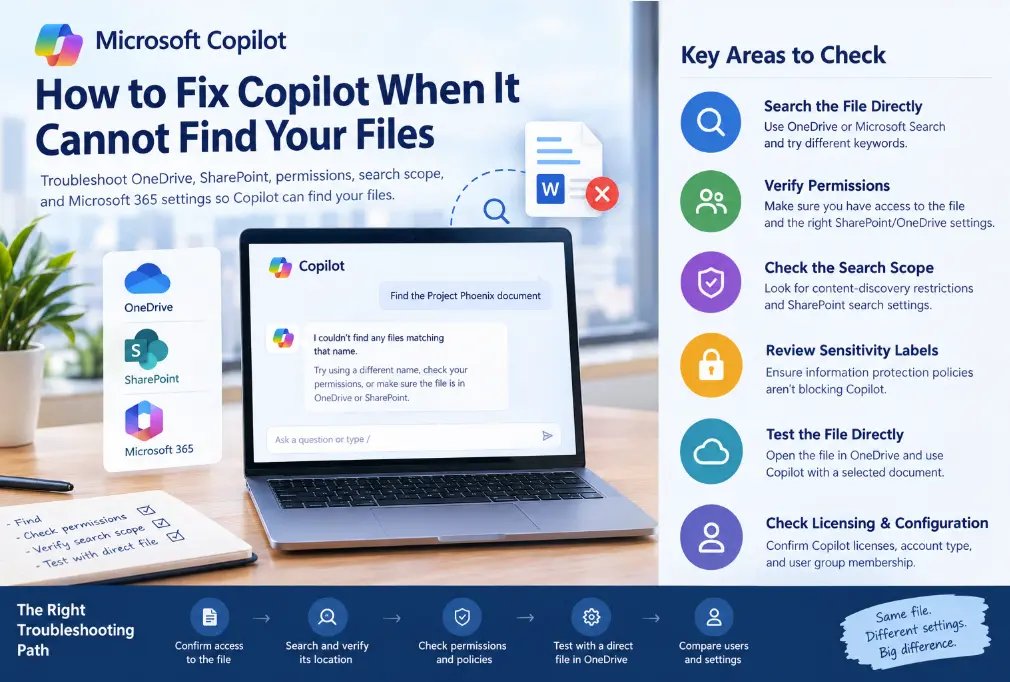
A practical troubleshooting sequence
For IT teams, the fastest approach is to work from the file outward rather than changing tenant-wide settings immediately.
Use this sequence:
- Open the file directly. Confirm the user can access it.
- Search OneDrive or Microsoft Search. Determine whether the file is discoverable outside Copilot.
- Check the storage location. Identify whether it lives in OneDrive, SharePoint, Teams-backed storage, or another source.
- Verify permissions. Check both direct and inherited access.
- Check discovery restrictions. Review SharePoint search and content-discovery controls.
- Inspect sensitivity labels and Purview policies. Especially when the file is found but its contents cannot be processed.
- Test the file directly in OneDrive Copilot. Use an explicitly selected document to isolate retrieval from general search.
- Compare users. If the problem affects only certain accounts, compare licenses, permissions, groups, and configuration.
- Escalate with evidence. Record the file location, user account, exact prompt, search results, permissions, and policy settings before opening a Microsoft support case.
This approach prevents the common mistake of changing several Microsoft 365 settings at once and then losing track of what actually fixed the problem.
The key distinction: access versus discovery
The most important concept is that being able to open a file does not guarantee that Copilot will surface it in every experience.
Copilot operates within Microsoft’s existing security and search architecture. OneDrive and SharePoint permissions determine what the user can access, while search and discovery controls can influence what content is surfaced to Copilot.
That means the right question is not simply:
“Why can’t Copilot find my file?”
Instead, break the problem into four questions:
- Can I access the file?
- Can Microsoft Search find the file?
- Is the file within the relevant Copilot discovery scope?
- Can Copilot process the file’s contents under the applicable security and compliance policies?
Once you frame the problem this way, troubleshooting becomes much more predictable.
Practical takeaway: troubleshoot the retrieval path, not just Copilot
When Copilot cannot find a file, resist the temptation to reinstall applications, rewrite prompts repeatedly, or immediately change tenant-wide settings.
Start with the document.
Confirm its location. Verify permissions. Search for it directly. Check SharePoint discovery controls. Inspect sensitivity and compliance policies. Then use a directly selected file to determine whether the problem is discovery or content processing.
For Microsoft 365 administrators, this also highlights a broader lesson: Copilot quality depends heavily on the quality of the underlying Microsoft 365 information architecture.
Clean permissions, well-managed SharePoint sites, predictable storage locations, and deliberate information-protection policies make Copilot easier to troubleshoot—and make its answers more trustworthy.
If a document is accessible, searchable, correctly governed, and within the user’s Copilot scope, you have eliminated most of the variables that can make a perfectly good file appear to be missing.
Extra posts:
 How to Fix Copilot When It Says “Something Went Wrong”
  AI Mistakes in Microsoft Copilot and How to Fix Them
  How to Fix SharePoint Files Not Opening: Common Causes and Easy Solutions
  How to Fix Copilot When It Gives a Blank Screen
  How to Fix Copilot With Multiple Microsoft 365 Accounts
  How to Fix Copilot Not Working in Outlook: Easy Troubleshooting Guide