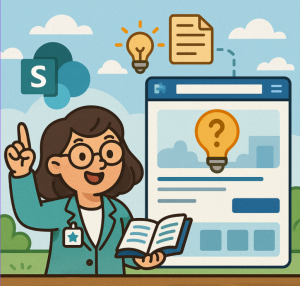
In September 2025, Microsoft launched the Knowledge Agent feature in public preview for SharePoint, as part of the broader Copilot & AI investments. This marks a significant step toward making SharePoint not just a content repository but a more intelligent, AI-aware knowledge system.
What is Knowledge Agent?
At its core, Knowledge Agent is an AI-powered layer built into SharePoint that helps you enrich, organize, and maintain content—making it more usable by people and other AI systems like Copilot.
Key things to know about its role and context:
- It bridges the gap between unstructured content (files, pages) and structured metadata, improving discoverability and intelligence.
- It works in tandem with Microsoft 365 Copilot—better organized and annotated content leads to more accurate, context-aware answers.
- Unlike earlier tools that only reasoned over file content, Knowledge Agent leverages site metadata, metadata extraction, and summarization workflows.
- It is delivered as a built-in capability: when enabled, users will see a floating button in SharePoint (lower right corner) to invoke contextual AI features.
How to Get Started (Preview Phase)
Prerequisites & Licensing
- A Microsoft 365 Copilot license is required for users.
- An administrator must enable the feature for the tenant.
- It is not yet available in some sovereign or government clouds.
Enabling It
At present, enabling is done via PowerShell, using the Set-SPOTenant command with the -KnowledgeAgentScope parameter.
Possible scopes include:
AllSites— enable everywhereExcludeSelectedSites— enable everywhere except up to 100 specified sitesNoSites— disable entirely
Examples:
Connect-SPOService https://yourtenant-admin.sharepoint.com
Set-SPOTenant -KnowledgeAgentScope AllSites
Exclude sites:
Set-SPOTenant -KnowledgeAgentScope ExcludeSelectedSites `
  -KnowledgeAgentSelectedSitesList @("https://.../site1", "https://.../site2")
Check status:
Get-SPOTenant | Select KnowledgeAgentScope
Currently, site-level opt-in/out will only be available starting November 1, 2025. Full general availability is expected in early 2026.
Who Sees It
After enabling, users with a Copilot license and site permissions (owners, members) will see the Knowledge Agent button and features. Consumers (read-only users) may have limited capabilities such as “Ask a Question.”
Core Features & Capabilities
| Feature | What It Does | Benefit |
|---|---|---|
| Ask a Question | Pose natural-language questions about files, pages, or sites. | Quickly find content without manual searching. |
| Summarize File / Page | Generate summaries of long documents or pages. | Save time previewing large files. |
| Compare Files | Show differences and similarities between two files. | Useful for reviews and versioning. |
| Organize This Library | Suggest metadata columns, tagging, and groupings. | Reduces manual curation work. |
| Set Up Rules | Create simple automation rules using natural language. | Automates repetitive tasks. |
| Create New View | Build custom views based on metadata. | Easier navigation of large libraries. |
| Improve This Site | Suggest fixes for broken links, stale pages, or gaps. | Keeps sites healthy and relevant. |
The floating button adapts depending on context (file vs page vs library) and user role (owner, member, consumer). In the background, the agent may also backfill metadata and summaries for older content.
Recommended Strategy for Early Adopters
- Start small — pilot with limited sites and libraries.
- Set governance rules — decide who approves or reviews agent suggestions.
- Enforce taxonomy standards — control naming conventions and classification.
- Train users — explain how to accept/reject suggestions and monitor outputs.
- Review outputs regularly — catch misclassifications early.
- Plan exceptions — for file types or formats the agent struggles with.
- Stay updated — Microsoft will roll out improvements during the preview.
Why It Matters
- AI needs clean data — Copilot’s effectiveness depends on structured, well-tagged content.
- Content hygiene — Helps reduce sprawl, outdated files, and broken links.
- Empowerment — Makes site owners and authors more effective without deep technical skills.
- Shift in role — Transforms SharePoint from passive storage to an active, intelligent knowledge platform.
The Knowledge Agent is one of the most promising AI features in SharePoint yet. It helps automate content hygiene, enriches knowledge bases, and improves Copilot’s performance.
For now, treat it as an experimental tool:
- Pilot carefully,
- Watch for governance gaps,
- Educate users,
- Provide oversight.
By the time it reaches general availability in 2026, Knowledge Agent could become a core part of every SharePoint environment — and a major step toward a truly intelligent workplace.
Extra posts:
 Building a Culture of Knowledge Sharing with SharePoint & Viva
  Public vs Private vs Hybrid Cloud Models Explained
  The Future of SharePoint AI, Agents, and Smarter Collaboration (2025 Update)
  The “Agentic” Intranet: Securing and Scaling M365 Copilot with SharePoint & Teams
  Introducing the Unified Clipchamp Start Page in Microsoft 365
  The Art of Delegating to AI A New Prompting Mindset for Knowledge Workers