In 2026, SharePoint has evolved from being a basic collaboration portal into the backbone of digitally-connected organizations. With businesses demanding agility, security, and personalized employee experiences, the architecture of your SharePoint intranet isn’t just “plumbing” it’s a strategic asset that shapes how people work, share knowledge, and innovate.
In this guide, we’ll explore modern SharePoint architecture principles, practical best practices, and technical steps that will ensure your intranet scales with your organization securely and intelligently.
Why Modern SharePoint Architecture Matters in 2026
SharePoint today is deeply integrated within Microsoft 365. It’s no longer a standalone file repository — it’s the engine that powers:
- Employee experiences
- Document collaboration
- Knowledge hubs and portals
- Workflows and automation
- Business insights through analytics
Modern architecture increases:
- Performance & reliability
- Security & compliance
- User adoption
- Ease of governance
- Integration with Teams, Power Platform & Viva
Core Principles of Scalable SharePoint Architecture
Here are the five architectural principles every modern SharePoint intranet should follow:
1. A Flat Site Structure with Hub-Based Organization
Traditional deep hierarchies slow navigation and complicate governance.
Best Practice:
- Create SharePoint sites that serve specific teams or business functions.
- Organize them under SharePoint Hubs to centralize navigation, search, branding, and policies.
- Avoid long nested site collections.
Technical Step:
- Create hub sites via the Microsoft 365 admin center.
- Assign related sites to hubs.
- Standardize hub navigation so users can move seamlessly across business areas.
2. Information Architecture Designed for Search & Relevance
Search is the heartbeat of intranets.
Best Practice:
- Use metadata, content types, and managed properties instead of folders.
- Implement consistent naming conventions.
- Tune search result sources and verticals for key business scenarios (e.g., policies, HR, IT support).
Technical Step:
- Define content types in the SharePoint admin center.
- Apply columns such as Department, Project, Document Type.
- Map site columns to search managed properties.
3. Security & Compliance at the Core
With hybrid work and regulatory requirements, security is non-negotiable.
Best Practice:
- Use sensitivity labels and DLP policies in Microsoft Purview.
- Apply least-privilege access controls.
- Automate lifecycle policies to archive or delete unused content.
Technical Step:
- Create sensitivity labels for confidential data.
- Apply labels to sites or libraries.
- Configure retention policies with time-based rules.
4. Integration with the Microsoft 365 Ecosystem
A modern SharePoint intranet shouldn’t stand alone — it should connect with Teams, Viva, Power Platform, and Azure.
Best Practice:
- Surface SharePoint pages and content in Teams channels.
- Use Power Automate for approval workflows.
- Integrate Viva Connections for personalized dashboards.
Technical Step:
- Enable Viva Connections with curated dashboards.
- Embed SharePoint pages into Teams tabs.
- Build flows in Power Automate to automate document approvals.
5. Performance, Monitoring & Analytics
A scalable intranet is measurable.
Best Practice:
- Monitor usage with Microsoft 365 Reports.
- Use telemetry to identify slow pages or unused sites.
- Continuously optimize based on insights.
Technical Step:
- Access SharePoint analytics via the admin center.
- Track key indicators like page views, storage growth, and search queries.
- Adjust architecture based on trends.
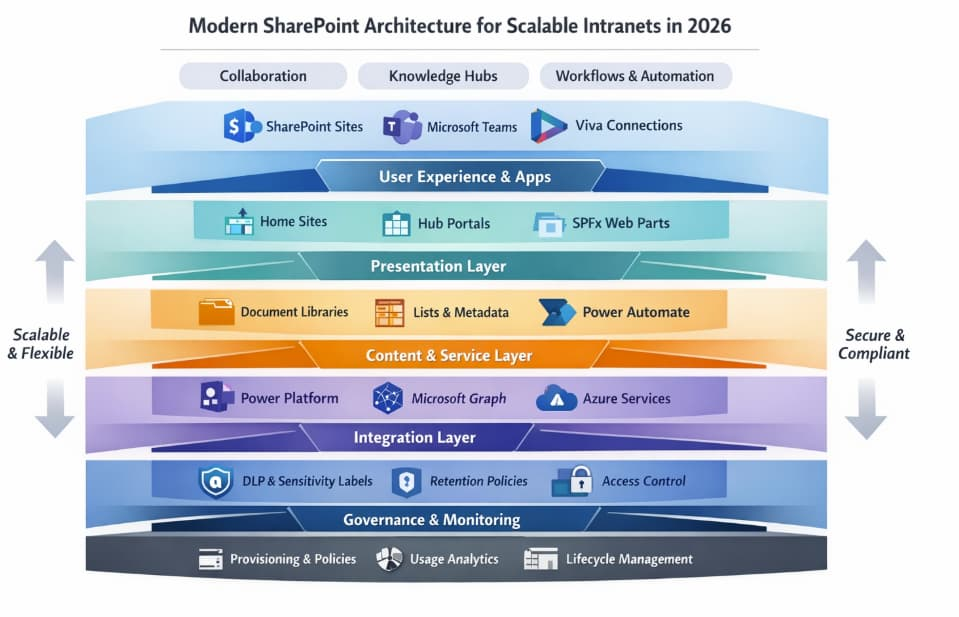
Technical Architecture Layers Explained
A strong SharePoint architecture follows layered design:
1. Presentation Layer
- Homepages, department portals, and landing pages.
- Built using modern pages, SPFx web parts, and adaptive design.
Tip: Avoid custom master pages in favor of theme consistent with Microsoft 365.
2. Content & Service Layer
- Libraries, lists, metadata schema.
- Centralized content types and site columns.
Tip: Use content hubs for reusable taxonomy.
3. Integration Layer
- Connectors to Teams, Outlook, Power Apps, Dataverse.
- Automated workflows with Power Automate.
Tip: Keep integration logic documented in an architecture repository.
4. Security & Compliance Layer
- DLP, retention labels, conditional access.
- External sharing policies.
Tip: Align SharePoint policies with corporate security and compliance frameworks.
Governance: The Glue That Makes Architecture Work
Even the best architecture fails without governance.
Key Governance Practices:
- Site provisioning process: Request-to-create workflows.
- Stewardship model: Owners accountable for content quality.
- Change control: Document updates to architecture standards.
Technical Steps:
- Create a provisioning Power App for site requests.
- Automate approvals with Power Automate.
- Set standardized templates for common site types.
Real-World Challenges and How to Solve Them
Challenge 1: Uncontrolled Site Sprawl
Solution: Use automated provisioning with approval steps and lifecycle policies.
Challenge 2: Poor Search Relevance
Solution: Implement metadata strategy and tune search verticals.
Challenge 3: Security Overexposure
Solution: Enforce sensitivity labeling and audit shared links regularly.
Future Trends to Watch in 2026 and Beyond
SharePoint continues evolving — and these trends are shaping its architecture:
- AI-powered search leveraging Microsoft Graph insights.
- Predictive content delivery based on employee roles and behavior.
- Deeper Viva integration for wellbeing, learning, and employee experience.
- Low-code/No-code apps embedded via Power Platform.
Modern SharePoint architecture is far more than organizing sites and pages. In 2026, it’s about connecting people, knowledge, and processes across a digital enterprise.
By following scalable architectural principles, strong governance, and proven technical best practices — you can deliver an intranet that’s not only efficient but transformative.
Whether you’re planning your first modern intranet or evolving a legacy implementation, let this guide serve as your blueprint for success.
Extra posts:
 Best Practices for Configuring Administrative Roles Secure, Scalable, and Sensible
  SharePoint Framework (SPFx) The Modern Development Model for SharePoint
  How to Design a Future-Proof SharePoint Information Architecture
  Documenting Software Architecture Best Practices for Clarity and Scalability
  Unlocking the Power of SharePoint Embedded A Modern Approach to Content Management
  Architecture Decision Records (ADRs) A Lightweight Governance Model for Modern Software Teams