
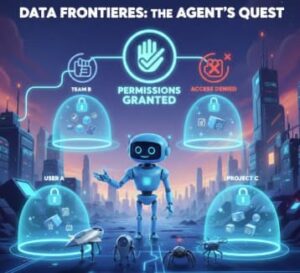
We’re entering a new era of AI one where copilots don’t just answer questions but take action. They schedule meetings, update CRM records, draft contracts, analyze dashboards, trigger workflows, and even coordinate across tools. These “agentic” copilots move beyond passive assistance into active participation.
But as AI systems become more capable and autonomous but a critical question emerges:
Where are the data boundaries? And who controls permissions in an agentic copilot world?
If your AI can act on your behalf, it must also respect the same guardrails you would. Otherwise, the promise of productivity quickly turns into a governance nightmare.
Let’s dig what data boundaries mean in this new landscape and how organizations can think clearly about permissions before scaling AI agents across their systems.
From Chatbot to Agent: What Changed?
Traditional AI assistants were reactive. You asked, they answered. The interaction was contained within a prompt window.
Agentic copilots are different. They can:
- Access multiple internal systems
- Retrieve, update, and create records
- Trigger workflows
- Call APIs
- Operate continuously with limited supervision
This shift from “responding” to “acting” expands the risk surface. When an AI can move data between systems, initiate transactions, or access sensitive files, data governance becomes mission-critical.
So more autonomy = more responsibility.
Understanding Data Boundaries in an AI-Driven Enterprise
Data boundaries define what information an AI can access, where it can move that information, and how it can use it.
In an agentic copilot environment, boundaries exist across several dimensions:
1. System Boundaries
Which systems can the agent connect to?
CRM? ERP? HRIS? Cloud storage? Internal knowledge base?
Access should be intentional and scoped — not blanket.
2. Role-Based Boundaries
If a sales rep’s copilot can see pipeline data, that doesn’t mean it should access payroll or legal documents.
AI permissions must mirror human permissions. The copilot should inherit access rights from the user — not exceed them.
3. Contextual Boundaries
Just because an agent can access certain data doesn’t mean it should use it in every context.
For example:
- A support copilot shouldn’t expose internal pricing logic to customers.
- A marketing agent shouldn’t pull confidential deal terms into campaign drafts.
Context-aware access control is essential.
4. Data Movement Boundaries
When agents operate across platforms, data may be transferred or replicated.
Organizations must define:
- Can the AI write data back into systems?
- Can it sync across environments?
- Can it export data externally?
Boundaries around data movement are often overlooked — but they’re where risk multiplies.
The Permissions Problem in Agentic AI
Permissions in an agentic world are not just about “read” vs “write.” They are about intent, traceability, and accountability.
Here are the core challenges:
1. Over-Permissioning
When deploying copilots, teams often grant broad API access “to make it work.”
This shortcut can expose:
- Sensitive financial data
- PII (Personally Identifiable Information)
- Strategic documents
The principle of least privilege must apply to AI agents just as it does to humans.
2. Invisible Actions
If an AI autonomously updates records or triggers workflows, how do you audit those actions?
Every action must be:
- Logged
- Attributed
- Reversible (when possible)
Transparency builds trust — internally and externally.
3. Delegated Authority
An agent operating on behalf of a manager could theoretically approve requests, reassign tasks, or modify contracts.
But where is the line between assistance and authority?
Organizations must define:
- What requires human approval?
- What can be automated?
- What thresholds trigger escalation?
Clear decision boundaries prevent silent errors.
Designing Secure Agentic Copilots
To operate safely in a modern enterprise, agentic copilots need intentional architecture.
Here are foundational design principles:
1. Identity-Based Access Control
Every AI agent should operate under a defined identity — either:
- The user’s identity (inherited permissions), or
- A service account with tightly scoped access
Never allow anonymous or unrestricted system-level access.
2. Granular Permission Layers
Break permissions into fine-grained controls:
- Read-only vs. write access
- Field-level visibility
- Action-level permissions (approve, delete, modify, export)
The more granular the permission model, the safer the deployment.
3. Human-in-the-Loop Safeguards
Not every action should be fully autonomous.
Examples:
- Drafting a contract? AI can do it.
- Sending the signed agreement to a client? Require approval.
- Updating compensation data? Human confirmation required.
4. Auditability and Observability
You should be able to answer:
- What did the copilot access?
- What did it change?
- Who initiated the instruction?
- When did it act?
Without audit logs, AI becomes an untraceable operator — and that’s unacceptable in regulated industries.
The Regulatory and Compliance Angle
As agentic AI spreads across finance, healthcare, and enterprise operations, compliance frameworks must evolve.
Key considerations include:
- GDPR and data residency rules
- SOC 2 and ISO 27001 requirements
- HIPAA (for healthcare data)
- Financial reporting integrity
If an AI agent processes regulated data, the organization remains accountable — not the AI vendor.
That means governance, documentation, and risk assessments must include AI agents explicitly.
Cultural and Organizational Implications
Data boundaries are not purely technical. They are cultural.
When employees trust that:
- AI won’t expose sensitive information
- Access controls are respected
- Actions are transparent
Adoption accelerates.
But if teams fear:
- Data leaks
- Unintended automation
- Silent system changes
They will resist AI deployment — no matter how advanced the technology.
Trust is the real infrastructure.
A Practical Framework for AI Permission Strategy
If you’re building or deploying agentic copilots, start with these five steps:
- Map Data Access by Role
Identify what each role can access today. Mirror that for AI. - Define Action Categories
Separate AI capabilities into:- Informational
- Advisory
- Transactional
- Set Escalation Rules
Define what requires approval and at what thresholds. - Implement Logging and Monitoring
Make AI actions visible in dashboards and reports. - Continuously Review Permissions
Just as you audit human access quarterly, review AI access too.
Agentic systems are dynamic — so governance must be ongoing.
Policy-Aware AI
The next generation of agentic copilots will be policy-aware by design.
Instead of hard-coded rules, they will interpret organizational policies dynamically:
- “This document contains confidential financial data.”
- “This request exceeds approval limits.”
- “This dataset cannot leave the EU region.”
Embedding policy intelligence directly into AI agents will transform governance from reactive to proactive.
Agentic copilots promise unprecedented productivity. They can eliminate repetitive work, accelerate decisions, and unify fragmented systems.
But autonomy without boundaries is dangerous.
In an agentic copilot world, data boundaries and permissions are not backend details — they are strategic foundations. The organizations that thrive will be those that:
- Design for least privilege
- Prioritize auditability
- Maintain human oversight
- Treat AI governance as core infrastructure
AI agents may act on our behalf — but responsibility still belongs to us.
The future of enterprise AI won’t just be defined by capability.
It will be defined by control.
Extra posts:
 10 Real-World Copilot Studio Use Cases That Save Teams Hundreds of Hours
  Managing Access and Permissions for Copilot in Microsoft 365
  Boosting Productivity with GitHub Copilot Real-World .NET Coding Examples
  Common Mistakes Orgs Make When Adopting Agentic AI
  Real Use Cases: 5 Agentic AI Workflows That Actually Save Time
  Copilot in Excel Turning Data Nightmares into Insights in Seconds