
As modern applications scale to serve millions of users, ensuring consistent performance and responsiveness becomes a challenge. Traditional CRUD models can quickly become bottlenecks when they are expected to handle high-throughput reads and complex writes in a single model.
Enter CQRS (Command Query Responsibility Segregation) — a powerful architectural pattern that separates read and write operations to optimize for scalability, performance, and maintainability.
In this blog post, we’ll explore the fundamentals of CQRS, how it improves application efficiency, and how you can implement it using Amazon Web Services (AWS).
What is CQRS?
CQRS stands for Command Query Responsibility Segregation. The core idea is simple: split your system into two distinct paths — one for handling commands (writes) and another for handling queries (reads).
- Commands: Actions that modify the system state (e.g., “CreateOrder”, “UpdateUser”).
- Queries: Requests that retrieve data without modifying it (e.g., “GetOrders”, “ListProducts”).
By separating these responsibilities, each side can be optimized independently for its unique requirements.
Why Use CQRS?
🚀 Performance
Read-heavy applications can benefit from read-optimized databases and caching layers. Meanwhile, write paths can enforce strong validation, transactional consistency, and robust error handling.
📈 Scalability
Read and write paths can scale independently:
- Read traffic? Add more read replicas or cache layers.
- Heavy write operations? Use asynchronous processing and partitioning.
🔐 Security & Simplicity
- Write paths can implement strict business logic and access controls.
- Read paths can expose simplified, denormalized data to consumers.
🔄 Flexible Data Models
With CQRS, you’re free to use different data storage technologies for commands and queries — optimizing for the specific needs of each.
CQRS on AWS: Architectural Overview
AWS provides a rich ecosystem of managed services that make implementing CQRS both scalable and cost-effective.
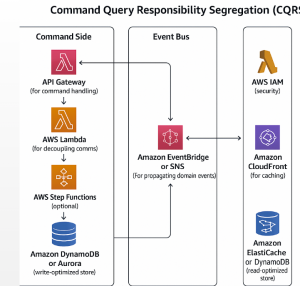
🔨 Command (Write) Side
- Amazon API Gateway or AWS App Runner: Handle API requests and route them to microservices.
- AWS Lambda or Amazon ECS: Process business logic.
- Amazon DynamoDB / Amazon RDS: Store transactional data.
- Amazon SQS or Amazon EventBridge: Queue or route events for asynchronous processing.
- AWS Step Functions: Orchestrate complex workflows.
🔍 Query (Read) Side
- Amazon DynamoDB with Global Secondary Indexes: For fast, scalable read access.
- Amazon ElastiCache (Redis/Memcached): Cache popular queries for ultra-low latency.
- Amazon OpenSearch Service: Full-text search and analytics over read-optimized data.
- AWS Lambda: Lightweight, stateless query handlers.
🔁 Syncing Read and Write Models
- When a command completes, it can publish an event (e.g.,
OrderCreated) via Amazon EventBridge or SNS. - Event consumers update the read model asynchronously, ensuring eventual consistency.
Example flow:
- User places order (Command).
- Lambda stores order in DynamoDB.
OrderCreatedevent sent via EventBridge.- Another Lambda updates the read model (e.g., cache, OpenSearch).
- Read APIs retrieve from read-optimized store.
Real-World Example: Online Marketplace
Let’s say you’re building an online marketplace like Etsy or Amazon.
Command Path:
- “AddProduct” writes to a normalized RDS schema with category, stock, and seller details.
- Validations ensure no product duplicates and correct pricing.
- Event published to
ProductAdded.
Query Path:
- Query Lambda listens to
ProductAddedand updates a denormalized view in DynamoDB with product title, price, rating, and image. GetProductListAPI retrieves from this view, which is optimized for fast display.- Popular results are cached using ElastiCache for sub-millisecond access.
Benefits of Using CQRS in AWS
- Autoscaling: AWS Lambda and DynamoDB scale with demand automatically.
- Loose Coupling: Services communicate via events, improving flexibility.
- Cost Efficiency: Pay only for what you use with serverless components.
- Global Performance: With DynamoDB Global Tables and CloudFront, CQRS-based apps can serve a global user base with low latency.
Best Practices for CQRS on AWS
✅ Use EventBridge or SNS for Loose Coupling
Avoid direct calls between command and query services. Use events for communication.
✅ Design for Eventual Consistency
Your read model may lag briefly behind the write model. Design UI/UX to handle this gracefully.
✅ Keep Command Models Clean and Focused
Apply strong validation and business logic only on the command side.
✅ Optimize Read Models for Consumers
Denormalize data and shape it to fit the needs of the frontend, mobile apps, or reporting tools.
✅ Monitor and Trace
Use AWS CloudWatch, X-Ray, and AWS CloudTrail to monitor system behavior across both sides.
CQRS offers a strategic advantage in building high-performance, scalable, and resilient applications — especially in distributed cloud environments. With AWS, implementing CQRS becomes not only possible but practical, thanks to the platform’s rich set of services and infrastructure automation.
Whether you’re building an e-commerce platform, real-time analytics system, or microservices-based architecture, CQRS on AWS empowers you to optimize each part of your system for its unique load and purpose.
Ready to try CQRS on AWS? Start small with Lambda, DynamoDB, and EventBridge — and evolve your architecture as your system grows.
Extra posts:
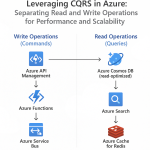 Leveraging CQRS in Azure Separating Read and Write Operations for Performance and Scalability
 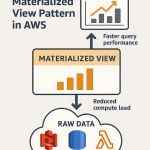 🚀 Materialized View Pattern in AWS Precompute for Performance
  Scalability Patterns in the Cloud AWS & Azure Approaches
  Building Resilient Systems with Immutable Infrastructure on AWS
  Token-Based Authentication in AWS Using JWT for Stateless Security
 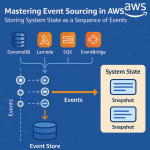 Implementing Event Sourcing in AWS Modeling State as a Sequence of Events