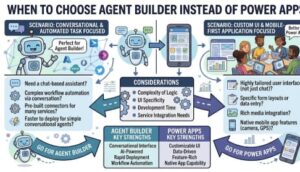
The Microsoft Power Platform has transformed how organizations build business solutions without extensive coding. Two of the most talked-about technologies in this ecosystem are Power Apps and Agent Builder. While both help organizations automate work and improve productivity, they serve very different purposes.
Many businesses make the mistake of assuming these tools compete with each other. In reality, they solve different problems. Choosing the wrong one can increase development time, reduce user adoption, and fail to deliver the expected business value.
So, when should you choose Agent Builder instead of Power Apps? The answer depends on what you’re trying to accomplish.
In this guide, we’ll explore the strengths of each platform, compare their capabilities, and help you determine when Agent Builder is the better choice for your business.
Understanding Power Apps
Power Apps is Microsoft’s low-code application development platform that enables businesses to create custom applications for web and mobile devices. These apps are designed to replace manual processes, spreadsheets, or outdated legacy systems.
Organizations commonly use Power Apps for:
- Employee onboarding
- Inventory management
- Inspection forms
- Leave management
- Expense approvals
- Customer relationship management
- Data collection
Power Apps excels when users need a structured interface where they enter, edit, and manage business data.
For example, if warehouse employees need to scan barcodes, update stock levels, and submit inventory records, Power Apps is an excellent solution.
What Is Agent Builder?
Agent Builder is Microsoft’s AI-powered platform for creating intelligent conversational agents that assist users through natural language interactions. Rather than building traditional applications, Agent Builder allows organizations to create AI assistants capable of answering questions, retrieving information, automating repetitive tasks, and guiding users through business processes.
Instead of clicking through multiple screens, users simply ask questions like:
- “How many vacation days do I have left?”
- “Create a support ticket.”
- “Find the latest sales report.”
- “Summarize today’s customer feedback.”
- “Help me prepare a project update.”
The AI agent understands context, retrieves information from connected systems, and performs actions on behalf of the user.
This conversational approach significantly reduces friction while improving employee productivity.
The Fundamental Difference
The biggest distinction is simple.
Power Apps builds applications.
Agent Builder creates AI assistants.
Power Apps focuses on structured workflows where users navigate forms, buttons, and dashboards.
Agent Builder focuses on conversations where users interact naturally with AI.
Think of it this way:
If your users need a digital form, build a Power App.
If your users need an intelligent assistant, build an AI agent.
When Agent Builder Is the Better Choice
1. Employees Frequently Ask the Same Questions
Many HR, IT, finance, and operations teams spend countless hours answering repetitive questions.
Examples include:
- Password reset instructions
- Company policies
- Leave balances
- Benefits information
- Expense reimbursement rules
- Software installation guides
Instead of creating a portal that employees must search manually, an AI agent can provide instant answers in seconds.
This dramatically reduces support workload while improving employee satisfaction.
2. Users Prefer Conversations Over Forms
Not everyone enjoys navigating multiple application screens.
Employees increasingly expect workplace technology to work like modern AI assistants.
Instead of opening several applications, users can simply ask:
“Book vacation for next Friday.”
The agent understands the request, checks available leave, initiates the workflow, and confirms the submission.
This creates a much smoother user experience.
3. You Need AI-Powered Knowledge Retrieval
Organizations often store valuable information across multiple systems:
- SharePoint
- Microsoft Teams
- Internal documentation
- PDFs
- Knowledge bases
- Company websites
Finding the right information can be time-consuming.
Agent Builder can search across connected sources and provide accurate answers instantly, making it ideal for knowledge management.
4. Customer Support Needs Faster Responses
Customer service teams handle repetitive requests every day.
Instead of hiring additional support staff, businesses can deploy AI agents to answer common questions around the clock.
Customers receive immediate assistance, while human agents focus on complex issues that require personal attention.
This improves customer satisfaction while lowering operational costs.
5. You Want Intelligent Task Automation
Agent Builder goes beyond answering questions.
It can automate tasks such as:
- Creating tickets
- Scheduling meetings
- Drafting emails
- Generating summaries
- Updating records
- Triggering workflows
The AI becomes an active assistant rather than simply a chatbot.
When Power Apps Is Still the Better Option
Although Agent Builder offers impressive AI capabilities, Power Apps remains the preferred solution for many business scenarios.
Choose Power Apps when:
- Employees must complete structured forms.
- Complex data entry is required.
- Users need dashboards and reports.
- Mobile-first applications are important.
- Barcode scanning is required.
- Offline functionality is necessary.
- Multiple approval stages must be managed visually.
Power Apps provides complete control over the application’s user interface and business logic.
Real-World Comparison
Imagine an HR department.
Using Power Apps
Employees:
- Submit leave requests
- Update personal information
- Complete performance reviews
- Upload supporting documents
Managers:
- Review requests
- Approve leave
- Monitor employee records
Everything happens through forms and structured workflows.
Using Agent Builder
Employees ask:
- “How many leave days do I have?”
- “Can I carry over unused vacation?”
- “Show my payslips.”
- “Submit annual leave for next Monday.”
The AI understands the request and completes the action automatically.
Both tools solve HR problems—but in completely different ways.
Can You Use Both Together?
Absolutely.
In fact, many successful organizations combine both technologies.
For example:
An employee asks an AI agent to submit an expense claim.
The agent launches the appropriate Power App for uploading receipts.
Once submitted, Power Automate routes the approval.
The AI then notifies the employee when the expense has been approved.
This combination delivers an outstanding employee experience while leveraging the strengths of each platform.
Benefits of Choosing Agent Builder
Organizations adopting Agent Builder can experience several advantages:
- Faster employee support
- Reduced help desk workload
- Improved productivity
- Better knowledge sharing
- Natural language interactions
- AI-driven automation
- Higher user adoption
- 24/7 availability
- Consistent responses
- Easier access to business information
These benefits become even more valuable as organizations embrace AI-driven digital transformation.
Questions to Ask Before Choosing
Before deciding between Agent Builder and Power Apps, consider the following questions:
- Do users primarily fill out forms or ask questions?
- Is conversational AI important for the experience?
- Will users benefit from natural language interactions?
- Are repetitive support requests consuming valuable time?
- Does the solution require dashboards or only intelligent assistance?
- Is AI expected to complete tasks automatically?
Your answers will quickly indicate which platform is the better fit.

hoosing between Agent Builder and Power Apps isn’t about selecting the more advanced technology—it’s about choosing the right tool for the problem you’re solving.
If your business requires structured applications with forms, data entry, and visual workflows, Power Apps remains the ideal choice.
However, if your goal is to provide employees or customers with an intelligent assistant that understands natural language, answers questions, retrieves knowledge, and automates routine tasks, Agent Builder offers a more modern and efficient solution.
As organizations increasingly embrace artificial intelligence, conversational experiences are becoming the preferred way to interact with business systems. Rather than replacing Power Apps, Agent Builder complements it by adding a layer of intelligence and automation that enhances productivity and user satisfaction.
The most successful digital transformation strategies often combine both technologies, allowing businesses to deliver powerful applications alongside intelligent AI assistants that make everyday work faster, simpler, and more engaging.