
Microsoft is changing how organizations pay for and govern some of the more advanced capabilities in Microsoft Copilot, introducing a two-part model that combines the existing per-user subscription with usage-based billing.
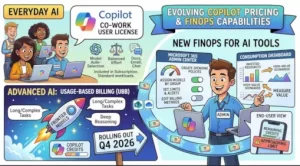
Under the evolving Microsoft Copilot pricing model, everyday AI remains covered by the user subscription license (USL), while certain advanced AI experiences can consume Copilot Credits through usage-based billing (UBB).
The new approach is scheduled to begin rolling out in Copilot in Q4 2026, alongside a broader set of financial-management and governance tools designed to give IT administrators more control over AI consumption.
For businesses adopting increasingly capable AI systems, the shift is significant because the cost of using Copilot will increasingly depend not only on who has access, but also on what type of AI work they perform.
Microsoft Is Splitting Everyday and Advanced AI Usage
The basic structure is relatively straightforward.
Everyday Copilot use remains part of the user subscription license, which is priced per user, per month. That subscription includes model selection and Microsoft’s Auto capability, which evaluates factors such as accuracy, speed and cost when routing a request to an appropriate model and reasoning level.
The more demanding side of Copilot is different.
Microsoft says users may encounter usage-based billing when they use a frontier model or another advanced AI capability, or when they reach a usage limit and choose to extend their work using Copilot Credits.
That creates a distinction between predictable subscription access and consumption tied to more resource-intensive AI workloads.
The key changes are:
- Everyday AI remains covered by the user subscription license.
- Advanced AI capabilities can use Copilot Credits.
- Usage-based billing is expected to roll out in Q4 2026.
- Organizations can establish spending policies before credits can be consumed.
- Administrators gain tools for monitoring consumption, setting limits and managing billing.
Microsoft’s current documentation describes Copilot Credits as a common consumption currency for eligible Microsoft AI experiences, with usage-based billing charging according to actual consumption rather than a fixed per-user amount.
UBB Will Be Visible to Users, but Admin Controls Matter
One of the more important details for enterprise customers is that usage-based billing capabilities will be visible in the Copilot experience even before an organization has enabled them for consumption.
Microsoft says UBB functionality is visible to end users by default, but Enterprise tenants must have an administrator create a spending policy in the Microsoft 365 admin center before Copilot Credits can actually be consumed.
That means simply seeing an advanced AI option in Copilot does not necessarily mean an employee can generate consumption charges.
The organization’s configuration determines whether that usage is permitted.
This gives administrators an opportunity to establish governance before advanced AI consumption starts becoming a budget issue.
New FinOps Tools Put AI Spending Under the Microscope
Alongside the pricing change, Microsoft is introducing a broader set of FinOps capabilities for AI.
The goal is not simply to show how many credits an organization has used. Microsoft is positioning the tools around three related questions:
- How much AI is being consumed?
- Where is that consumption happening?
- What business value is being generated from it?
The Microsoft 365 admin center’s Cost Management experience is being expanded to cover additional Copilot workloads, including Copilot Code, Copilot Managed Runtime and advanced work for SharePoint and OneDrive in Copilot.
Microsoft also says support will extend to agents built through Copilot Studio in October.
The broader direction is clear: AI spending is becoming an operational discipline rather than simply a licensing decision.
Microsoft’s current Cost Management documentation describes controls for spending policies, user and group access, spending limits, alerts, billing methods and detailed consumption analysis.
Admins Can Set Spending Policies by Group
Another notable addition is more granular control over how advanced AI is used.
When configuring a spending policy, administrators can assign models and effort levels to groups. The controls are intended to help organizations balance AI capability against cost and business requirements.
For Cowork, this can also include governance over which models the Auto setting is allowed to select.
That matters because AI consumption is not necessarily uniform from one request to another. Microsoft’s documentation notes that credit usage can vary according to factors including the models used, the amount of context retrieved, runtime and tools involved.
In practice, an organization could therefore approach AI governance differently for different teams.
A group working on complex research or engineering tasks might be permitted access to more advanced capabilities, while other groups could operate under tighter limits.
Microsoft Wants Companies to Measure Value, Not Just Usage
Perhaps the most interesting part of the announcement is Microsoft’s emphasis on outcomes.
The new consumption dashboard in Insights is designed to help leaders understand how Cowork is being used to complete meaningful work, rather than simply counting interactions.
The idea is to connect credit consumption with business outcomes.
That could allow organizations to examine whether particular AI workflows justify their resource consumption, identify valuable scenarios and compare the resources invested with the results achieved.
This reflects a broader shift in enterprise AI management.
As AI moves from simple chat and content generation toward longer, multistep tasks, counting prompts or active users alone becomes a less useful measure of value. A system that performs a small number of expensive tasks could potentially be more important to a business than one generating a large volume of inexpensive interactions.
Microsoft is therefore building cost visibility and outcome measurement into the same management conversation.
End Users Will Also See Their Copilot Spending
The changes are not limited to administrators.
Microsoft says end users will be able to see their UBB spending directly within the Cowork experience, including credit usage, remaining credits and credit history.
Users will also receive banners as they approach applicable limits.
That visibility could change how employees interact with advanced AI. Instead of consumption being an invisible back-end process, users can have a clearer indication that certain AI tasks draw from an organizational resource.
For finance and IT teams, this could also reduce the gap between technical usage and financial accountability.
What Organizations Need to Do Before Q4
Organizations do not need to make changes simply to continue using capabilities covered by the existing user subscription license.
The preparation becomes more important for businesses that intend to allow usage-based AI.
Administrators can prepare by reviewing:
- Which groups should have access to UBB-enabled experiences.
- Which spending limits should apply.
- Which models and effort levels should be available to specific groups.
- How alerts should be configured.
- Which billing method should be attached to spending policies.
- How consumption will be monitored and reported.
- How AI usage will be connected to measurable business outcomes.
Microsoft’s administration guidance provides controls for creating and editing spending policies, configuring billing methods and monitoring Copilot Credit consumption.
September 2026 Brings the First FinOps Visibility
The rollout is staged rather than arriving as one single change.
According to Microsoft’s announcement, the listed FinOps capabilities are available in preview during September 2026, while end-user visibility into Copilot Credit usage, remaining credits and credit history is generally available during the same month.
The broader UBB rollout in Copilot is planned for Q4 2026.
Microsoft is also planning to enable UBB as part of the Frontier public preview experience.
That timing gives organizations a window to establish governance before advanced consumption becomes more broadly available.
The Bigger Shift: AI Becomes a Managed Consumption Resource
Microsoft’s pricing evolution reflects a practical challenge facing enterprise AI deployments: the cost profile changes as AI systems become capable of doing more complex work.
A simple question-and-answer interaction and a long-running, multistep AI workflow do not necessarily consume the same resources. Usage-based billing gives Microsoft a mechanism for associating those differences with consumption.
For customers, that also means AI governance increasingly sits at the intersection of IT, finance, security and business operations.
The important question heading into the Q4 2026 rollout will not simply be whether employees can access more powerful AI.
It will be how organizations decide where advanced AI creates enough value to justify the resources it consumes.
That makes Microsoft’s new FinOps tools as important to the announcement as the pricing model itself. The coming rollout will give companies more ways to control AI spending, but it will also place greater emphasis on understanding which AI workloads are worth funding and how that value can be demonstrated.
Extra posts:
 Microsoft Copilot Is Getting a Major Upgrade: New AI Agents, Code Tools and Smarter Office Workflows Arrive
  Microsoft 365 Usage Reports Are Changing on September 21: What Admins Need to Know
  Microsoft Copilot URL Is Changing: Organizations Must Allow copilot.cloud.microsoft Before October
  Microsoft Copilot Studio Gets a Security Boost with Entra-Based User and S2S Authentication
  Microsoft 365 Copilot: Meet Microsoft Scout, the Always-On Personal Agent Changing How Work Gets Done
  Microsoft 365 Copilot Is Changing How Code Appears in Chat: What Users Need to Know