
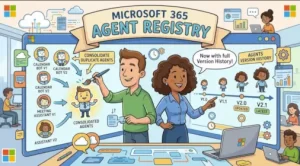
Microsoft is changing how administrators view and manage AI agents in the Microsoft 365 admin center, with the Agent Registry set to consolidate duplicate agent entries into single records and introduce a clearer version-history experience.
The update, identified by Microsoft as message MC1477184, was published on September 22, 2026, and is scheduled to roll out worldwide from mid-September through late September 2026.
For organizations using the Agent Registry, the most visible change may be a lower agent count. Microsoft says the reduction will not mean agents are being deleted. Instead, multiple records representing the same agent will be combined into one record, with published versions and applicable drafts accessible through a version selector.
No administrator action is required to enable the change.
What is changing in the Microsoft 365 Agent Registry?
The Microsoft 365 Agent Registry is being redesigned to provide a more consolidated view of deployed agents.
Previously, an agent could appear more than once in the Registry when it had been published across different scopes or when multiple published versions existed. That could make the inventory appear larger than the number of distinct agents actually deployed.
Under the new model, each agent will appear once in the Registry.
The Registry will show the most recently published organizational version by default. Administrators can then select an agent to open its details flyout, where a version selector will provide access to other available versions.
That selector can include:
- Published versions of the agent
- In-progress draft versions, where applicable
- Details associated with the selected version
The result is a shift from treating individual entries as the primary unit of inventory toward treating the agent itself as the central record.
Why Microsoft is making the change
Microsoft says the update is intended to simplify agent governance, inventory management and lifecycle administration.
As organizations deploy more AI-powered agents across Microsoft 365 environments, a registry based on individual publishing entries can make it harder to understand exactly how many distinct agents are operating in an environment.
Consolidating those records gives administrators a clearer inventory while preserving access to the underlying version information.
The change also brings version management closer to the agent record itself. Instead of navigating separate Registry entries to distinguish between versions or publishing scenarios, administrators will be able to select an agent and review its available versions from the details flyout.
For organizations developing formal AI governance practices, that distinction matters because the number of Registry entries will no longer necessarily correspond to the number of versions, scopes or historical publishing records.
Agent counts may decrease—but agents are not being removed
One of the most important points for administrators is the expected change in Registry counts.
Microsoft says total agent counts may decrease after the rollout because duplicate entries will be consolidated.
That does not mean agents are being deleted.
For example, if the Registry previously displayed multiple entries representing the same underlying agent because of different publishing scopes or versions, those entries will become a single agent record.
This could create an apparent discrepancy when administrators compare pre-update and post-update reports.
A dashboard showing one total before the rollout could show a smaller total afterward even though the organization’s actual collection of agents has not been reduced by Microsoft.
That distinction will be particularly important for teams that use Registry counts as an operational or governance metric.
Governance actions will continue to apply across versions
The consolidation does not change the scope of key governance actions.
Microsoft says actions such as Block will continue to apply to the entire agent across all versions.
This means administrators should not interpret the new version selector as creating completely separate governance objects. The Registry is providing more granular visibility into versions while governance actions remain applied at the agent level.
That separation between version visibility and agent-level governance is one of the key concepts to understand in the new experience.
Who will be affected?
The change applies to organizations using the Agent Registry and is particularly relevant to administrators and teams responsible for Microsoft 365 governance.
Microsoft identifies the following affected administrator roles:
- Global Administrators
- Global Readers
- AI Administrators
The affected platform is the Microsoft 365 admin center, specifically the Agent Registry.
The rollout is enabled by default, so organizations do not need to configure a new setting to receive the updated experience.
Reporting and dashboards could require attention
The biggest practical consideration may not be the Registry interface itself, but the systems built around its data.
Microsoft specifically warns that reports, dashboards, exports and custom processes that depend on previous per-entry counts may display different totals after the rollout.
Organizations that have incorporated Agent Registry data into internal reporting should therefore avoid treating a lower count as evidence that agents have disappeared.
This is especially relevant for automated workflows or scripts that use Registry exports.
Microsoft says exports will include options for exporting agents and their associated versions, which should give administrators a more detailed way to work with the consolidated data.
Still, any downstream process designed around the previous data structure may need to be reviewed.
Administrators should check
- Internal dashboards that track agent counts
- Scheduled reports using Registry data
- Scripts or automation that process Registry exports
- Governance documentation based on previous Registry behavior
- Training materials showing the former agent details experience
- Compliance or audit processes that use agent counts as evidence
What organizations should do before and after rollout
There is no mandatory action associated with the change, according to Microsoft.
However, organizations with mature governance or reporting processes may want to prepare for the transition rather than treating the new interface as a purely cosmetic update.
Microsoft recommends informing governance and operations teams that Registry counts may decrease.
Administrators should also review internal reports, dashboards, scripts and other processes that depend on Registry counts or export data.
After the rollout, teams should validate their downstream reporting to confirm that the new consolidated structure is being interpreted correctly.
Documentation and training materials may also need updating, particularly if they instruct administrators to manage multiple Registry entries for different versions of the same agent.
What this means for AI agent governance
The update reflects a broader administrative challenge emerging as organizations adopt more AI agents: inventory accuracy becomes increasingly important as deployment scales.
A Registry that treats duplicate publishing records as separate entries can make an environment appear more complex than it is. Consolidating those records provides a clearer distinction between an agent and its versions.
That could make routine inventory reviews easier, while the version selector gives administrators access to the historical or draft context they still need.
At the same time, organizations that built governance metrics around raw entry counts will need to adjust their interpretation of those numbers.
The change therefore affects both the user interface and the way some organizations measure their agent environments.
The September 2026 rollout timeline
Microsoft says the worldwide rollout began in mid-September 2026 and is expected to finish in late September 2026.
That means organizations may encounter the new Registry experience at different points during the rollout window.
As the update reaches more tenants, administrators may notice a change in reported agent totals or a different structure in Registry exports.
The timing also makes September a useful point for teams to review any internal documentation or reporting processes that depend heavily on the current Registry model.
What administrators should watch next
The immediate change is straightforward: duplicate agent entries will become consolidated records, while version information will remain available through the agent details flyout.
The more significant question for organizations will be how their existing reporting and governance processes adapt to the new data model.
Teams should pay particular attention to any automated process that assumes one Registry entry represents one version or one publishing scope.
As Microsoft’s AI agent ecosystem continues to expand, the distinction between an agent, its versions, and its publishing contexts is likely to become increasingly important for administrators.
For now, the Microsoft 365 Agent Registry update requires no configuration. The practical task for organizations is simply to recognize that a smaller Registry count after the rollout can reflect consolidation rather than deletion—and to make sure their reports, dashboards and internal processes reflect that distinction.
Extra posts:
 Microsoft Launches Agent 365 to Bring Control, Security, and Visibility to the Age of AI Agents
  Governance of AI Agents with Microsoft Entra & Agent 365
  Microsoft 365 E7 and Agent 365 Are Now Generally Available: The Future of AI-Powered Work Has Arrived
  Microsoft 365 Copilot: Meet Microsoft Scout, the Always-On Personal Agent Changing How Work Gets Done
  Microsoft 365 Adds New Copilot Governance Control for Advanced Agents and Plugins
  Microsoft Expands Microsoft 365 Copilot Legal Agent Worldwide: AI-Powered Contract Review Comes to Global Frontier Users