
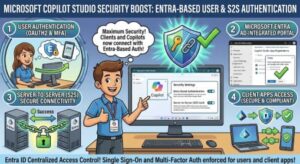
Microsoft is bringing a major authentication update to Copilot Studio, giving organizations more secure and flexible ways to connect agents with users, applications, and enterprise services.
Microsoft has announced a new capability for Microsoft Copilot Studio that will allow administrators to connect agents using Microsoft Entra-based identity. The update introduces two important authentication approaches: user-based delegated access and service-to-service (S2S) authentication.
The feature is scheduled to reach general availability on September 30, 2026.
For organizations building and deploying AI agents across business environments, the change could be significant. As AI agents move beyond simple question-and-answer experiences and begin interacting with enterprise applications and data, identity and access management are becoming increasingly important. Microsoft’s latest Copilot Studio update is designed to address that need by giving administrators greater control over how agents authenticate and access resources.
What is changing in Microsoft Copilot Studio?
Microsoft Copilot Studio has increasingly become a platform for organizations looking to build AI agents that can assist employees, customers, and business teams. These agents may need to interact with enterprise systems, retrieve information, perform tasks, or work alongside existing applications.
The new authentication capability adds Microsoft Entra-based identity options to those scenarios.
With the update, administrators will be able to configure Copilot Studio agents to use Microsoft Entra ID for either delegated user access or service-to-service authentication.
In simple terms, that means organizations can choose an authentication model that better matches how an agent is being used.
For scenarios where an agent needs to act on behalf of a signed-in user, delegated user access can provide a way for the agent to operate within the permissions associated with that user’s identity.
For scenarios where an application or backend service needs to communicate with an agent without a user directly participating in every interaction, service-to-service authentication provides another option.
That flexibility is particularly relevant for businesses that are moving from experimental AI projects toward production-grade agent deployments.
Why Microsoft Entra ID matters for AI agents
Authentication might not be the most visible part of an AI agent, but it is one of the most important.
Traditional applications already rely heavily on identity management to determine who can access information and what they are allowed to do. AI agents introduce another layer of complexity because they can potentially access information, call services, and perform actions on behalf of people or applications.
That makes it increasingly important to establish clear identity boundaries.
Microsoft Entra ID is Microsoft’s cloud-based identity and access management platform. By allowing Copilot Studio agents to use Entra-based authentication, organizations can apply established identity and access management practices to their agent scenarios.
Instead of treating an AI agent as an isolated tool, administrators can integrate authentication into the broader enterprise identity environment.
This can make it easier for IT and security teams to understand how agents authenticate and how access is managed.
Delegated access gives agents a user context
One of the most notable parts of the announcement is the support for user-based delegated access.
There are situations where an agent needs to perform an action in the context of a specific employee. For example, an employee might use an internal agent to retrieve information or interact with a business system.
In these situations, the identity of the user can matter.
Delegated authentication allows access to be associated with the user rather than treating every agent interaction as an anonymous or completely independent request.
This approach can be useful for organizations that need their AI experiences to respect existing user permissions and identity controls.
It also fits into a broader trend in enterprise AI: giving agents enough access to be useful without giving them unlimited access to everything.
Service-to-service authentication expands automation possibilities
The second major option is service-to-service authentication, commonly referred to as S2S authentication.
This is particularly relevant to automated workflows and applications where there isn’t necessarily a person sitting behind every request.
For example, an existing enterprise application could potentially need to communicate with a Copilot Studio agent as part of a larger workflow. In that scenario, requiring an employee to sign in for every request would not be practical.
S2S authentication provides a model designed for application-to-application communication.
For organizations building AI into existing business applications, this could make Copilot Studio agents easier to integrate into automated processes.
It also gives developers and administrators another authentication pattern to consider when designing agent architectures.
Copilot Studio agents can connect with existing applications
Microsoft is also highlighting the ability to use the Microsoft 365 Agents SDK to call Microsoft Copilot Studio agents from existing web and native applications.
This is an important detail because businesses rarely build their technology environments from scratch.
Many organizations already have employee portals, customer-facing applications, mobile apps, desktop software, and internal business systems. Being able to connect those applications to AI agents can make it easier to introduce AI capabilities without completely rebuilding existing technology.
The Microsoft 365 Agents SDK can therefore play an important role in connecting existing applications with Copilot Studio-based agents.
Combined with Entra-based authentication, this creates a more enterprise-focused approach to agent integration.
What does this mean for administrators?
For IT administrators and security teams, the biggest benefit may be additional control.
Rather than relying on a single authentication approach for every agent scenario, administrators can choose between delegated user access and S2S authentication based on the application’s requirements.
This can help organizations design more appropriate access models for different types of agents.
For example, an employee-facing assistant may benefit from a user-based authentication model, while an automated backend workflow may be better suited to S2S authentication.
The distinction is important because authentication requirements can vary significantly between interactive and automated AI experiences.
Organizations should still evaluate permissions, access scopes, governance policies, and security requirements carefully when deploying agents. Authentication alone does not replace broader identity and security practices.
What does this mean for developers?
Developers working with Copilot Studio may find the update particularly interesting if they are integrating agents into existing applications.
The ability to call Copilot Studio agents from web and native applications using the Microsoft 365 Agents SDK opens additional possibilities for embedding conversational and agent-based experiences into products that businesses already use.
Instead of forcing users to move to a separate AI interface, organizations can potentially bring agent capabilities directly into existing applications and workflows.
That could make AI feel less like a standalone product and more like another capability built into the software employees already rely on.
A step toward more scalable enterprise AI
The timing of the announcement is also notable.
As companies experiment with AI agents, the conversation is shifting from “Can we build an agent?” to “How do we manage agents securely at scale?”
That second question is arguably more challenging.
A small proof-of-concept can operate with relatively simple assumptions. A production environment involving hundreds or thousands of users, multiple applications, sensitive business information, and automated processes requires much stronger identity and governance controls.
Microsoft’s addition of Entra-based user and S2S authentication to Copilot Studio reflects this evolution.
The focus is not simply on making agents more capable. It is also on making them easier to integrate into the security and identity structures that enterprises already have in place.
When will the feature be available?
Microsoft says the new Microsoft Copilot Studio authentication capability will reach general availability on September 30, 2026.
The announcement is currently provided as an awareness message, meaning administrators do not need to take any action at this time.
Organizations using Copilot Studio can nevertheless use the time before general availability to consider where delegated user authentication or S2S authentication might fit into their agent strategy.
Teams responsible for identity, security, application development, and AI governance may also want to discuss how these authentication models align with their existing architecture.
The bigger picture
AI agents are quickly becoming part of the enterprise software landscape. But successful enterprise AI is not just about what an agent can do. It is also about knowing who the agent is acting for, what it can access, and how that access is controlled.
Microsoft’s latest Copilot Studio announcement addresses an important part of that equation.
By introducing Microsoft Entra-based authentication options for delegated user access and service-to-service communication, Microsoft is giving organizations more flexibility in how they connect agents to their users and applications.
The addition of Microsoft 365 Agents SDK support for calling Copilot Studio agents from web and native applications further extends the possibilities for integration.
For businesses already exploring Copilot Studio, the update could make it easier to think about agents as part of a broader enterprise application and identity architecture rather than as isolated AI tools.
General availability is expected on September 30, 2026, and no immediate administrator action is required.
As enterprise AI adoption continues to grow, secure identity will remain one of the foundations for putting intelligent agents into real-world business environments. This Copilot Studio update is another step in that direction.
Extra posts:
 Token-Based Authentication in Azure Using JWT for Stateless Security
  Token-Based Authentication in AWS Using JWT for Stateless Security
  What Microsoft Entra Really Means for Identity and Security
  Microsoft Entra Suite The Future of Identity and Access Security
  Boost Your Startup with Microsoft AI & Copilot A Game-Changer for Entrepreneurs
  Microsoft 365, Copilot, and Copilot Studio: January News Roundup