
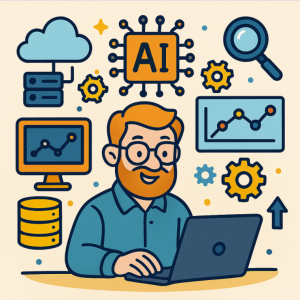
The complexity of today’s digital systems has pushed traditional IT operations to their limits. With hybrid clouds, microservices, and continuous delivery pipelines, the amount of data generated from logs, metrics, traces, and events is overwhelming. That’s where AIOps (Artificial Intelligence for IT Operations) comes in.
AIOps uses machine learning, big data analytics, and automation to enhance IT operations. Instead of reactive firefighting, teams can proactively detect anomalies, predict incidents, and automate resolutions—ensuring higher availability and efficiency.
Why AIOps Matters
- Noise Reduction – IT teams often drown in alerts. AIOps can correlate and filter events to focus only on actionable insights.
- Faster Incident Response – By predicting issues before they escalate, AIOps reduces downtime and improves mean time to resolution (MTTR).
- Automation at Scale – Routine fixes (e.g., restarting a service, scaling resources) can be automated, freeing engineers for higher-value tasks.
- Continuous Learning – Unlike static monitoring rules, AIOps adapts as systems evolve.
Key Capabilities of AIOps
- Data Ingestion: Collecting logs, metrics, traces, and events across systems.
- Anomaly Detection: Identifying unusual behavior in performance or availability.
- Root Cause Analysis: Correlating signals to pinpoint the source of incidents.
- Prediction: Forecasting potential failures (e.g., disk running out of space).
- Automation: Triggering self-healing workflows.
How to Implement AIOps in a Project
1. Define Business and Operational Goals
Start with clear outcomes—do you want to reduce MTTR, improve uptime, or cut cloud costs? Align AIOps objectives with business priorities.
2. Assess Your Data Landscape
AIOps thrives on data. Ensure you have access to logs, metrics, events, and traces from your infrastructure, applications, and monitoring tools.
3. Choose the Right AIOps Platform
Options include:
- Commercial Tools: Splunk ITSI, Dynatrace, Moogsoft, New Relic.
- Open Source & DIY: ELK stack + ML plugins, Prometheus with anomaly detection, or custom pipelines using Python + TensorFlow.
4. Build a Data Pipeline
- Integrate with observability platforms (e.g., Prometheus, Grafana, ELK).
- Use stream processing (Kafka, Flink, Spark) for real-time ingestion.
- Normalize and enrich data for ML models.
5. Apply Machine Learning
- Start small with anomaly detection (e.g., seasonal time-series models for CPU/memory).
- Use correlation analysis to group related alerts.
- Train predictive models for capacity planning or failure prediction.
6. Automate Remediation
Integrate with orchestration tools (e.g., Kubernetes, Ansible, Terraform) to trigger automated workflows like scaling, restarting services, or rerouting traffic.
7. Start with Pilot Projects
Pick one use case—say, anomaly detection on application response times—and iterate. Once successful, expand AIOps to other parts of your IT landscape.
8. Continuously Monitor and Improve
AIOps is not “set and forget.” Continuously refine ML models, update automation scripts, and gather feedback from engineers to improve.
Example Use Case
Imagine an e-commerce company running a microservices architecture.
- Problem: High volume of false alerts and long resolution times.
- AIOps Implementation:
- Collect logs/metrics from Kubernetes clusters into an ELK pipeline.
- Apply anomaly detection to identify unusual latency in the checkout service.
- Correlate alerts across services to pinpoint a database connection leak.
- Automate a restart workflow via Kubernetes to restore service instantly.
- Result: 40% reduction in MTTR and improved customer experience.
AIOps is not just a buzzword—it’s a practical way to handle modern IT complexity. By combining data, machine learning, and automation, organizations can shift from reactive firefighting to proactive, intelligent operations.
If you’re planning to adopt AIOps, start small, integrate with existing monitoring, and scale gradually. With the right approach, AIOps can become the foundation of a resilient, self-healing IT ecosystem.
Extra posts:
 Revolutionizing Operations with AI From Efficiency to Autonomy
  AgentOps: The Missing Layer Between DevOps and AIOps
  Unveiling Microsoft Fabric AI The Future of Data Intelligence
  Best AI Tools for Audio Revolutionizing Sound with Artificial Intelligence
  Exploring Agentic AI The Future of Autonomous and Goal-Driven Intelligence
  MCP & AI Unlocking Agentic Intelligence with a “USB-C Connector” for AI