
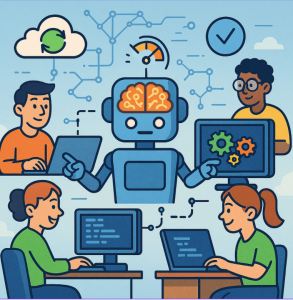
In today’s digital-first world, businesses can’t afford slow or unreliable software delivery. DevOps has already helped bridge the gap between development and operations, enabling faster releases and better collaboration. But as systems become more complex, traditional DevOps practices alone aren’t enough to keep up. This is where Artificial Intelligence (AI) steps in.
AI-powered DevOps—often called AIOps—isn’t just a buzzword. It’s becoming a critical enabler for modern software teams. By combining the agility of DevOps with the intelligence of AI, organizations can build, test, deploy, and monitor applications more efficiently than ever before.
Where AI Fits in DevOps
AI can enhance DevOps at multiple stages of the software delivery lifecycle:
1. Smarter Monitoring & Incident Management
Traditional monitoring tools generate thousands of alerts, many of which are noise. AI helps by identifying patterns, correlating events, and prioritizing the most critical incidents. This reduces alert fatigue and allows teams to focus on real issues. Predictive analytics can even forecast system failures before they happen.
2. Automated Testing
AI can analyze code changes and automatically select the most relevant tests, reducing testing time significantly. Machine learning models can also detect patterns in past bugs, helping to predict where new defects are most likely to occur.
3. Intelligent CI/CD Pipelines
AI can optimize Continuous Integration/Continuous Deployment (CI/CD) pipelines by learning from historical builds and deployments. For instance, it can recommend the fastest build configurations or predict which deployments might fail based on past trends.
4. Security and Compliance (DevSecOps)
With AI-driven tools, security scans can be smarter and faster. Instead of flagging every potential vulnerability, AI can identify which issues are truly high-risk and need immediate attention, enabling proactive security at scale.
5. Resource Optimization
AI can help dynamically allocate infrastructure resources in cloud environments. By predicting workloads, it ensures that applications have enough capacity without overspending.
Benefits of AI in DevOps
- Reduced Downtime – Proactive anomaly detection prevents outages.
- Faster Releases – Automated testing and optimized pipelines speed up delivery.
- Better Decision-Making – Data-driven insights help teams prioritize effectively.
- Improved Collaboration – AI tools streamline workflows across teams.
- Cost Efficiency – Smarter resource allocation reduces waste in cloud spending.
Challenges to Consider
Adopting AI in DevOps isn’t without hurdles. Data quality, integration complexity, and resistance to change can slow adoption. Teams must also ensure AI systems remain explainable and transparent—nobody wants a “black box” making critical production decisions without oversight.
The Future of AIOps
The next wave of DevOps will likely rely heavily on AI-driven automation. Imagine CI/CD pipelines that self-heal, systems that automatically remediate vulnerabilities, or predictive scaling that adjusts before demand spikes. AI won’t replace engineers, but it will empower them to focus on higher-value tasks instead of firefighting.
AI in DevOps is no longer optional—it’s a competitive advantage. Organizations that embrace AIOps will be able to deliver software faster, with fewer errors, and at lower cost. The key is to start small: introduce AI into monitoring, testing, or resource optimization, then scale as confidence grows.
The future of DevOps isn’t just about speed—it’s about smart, data-driven agility, and AI is the fuel driving that transformation.
Extra posts:
 The Best AI Photo Editing Software in 2025 Smarter, Faster, and Stunning
  Using Microsoft Copilot in Word to Write Faster and Smarter
  Software Architecture Frameworks and Artificial Intelligence Building Smarter Systems
  DevOps Meets Microsoft AI Accelerating Innovation in the Cloud Era
  Leveraging Microsoft Copilot to Analyze IT Project Delivery vs. Milestones and Plan Due Dates Top AI & CLI Prompts DevOps Can Use to Manage Azure Efficiently