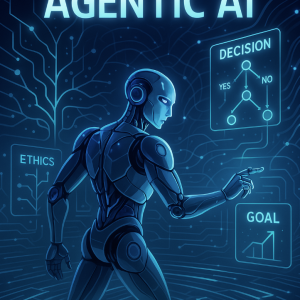
Artificial Intelligence (AI) has been evolving rapidly, moving from rule-based systems to machine learning, and now toward a new frontier: Agentic AI. Unlike traditional AI systems that are passive tools requiring constant human guidance, agentic AI introduces the concept of autonomous, goal-driven agents capable of making decisions, learning from environments, and executing complex tasks with minimal supervision.
In this blog, we’ll explore what Agentic AI is, how it works, why it’s significant, and its potential impact across industries.
What is Agentic AI?
Agentic AI refers to AI systems that operate as independent agents with the ability to:
- Understand goals
- Plan actions
- Make decisions
- Interact with environments
- Adapt and improve over time
These agents don’t just respond to input; they take initiative, making them fundamentally different from prompt-based or reactive AI models like chatbots or recommendation systems.
At its core, an agentic AI system mimics the characteristics of a human agent: autonomy, adaptability, intentionality, and persistence.
Key Components of Agentic AI
To function effectively, an Agentic AI typically includes the following components:
- Goal Setting Module – Understands or receives objectives from users.
- Planning Engine – Breaks down goals into actionable steps or subgoals.
- Memory and Context Management – Maintains awareness of history, ongoing tasks, and past experiences.
- Decision-Making Logic – Chooses optimal actions based on rules, probability, or learned behavior.
- Action Execution – Interacts with tools, APIs, or environments to perform tasks.
- Feedback Loop – Monitors outcomes and adapts behavior based on success/failure.
These systems often integrate large language models (LLMs) with APIs, databases, tools, and sensors—enabling agents to reason and act with purpose.
Examples of Agentic AI in Action
Agentic AI is already being prototyped and deployed in several exciting use cases:
- AutoGPT / BabyAGI: These open-source projects allow AI agents to autonomously run tasks like writing reports, researching topics, or building software.
- Personal AI Assistants: Agents that manage your calendar, write emails, or even negotiate bookings on your behalf.
- Autonomous DevOps: AI agents that monitor infrastructure, detect anomalies, deploy patches, and optimize resources—all with minimal human input.
- AI in Robotics: Drones or robots using Agentic AI to patrol environments, make decisions on the fly, and avoid obstacles without remote control.
Benefits of Agentic AI
- Autonomy: Minimizes the need for manual input or constant monitoring.
- Productivity Boost: Agents can multitask and work 24/7 to complete repetitive or complex workflows.
- Consistency: Unlike humans, AI agents can follow protocols and procedures precisely.
- Scalability: Multiple agents can be deployed in parallel to scale operations without scaling headcount.
Challenges and Considerations
While promising, Agentic AI comes with several challenges:
- Alignment with Human Intentions: Ensuring agents don’t interpret goals in unintended or harmful ways.
- Safety and Control: Autonomous systems must remain controllable and predictable.
- Ethical Concerns: Questions about replacing human roles, data usage, and decision-making transparency.
- Complexity and Cost: Building and maintaining goal-driven agents is more complex than traditional AI workflows.
Future of Agentic AI
The rise of Agentic AI signals a major shift in how we will interact with technology. We’re moving toward a world where intelligent agents act as digital co-workers, capable of collaboration, negotiation, and innovation.
With advancements in multi-agent systems, reinforcement learning, and integration with physical and digital ecosystems, Agentic AI has the potential to reshape everything from enterprise automation to personal productivity, healthcare, finance, and education.
Extra posts:
 MCP & AI Unlocking Agentic Intelligence with a “USB-C Connector” for AI
  Unleashing the Power of Microsoft Fabric and AI A New Era of Data-Driven Intelligence
  Unveiling Microsoft Fabric AI The Future of Data Intelligence
  Unlocking the Future Exploring the Microsoft Device Ecosystem Platform
  Designing and Creating Agentic AI in Azure
  How Agentic AI Works and How to Build It in Azure