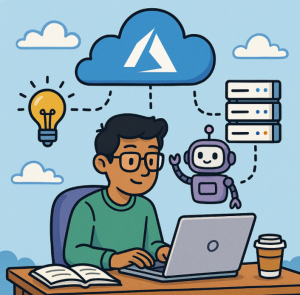
Generative AI has quickly become one of the most transformative technologies in the cloud era, enabling businesses to create content, enhance productivity, and unlock entirely new use cases. With Microsoft Azure’s AI services, developers and organizations can harness powerful generative AI capabilities without the need to build everything from scratch.
In this blog, we’ll explore what generative AI in Azure looks like, the key services available, and how you can get started using them in your applications.
🌐 What is Generative AI in Azure?
Generative AI refers to AI systems capable of producing new content—text, images, code, audio, or even synthetic data—based on learned patterns. Azure makes this technology accessible by providing pre-trained foundation models and developer-friendly APIs that are scalable, secure, and enterprise-ready.
At the core of Azure’s generative AI offerings are:
- Azure OpenAI Service – Access to powerful models like GPT, Codex, and DALL·E for natural language, coding, and image generation.
- Azure Machine Learning – A platform for training, fine-tuning, and deploying custom generative models.
- Cognitive Services – Prebuilt APIs for vision, speech, and language tasks that complement generative AI applications.
⚙️ How to Use Generative AI in Azure
1. Set Up Azure OpenAI Service
The Azure OpenAI Service is the easiest entry point for generative AI. It provides access to OpenAI models via REST APIs or SDKs.
Steps:
- Sign in to the Azure Portal.
- Create a new Azure OpenAI resource in your subscription.
- Once provisioned, navigate to the Playground in the Azure AI Studio to experiment with prompts and outputs.
- Use the provided API keys and endpoint to integrate the models into your applications.
Example: Python Code Snippet
import openai
import os

openai.api_type = "azure"
openai.api_base = os.getenv("AZURE_OPENAI_ENDPOINT")
openai.api_version = "2023-05-15"
openai.api_key = os.getenv("AZURE_OPENAI_KEY")

response = openai.ChatCompletion.create(
    engine="gpt-35-turbo",
    messages=[
        {"role": "system", "content": "You are a helpful assistant."},
        {"role": "user", "content": "Explain quantum computing in simple terms."}
    ]
)

print(response['choices'][0]['message']['content'])
2. Integrate with Azure Cognitive Services
Generative AI can be paired with Azure Cognitive Services to create richer applications:
- Combine GPT with Speech Services for conversational voice bots.
- Use Computer Vision to describe images, then feed those descriptions into generative text models.
3. Fine-Tune and Customize Models
Sometimes, pre-trained models aren’t enough. With Azure Machine Learning, you can:
- Fine-tune large language models on your own domain-specific data.
- Deploy models as endpoints with enterprise-grade monitoring and scaling.
- Use ML pipelines to integrate generative AI into existing business workflows.
4. Build Responsible AI Solutions
Microsoft emphasizes Responsible AI. Azure provides tools to ensure safe and ethical use of generative AI, such as:
- Content filtering to reduce harmful outputs.
- Transparency in model behavior.
- Governance and compliance features for enterprise scenarios.
🚀 Use Cases for Generative AI in Azure
Here are some real-world ways businesses are applying Azure’s generative AI:
- Customer Support: AI-powered chatbots that resolve issues in natural language.
- Content Creation: Automated blog drafts, product descriptions, or marketing copy.
- Code Assistance: Intelligent copilots that speed up software development.
- Data Insights: Summarization and natural language querying of enterprise data.
- Design & Creativity: Generating images, layouts, and prototypes with DALL·E.
Generative AI in Azure allows organizations to move from experimentation to real-world applications at scale. Whether you’re a developer building your first chatbot, or an enterprise seeking to integrate AI into your business processes, Azure provides the tools and infrastructure you need.
Start small—experiment with prompts in Azure OpenAI Studio—and gradually build more complex solutions by combining generative AI with Cognitive Services, Azure ML, and your own data.
The future of AI is generative, and with Azure, it’s within reach.
Extra posts:
 Azure AI Studio / Azure AI Foundry A Powerful Platform for Generative AI
  Understanding Azure AD Tenants, Users, Groups, and Roles: A Practical Guide
  Azure AI Adoption Framework A Strategic Guide for Organizations
  Machine Learning in Azure A Beginner’s Guide to Building Intelligent Solutions
  A Comprehensive Guide to Getting Started with GitHub Copilot For End Users
  Retrieval-Augmented Generation (RAG) in Azure AI A Step-by-Step Guide