
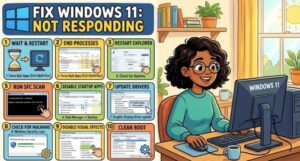
10 Ways to Get Your PC Working Again
ew things are more frustrating than sitting in front of your computer, clicking an app, and getting absolutely nothing in return. Your mouse may still move, but programs freeze, windows stop opening, or the entire desktop becomes sluggish. If Windows 11 is not responding, it can be difficult to know whether you should wait, restart, or start troubleshooting.
The good news is that a frozen Windows 11 PC does not necessarily mean there is a serious hardware problem. Temporary software glitches, too many background processes, insufficient storage, outdated drivers, corrupted system files, overheating, and problematic applications can all cause Windows to stop responding.
In this guide, we’ll walk through 10 practical ways to fix Windows 11 when it is not responding. Start with the simpler solutions and move toward the more advanced ones if the problem continues.
1. Give Windows a Moment to Recover
Before forcing your computer to shut down, give it a little time.
Sometimes Windows appears frozen because an application is performing a demanding task in the background. This can happen when opening a large file, installing an update, launching a resource-intensive application, or working with a large number of browser tabs.
Wait for a minute or two and see whether the system becomes responsive again.
If your mouse moves and some parts of Windows still respond, avoid immediately holding down the power button. A forced shutdown can cause unsaved work to be lost.
However, if the computer remains completely frozen for several minutes, it’s time to move on to the next step.
2. Close the Frozen Application
If only one application has stopped responding, the problem may be with that particular program rather than Windows 11 itself.
Try pressing Alt + F4 to close the active application. If that doesn’t work, open Task Manager by pressing:
Ctrl + Shift + Esc
In Task Manager, look for the application marked as Not responding. Select it and choose End task.
This will close the application and may immediately restore normal performance.
Keep in mind that ending a task can result in unsaved work being lost, so use it when the application genuinely refuses to recover.
3. Restart Windows 11
A simple restart can fix a surprising number of temporary Windows problems.
If your desktop is still responding, click Start > Power > Restart.
You can also press Ctrl + Alt + Delete and use the power option from the screen that appears.
Restarting clears temporary memory, closes stuck processes, and gives Windows a clean start. If your PC has been running for days or weeks without a restart, this is especially worth trying.
If Windows is completely frozen and you cannot access the Start menu or security screen, you may need to hold the physical power button until the PC shuts down. Use this only as a last resort because it can interrupt disk operations and cause data loss.
4. Check Task Manager for Resource-Hungry Processes
If Windows 11 keeps becoming unresponsive, Task Manager can help identify what’s causing the slowdown.
Press Ctrl + Shift + Esc and examine the Processes tab.
Pay attention to:
- CPU usage
- Memory usage
- Disk usage
- Network activity
- Applications consuming unusually high resources
If one application is using nearly all your CPU or memory, it could be responsible for the freezing.
For example, having dozens of browser tabs open alongside video editing software, games, cloud synchronization, and other applications can put significant pressure on system resources.
Close applications you don’t need and see whether Windows becomes responsive again.
5. Disable Unnecessary Startup Programs
Some computers become extremely slow shortly after Windows starts because too many applications launch automatically.
To check startup applications, open Task Manager and select Startup apps.
Review the programs listed there and look for applications you don’t need to start automatically. You can disable unnecessary startup items, particularly programs that consume significant resources.
Be careful not to disable essential Windows components or hardware-related utilities if you aren’t sure what they do.
Reducing startup programs can help Windows 11 boot faster and leave more memory and processing power available for the applications you actually use.
6. Update Windows 11
An outdated version of Windows can sometimes cause compatibility problems, bugs, or performance issues.
To check for updates, go to:
Settings > Windows Update
Select Check for updates and install available updates.
Microsoft regularly releases Windows updates containing security improvements, bug fixes, stability improvements, and compatibility changes.
After installing updates, restart your PC and check whether the freezing problem has disappeared.
If the issue started immediately after a specific update, however, the update itself could potentially be involved. In that situation, further troubleshooting may be necessary rather than repeatedly installing updates.
7. Update Your Device Drivers
Drivers allow Windows to communicate correctly with your hardware. Problems with graphics, network, storage, chipset, or other drivers can sometimes cause Windows 11 to freeze or become unstable.
Open Device Manager and review devices for warning symbols. Pay particular attention to graphics adapters, storage controllers, network adapters, and other hardware connected to your system.
For graphics drivers, it is often best to obtain the latest compatible driver directly from your computer manufacturer’s support page or the graphics hardware manufacturer’s official website.
If Windows started freezing after a driver update, you may also want to investigate whether rolling back that particular driver resolves the problem.
8. Run Windows System File Checker
Corrupted Windows system files can cause unexpected crashes, freezes, and applications that refuse to respond.
Windows includes a built-in tool called System File Checker, commonly known as SFC, that can scan protected system files and attempt to repair damaged ones.
To run it, search for Command Prompt, right-click it, and choose Run as administrator.
Then run:
sfc /scannowAllow the scan to finish. Depending on your computer, this may take some time.
If SFC finds damaged files, it will attempt to repair them automatically. Restart your computer afterward and check whether Windows is behaving normally.
9. Check Your Storage and Free Up Space
A Windows installation with very little free storage can experience performance problems.
Open Settings > System > Storage to see how much space is available.
If your system drive is almost full, consider removing temporary files, uninstalling applications you no longer use, emptying the Recycle Bin, and moving large personal files to another drive or cloud storage.
You don’t need to keep your drive completely empty, but maintaining reasonable free space gives Windows room for temporary files, updates, caching, and other operations.
Also consider checking the health of your storage drive if freezing happens frequently, especially when Windows is accessing files or launching programs.
10. Boot Into Safe Mode to Find the Cause
If Windows 11 continues to freeze, Safe Mode can help determine whether a third-party application or driver is responsible.
Safe Mode starts Windows with a limited set of drivers and services. If your computer works normally in Safe Mode but freezes during a regular startup, that can be a useful clue.
You can access Windows recovery options through Settings > System > Recovery and use the advanced startup options.
From the recovery environment, navigate to the startup settings and restart into Safe Mode.
Once there, check whether the freezing continues. If the problem disappears, recently installed applications, drivers, utilities, or startup services may deserve closer attention.
What If Windows 11 Is Still Not Responding?
If you’ve tried all 10 solutions and Windows continues freezing, the problem may be deeper than a temporary software issue.
Possible causes include failing RAM, a deteriorating SSD or hard drive, overheating, faulty hardware, incompatible software, or a damaged Windows installation.
Pay attention to patterns. Does the computer freeze when gaming? Does it happen when opening large files? Does it occur shortly after startup? Does the system become unresponsive only when a particular application is running?
These details can help narrow down the cause.
You should also back up important files before performing major repairs or resetting Windows. If hardware failure is suspected, continuing to use the computer without a backup could put important data at risk.

When Windows 11 is not responding, there’s no need to panic. In many cases, the problem is caused by a temporary application freeze, excessive resource usage, outdated software, unnecessary startup programs, or corrupted system files.
Start with the basics: wait briefly, close the frozen application, restart Windows, and check Task Manager. If the problem keeps coming back, move on to Windows updates, driver checks, system file repairs, storage cleanup, and Safe Mode troubleshooting.
The most important thing is to look for a pattern rather than repeatedly forcing the computer to shut down. A one-time freeze may be harmless, but frequent freezes are a sign that something deserves investigation.
With these 10 troubleshooting methods, you can often identify the cause of a Windows 11 PC not responding and get your computer working normally again without immediately resorting to a complete Windows reinstall.
Extra posts:
 How to Fix Windows 11 Problems Without Calling IT
  Why Is My Windows 11 Sandbox Not Working? 10 Ways to Fix It
  Windows 11 Update Stuck? Here’s How to Fix It (Expert Guide)
  How to Fix 100% Disk or CPU Usage in Windows 11
  Can I Rollback a Windows 11 Update? A Complete Guide to Reverting Windows Updates Safely
  Windows 10 Extended Security Updates: A Bridge to Your Windows 11 Experience