
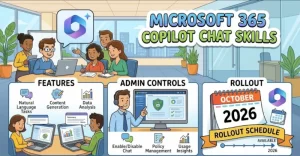
Microsoft is introducing customizable skills in Microsoft 365 Copilot Chat, giving employees a way to tailor AI assistance to specific tasks while allowing IT administrators to control how these capabilities are deployed across their organizations. The worldwide rollout is scheduled to begin in October 2026, with completion expected by mid-November.
The update introduces reusable task-specific instructions that can include supporting files or scripts. Users will be able to create, edit, upload, and share skills, while administrators can deploy, install, block, and review skills and compatible plugins through the Microsoft 365 admin center.
The release also connects skills more closely with Microsoft’s broader AI ecosystem. Skills will work across Copilot Chat and Copilot Cowork, while the Agent Store will expand to include plugins containing skills alongside existing agent offerings.
For businesses exploring practical uses for generative AI, the announcement signals a move toward more consistent, configurable AI workflows. It also places greater emphasis on administrative oversight, access management, and the distinction between personal customization and organization-wide deployment.
What Are Microsoft 365 Copilot Chat Skills?
Copilot Chat skills are reusable sets of task-specific instructions designed to help Microsoft 365 Copilot handle particular requests more consistently.
Instead of explaining the same process every time they interact with the assistant, users can create a skill that describes how a recurring task should be completed. Depending on the task, that skill can also include supporting files or scripts.
For example, an employee might create a skill that instructs Copilot to summarize meeting notes using a standard format, prepare project updates with consistent headings, or organize research into a predefined briefing structure.
These are illustrative use cases rather than a list of prebuilt skills announced by Microsoft.
The central idea is straightforward: users can give Copilot more context about how they want a particular job done, without having to repeat those instructions in every conversation.
Copilot can automatically invoke a relevant skill when a request matches its purpose. Users can also disable automatic invocation or explicitly select a skill through the new “Agents and Skills” section in Context IQ.
That flexibility matters because not every task requires specialized instructions. Users retain a choice between letting Copilot identify a relevant skill and selecting one themselves.
Key Features in the October 2026 Update
Microsoft’s announcement covers several connected capabilities that affect both everyday users and enterprise administrators.
1. Users Can Create, Edit, Upload, and Share Skills
Employees will be able to build skills around their individual workflows, revise existing instructions, upload skills they already have, and share user-created skills with others.
They will also be able to use skills deployed by their organization’s administrators and public skills published by independent software vendors (ISVs).
This creates multiple routes for adopting reusable AI instructions. Teams can develop their own approaches, administrators can distribute approved resources, and software vendors can publish skills for users who need specialized functionality.
However, sharing is subject to an important limitation. In tenants with Information Barriers enabled, users will initially be able to create skills for personal use and access eligible administrator-deployed or publicly published skills, but sharing their own skills will not be supported at launch.
Microsoft says this sharing capability will be enabled in the future in accordance with Information Barriers policies.
2. Administrators Gain Centralized Deployment Controls
The new capabilities extend beyond individual productivity. Microsoft 365 administrators will be able to manage skills and plugins containing skills through the Microsoft 365 admin center.
The available controls include the ability to:
- Deploy and install skills or compatible plugins.
- Block skills and plugins when necessary.
- Publish or install tools for intended users or groups.
- Review user-created skills through the administrative Tools inventory.
These controls give IT teams a central place to oversee the growing collection of AI tools available to employees.
Organizations can use this model to determine which tools should be available to specific departments or groups, while reviewing user-created resources that may become relevant to broader governance efforts.
Microsoft also points administrators to role-based access control (RBAC) and user- or group-level access management. These capabilities are particularly relevant to organizations that need to balance employee flexibility with internal policies.
For implementation details, administrators can consult Microsoft’s Agent Tools overview.
3. The Agent Store Expands to Include Plugins
Microsoft is expanding the Agent Store experience in Copilot Chat to make agents, skills, and plugins containing skills discoverable in one place.
This change should make it easier for employees to find tools relevant to their work without relying exclusively on manually supplied instructions or separate deployment processes.
There is, however, a distinction between plugins that contain skills and connector-only plugins.
According to the announcement, discovering connector-only plugins directly in the Agent Store is not included in this release. That capability is planned as a follow-up, while connectors will remain available through the Data Sources menu in Copilot Chat in the meantime.
The distinction is important for organizations planning deployments. The expanded Store should not yet be treated as a complete catalog of every available connector or plugin.
Microsoft has also announced a centralized plugin registry initiative. Administrators evaluating the broader management experience can read the Microsoft Copilot plugin registry announcement.
4. Skills Work Across Copilot Chat and Copilot Cowork
The release extends the usefulness of skills across two Microsoft experiences: Copilot Chat and Copilot Cowork.
Skills created in Copilot Chat can also be used in Cowork. Plugins deployed through the Microsoft 365 admin center will likewise be available in both experiences.
The reverse direction comes with a qualification. Skills created in Copilot Cowork will be available in Copilot Chat only when they are shared.
This asymmetry is worth noting for organizations developing internal guidance around AI workflows. Teams should understand where a skill was created, how it is shared, and which users can access it before treating it as a common organizational resource.
Microsoft also says that user-built skills and plugins created with WIQ Dev Tools or Agents Toolkit will be available in Copilot Chat.
For developers, that provides another route to bringing custom tools into the Copilot experience. More information about WIQ Dev Tools is available in Microsoft’s developer announcement.
Microsoft 365 Copilot Skills Rollout Schedule
Microsoft’s published schedule sets October 2026 as the beginning of the worldwide general availability rollout.
| Milestone | Expected timing |
|---|---|
| Worldwide general availability begins | October 2026 |
| Expected completion of worldwide rollout | Mid-November 2026 |
| Information Barriers tenant rollout | November 2026 |
These dates describe the announced rollout schedule, not a guarantee that every organization will receive the functionality on the same day.
As of October 12, 2026, the rollout window is underway according to Microsoft’s schedule. Organizations should check their own Microsoft 365 admin center and relevant Message Center notifications to confirm availability in their tenants.
Information Barriers tenants have a separate consideration. Their rollout is scheduled for November, and their initial experience will restrict the sharing of user-created skills.
Information Barriers are designed to help organizations control communication and collaboration between defined groups. In this context, the sharing limitation makes it especially important to distinguish personal skills from resources that can be distributed across teams.
How Administrators Can Deploy Skills and Plugins
Organizations preparing for the release can begin by reviewing their existing Copilot governance processes and deciding which users or groups should have access to new tools.
Microsoft’s recommended deployment route for a plugin containing skills is through the Microsoft 365 admin center.
The process is as follows:
- Open the Microsoft 365 admin center.
- Navigate to Agents > Tools > Upload.
- Upload the plugin app package.
- Publish or install the plugin for the intended users or groups.
- Review the available skills and plugins inventory in the admin center’s Tools area.
Administrators should also review which skills users create in Copilot Chat and assess how those resources fit into existing access policies.
Microsoft provides additional guidance in its Tools Registry documentation.
A measured rollout can help IT teams understand how employees use the feature before expanding availability. It can also clarify which tasks benefit from reusable instructions and where more formal review may be appropriate.
Security, Compliance, and Governance Considerations
The addition of customizable skills introduces a practical governance question: how should organizations manage instructions, supporting files, scripts, and plugins that employees use to guide AI-assisted work?
Microsoft states that the feature follows the data residency and processing commitments of its parent service. It also supports role-based access control, with administrators able to manage access through the admin interface at user and group level.
These commitments provide a governance framework, but they do not remove the need for organizations to establish their own internal practices.
Before broad deployment, IT and security teams should consider several steps:
- Define access policies: Determine which employees or groups can use particular skills and plugins.
- Review uploaded resources: Establish appropriate checks for supporting files, scripts, and plugin packages before organizational deployment.
- Monitor the available inventory: Use the Tools Registry to review the skills and plugins visible to administrators.
- Clarify sharing rules: Explain how personal skills differ from approved or shared resources, particularly in Information Barriers environments.
- Set expectations for employees: Provide guidance on when to use approved skills and how to report issues with AI-generated outputs.
These are recommended governance practices, not additional controls that Microsoft has explicitly promised as part of this announcement.
The broader point is that customization and oversight need to develop together. A skill may improve consistency for a routine task, but organizations still need to evaluate whether its instructions and outputs are appropriate for the intended use.
What the Update Means for Businesses
For employees, the immediate attraction is convenience. Reusable instructions can reduce repetitive prompting and help people follow consistent formats when handling recurring tasks.
For teams, shared skills could eventually help standardize routine work, provided the relevant sharing and access arrangements are supported.
For IT departments, the release offers a more centralized approach to managing the tools that shape employees’ AI interactions. The ability to deploy, block, and review skills and plugins becomes increasingly relevant as AI adoption expands beyond isolated experiments.
Software vendors and developers also have an opportunity to make specialized capabilities easier to discover through the evolving Agent Store and the integration of developer-built tools.
Still, availability alone will not determine the value of these features. The quality of the instructions, the suitability of the underlying workflow, the permissions assigned to users, and the reliability of the resulting output will all influence adoption.
Organizations should therefore evaluate skills against concrete tasks rather than assuming that every process will benefit from customization. A useful starting point is to identify repetitive, low-risk activities where standardized instructions could improve consistency without removing necessary human review.
What Happens Next?
The next important milestone is the completion of Microsoft’s worldwide rollout, expected by mid-November 2026, followed by the scheduled November rollout for Information Barriers tenants.
Organizations will also be watching for the planned expansion of connector-only plugin discovery in the Agent Store and future support for sharing user-created skills in Information Barriers environments.
These developments will help determine how easily skills can move from individual experimentation to repeatable team workflows.
For now, businesses can prepare by reviewing administrative access, checking their deployment processes, identifying suitable initial use cases, and monitoring Microsoft’s release communications for tenant-specific updates.
The longer-term question is not simply how many skills employees can create. It is whether organizations can make those skills discoverable, useful, and appropriately governed across the tools and teams that rely on Microsoft 365 Copilot.
Extra posts:
 Microsoft 365 Copilot Gets an Outlook Upgrade: Draft Emails Right Inside Copilot Chat on Mobile
  Microsoft 365 Copilot Is Changing How Code Appears in Chat: What Users Need to Know
  Microsoft Pauses Rollout of Copilot-Powered SharePoint Page Authoring: What Organizations Need to Know
  Microsoft Brand Kit Adds Custom Presentation Skills for Copilot in PowerPoint
  Microsoft Copilot Pricing Is Changing: Usage-Based Billing and New FinOps Controls Arrive
  Microsoft Copilot URL Is Changing: Organizations Must Allow copilot.cloud.microsoft Before October