
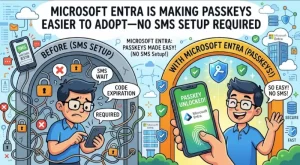
Microsoft Entra ID is preparing to let users register passkeys and passwordless sign-in as their first multifactor authentication (MFA) method, eliminating the previous requirement to configure SMS or voice authentication first. The change, announced in an update dated October 8, 2026, is designed to reduce registration friction and help organizations adopt phishing-resistant authentication more easily.
The rollout will take place in phases, starting in late October 2026 for the first group of supported authentication methods. Microsoft says administrators will not need to take action to enable the change, although reviewing existing authentication policies and user onboarding guidance is recommended.
For businesses relying on Microsoft Entra ID to secure employee access, the update addresses a practical challenge: making stronger authentication available without forcing users through an initial setup process built around less secure methods.
What Is Changing in Microsoft Entra ID?
Until now, users generally needed to register an alternative multifactor authentication method, such as SMS or a voice call, before adding certain passwordless credentials. These included FIDO2 passkeys, Windows Hello for Business and macOS Platform SSO.
That requirement created an additional step for users and could encourage organizations to establish weaker authentication methods before introducing stronger alternatives.
Under the planned change, eligible users who have not registered an MFA method will be able to begin with a supported passkey or passwordless sign-in method instead. Microsoft also plans to support Microsoft Authenticator passwordless sign-in as a user’s first registered MFA method.
The change covers several authentication technologies within Microsoft Entra ID, but support will arrive in stages rather than becoming available for every method simultaneously.
Why Passkey-First Registration Matters
Multifactor authentication helps protect accounts by requiring additional verification beyond a password. However, not all authentication methods offer the same level of protection against modern attacks.
SMS and voice-based verification can be exposed to threats such as SIM swapping, social engineering and interception. Passkeys use public-key cryptography and are designed to resist phishing by binding authentication to the legitimate website or service.
This distinction matters in enterprise environments, where a compromised account can provide access to corporate email, business applications, internal documents and sensitive information.
By allowing users to register a stronger method first, Microsoft is addressing a usability barrier that can slow security improvements. Instead of asking employees to establish a less secure method before setting up a passkey, organizations can move directly toward their preferred authentication approach.
The expected benefits include:
- Simpler onboarding: Fewer steps for employees setting up authentication for the first time.
- Stronger account protection: An easier path to phishing-resistant authentication methods.
- Less dependence on SMS and voice: Organizations can avoid making these methods a prerequisite for passkey adoption.
- More consistent security practices: IT teams can align onboarding instructions with their preferred authentication policies.
These benefits depend on how organizations configure their authentication methods and registration requirements. Removing the extra setup step does not automatically mean every user will register a passkey.
Microsoft Entra Passkeys: Rollout Timeline for 2026–2027
Microsoft has outlined two rollout phases for worldwide and Government Community Cloud (GCC) environments.
Phase 1: Initial passkey support
The first phase covers:
- Synced passkeys.
- Microsoft Entra passkeys on Windows.
- FIDO2 security keys.
According to the October 8 update, general availability is scheduled to begin in late October 2026, with completion expected by late November 2026. These dates replace the earlier estimates of early October and mid-November, respectively.
Phase 2: Additional passwordless methods
The second phase covers:
- Windows Hello for Business.
- macOS Platform SSO.
- Passkeys in Microsoft Authenticator.
- Microsoft Authenticator passwordless sign-in.
The supplied announcement lists early January 2026 as the start date and late February 2027 as the expected completion date. Because January 2026 is already in the past, administrators should verify the start date against Microsoft’s latest service announcement before planning deployments. The stated completion target is late February 2027.
Organizations should also remember that phased availability means the feature may not appear in every tenant at the same time.
Who Will Be Affected?
The change primarily affects two groups: users who have not yet registered an MFA method and administrators responsible for authentication onboarding and registration policies.
For employees, the practical difference is straightforward. Eligible users will no longer need to register SMS or voice authentication before setting up a supported passkey or passwordless sign-in method.
For IT and security teams, the change provides greater flexibility when designing registration experiences. Organizations that already encourage passkey adoption can make their onboarding instructions more direct, while those with specific verification requirements can continue to enforce their existing controls.
The update applies to the Microsoft Entra ID authentication ecosystem, including FIDO2 passkeys, Windows Hello for Business, macOS Platform SSO and Microsoft Authenticator passwordless capabilities, subject to the relevant rollout phase and configuration.
What Administrators Should Do Before the Rollout
Microsoft says no administrative action is required for the change itself. Even so, a small amount of preparation can help organizations avoid confusion and ensure that the new registration flow aligns with their security policies.
1. Review Conditional Access policies
Administrators should review Conditional Access policies that govern access to security information registration. These policies can determine whether users must complete additional verification before adding or changing authentication methods.
Organizations that require a higher level of assurance during registration should confirm that their policies continue to meet that requirement.
2. Check authentication method policies
Microsoft Entra administrators retain control over the methods users can register through existing authentication method policies and Conditional Access configurations.
Review which passkey types and passwordless options are permitted, which users are in scope, and whether any restrictions could affect the intended onboarding experience.
3. Update employee onboarding guidance
User-facing documentation should explain which authentication method employees are expected to configure first and how to complete the process.
If passkeys are the organization’s preferred option, make that clear in setup guides, help desk documentation and new-employee onboarding communications. Avoid instructing users to register SMS or voice authentication first unless organizational requirements make that necessary.
4. Plan support for different devices
Passkeys and passwordless options differ in where credentials are stored and how users access them. Synced passkeys can be available across supported devices through a passkey provider, while device-bound credentials may be tied to a particular authenticator or device.
IT teams should make sure their instructions reflect the methods supported by their environment and explain what employees should do if they change devices or need to recover access.
Does the Change Introduce New Security Controls?
The announcement does not describe a new standalone administrative control. Instead, it extends the registration experience while preserving existing policy-based governance.
Administrators will continue to manage the authentication methods users are permitted to register and apply Conditional Access requirements where appropriate.
This is an important distinction: making a passkey the first registered method is not the same as mandating passkeys for every user, nor does it remove the need for carefully designed access policies.
Organizations should assess the change alongside their broader identity security strategy, including account recovery, device management, privileged access and monitoring of authentication activity.
The Bigger Picture: Moving Beyond SMS-Based Authentication
The update arrives as enterprise identity security increasingly prioritizes authentication methods that can withstand phishing attacks. Passkeys reduce reliance on shared secrets and one-time codes, helping organizations strengthen the sign-in experience without necessarily adding more steps for employees.
The onboarding change also reflects an important lesson in security implementation: even effective controls can face adoption barriers when the setup process is unnecessarily complicated.
Removing the requirement to configure SMS or voice first will not solve every authentication challenge. Organizations will still need appropriate policies, recovery procedures, user education and support for different devices. However, it removes one obstacle between users and stronger sign-in methods.
What Happens Next?
The next milestone is the first rollout phase, expected to begin in late October 2026 and finish by late November. Organizations should monitor Microsoft’s service communications for confirmation of availability and any adjustments to the published schedule.
For now, administrators can review their registration policies, verify their supported authentication methods and prepare clearer passkey-first onboarding instructions.
As passwordless authentication becomes more accessible, the organizations best positioned to benefit will be those that combine stronger credentials with straightforward registration, consistent policy enforcement and a practical plan for account recovery.
Official resource: Register a synced passkey (FIDO2) — Microsoft Learn
Editorial note: The Phase 2 start date in the supplied announcement appears inconsistent with the October 2026 update date. Confirm the latest Microsoft timeline before publication.
Extra posts:
 Microsoft Teams Is Making External File Sharing Easier Here’s What IT Admins Need to Know
  Microsoft Defender for Endpoint Android Update Required: What Organizations Need to Know Before September 2026
  Microsoft Planner Is Getting a New Capacity View to Make Team Workloads Easier to See
  Microsoft Teams Mobile Gets a Fresh Look: New Chat and Channel Dashboard Makes Navigation Easier
  SharePoint OTP Retirement Is Coming: Microsoft Entra B2B Migration Starts October 2026
  OneDrive’s 520-Character Fix: Microsoft Makes Windows Sync Errors Easier to Solve