
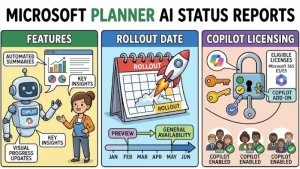
Microsoft is bringing AI-generated project status reports to Microsoft Planner through Planner Agent in Microsoft 365 Copilot, giving eligible users a new way to turn project task data into structured progress updates. The feature is designed to summarize project status, completed work, risks, blockers, milestones, and next steps without requiring users to compile every detail manually.
According to Microsoft’s feature announcement, worldwide general availability is scheduled to begin in late October 2026, with rollout expected to finish by mid-November 2026. The public preview rollout has already completed, and Microsoft says organizations do not need to take any mandatory action to receive the update.
The change could be particularly useful for project managers, department leaders, and teams that regularly prepare updates for executives or other stakeholders. However, access depends on licensing, existing permissions, and whether the underlying Planner plan contains enough information to generate a meaningful report.
What Is Changing in Microsoft Planner?
The new capability introduces AI-powered status report generation through Planner Agent, which is available within the Microsoft 365 Copilot experience. Rather than manually collecting task updates and organizing them into a report, users can ask the agent to generate a summary based on information available in an eligible Planner plan.
The feature is intended to transform everyday project management data into a more readable account of what is happening across a project. That includes information about tasks, assigned owners, due dates, task status, buckets, and recent activity.
Depending on the selected reporting options, generated reports can include:
- An executive summary of the project’s current position.
- Progress updates highlighting completed and ongoing work.
- Risks, blockers, and potential obstacles.
- Achievements and significant milestones.
- Recommended next steps and follow-up actions.
The goal is to reduce the administrative work involved in communicating project progress while making relevant information easier for different audiences to understand.
Importantly, this is an additional Planner capability, not a replacement for existing task management features. Teams can continue using Planner to organize work, assign responsibilities, track deadlines, and monitor project activity as before.
How AI-Generated Status Reports Work
The reporting process begins with the information already available in a user’s Planner environment. When an authorized user requests a report, Planner Agent draws on accessible plan data and organizes the information into a structured document.
Users can customize the output before generating the report, which provides flexibility for different reporting situations. A short update for a department head, for example, may require a different level of detail from a comprehensive project review intended for a delivery team.
Microsoft identifies several customization options:
- Audience: Tailor the report for executives, project stakeholders, or team members.
- Tone: Adjust how the report communicates progress and concerns.
- Length: Request a concise overview or a more detailed account.
- Reporting period: Focus on a relevant timeframe.
- Report sections: Choose which elements should appear in the output.
- Additional instructions: Provide further guidance on what the report should emphasize.
After generation, users can review and refine the content. This review step matters because AI-generated summaries should be checked against the underlying project information before being distributed as formal updates.
For teams that prepare recurring reports, the feature may help establish a more consistent reporting process. Instead of starting from a blank document each time, project managers can use existing task data as the foundation and concentrate on validating the information and adding context where necessary.
Microsoft Planner AI Status Reports: Rollout Timeline
Microsoft’s announcement sets out two rollout milestones for organizations worldwide.
| Deployment stage | Status or expected timing |
|---|---|
| Public preview | Rollout completed |
| General availability begins | Late October 2026 |
| Expected general availability completion | Mid-November 2026 |
The general availability schedule means eligible organizations should expect the feature to arrive progressively rather than necessarily appearing for every user on the same day.
As with other Microsoft 365 deployments, administrators should monitor their organization’s service communications and confirm availability in their own environment. The published timeline is an expected rollout window, not a guarantee that every tenant will receive the feature simultaneously.
Microsoft says no mandatory administrative action is required simply to receive the update. Nevertheless, organizations may want to review their existing Copilot and Planner Agent settings before the feature becomes available to users.
Who Can Generate Reports? Understanding Copilot Licensing
Licensing is one of the most important practical details in this update.
Users need an active Microsoft 365 Copilot license to generate AI-powered status reports through Planner Agent. The organization must also have Planner Agent enabled as part of the Microsoft 365 Copilot app.
There is, however, an important distinction between generating a report and accessing one that has already been created.
According to Microsoft’s announcement, users who view or edit generated reports do not need a Microsoft 365 Copilot license. The Copilot license requirement applies specifically to report generation.
This distinction could make it easier to distribute reports across a project team or leadership group without requiring every recipient to hold the same Copilot license.
Organizations should still review their own licensing arrangements, sharing configurations, and internal policies before adopting the feature for routine reporting.
Another prerequisite concerns the underlying plan: report generation requires a plan that is shared with a Microsoft 365 Group and contains sufficient task data. A sparsely populated plan or one without meaningful status updates may not provide enough information for a useful report.
Exporting, Sharing, and Reusing Generated Reports
The new feature is designed to support workflows beyond the initial Copilot conversation.
Once a report has been generated and reviewed, users can export it to a Copilot Page and share it through a link. Reports can also be exported to Microsoft Word or PDF, providing familiar formats for stakeholder communications, project reviews, and internal documentation.
These options give teams flexibility in how they distribute project information. A Copilot Page may be useful for collaborative access, while a Word document or PDF may better suit a formal reporting process or an established document archive.
The ability to reuse generated content could also reduce the time spent transferring information between project management tools and reporting documents. Still, teams should establish clear practices for reviewing, storing, and sharing reports, particularly when they contain sensitive project information.
Data Access, Security, and Compliance Considerations
AI-generated reporting introduces questions about how project data is processed and where the resulting reports are stored.
Microsoft states that Planner Agent generates reports using information from plans the requesting user is already authorized to access. Existing Planner sharing permissions, Copilot policies, and agent controls continue to apply, and the feature does not grant access to plans that the user cannot access.
The announcement also clarifies that generating a report does not edit the original Planner plan or its tasks. The feature creates a separate reporting output rather than changing the underlying project records.
However, the reporting process does introduce additional data handling. A generated status report appears in the Microsoft 365 Copilot conversation. If a user exports the report, a copy is also saved as a Copilot Page or Word document, depending on the selected option.
Organizations should therefore consider several points before incorporating the feature into established workflows:
- Permission management: Confirm that users have appropriate access to the plans and information used in reports.
- Information sharing: Review who can access exported documents and shared Copilot Pages.
- AI governance: Check applicable Copilot policies and Planner Agent controls.
- Accuracy and accountability: Require appropriate review before reports are used for formal decisions.
- Recordkeeping: Determine how generated reports should be retained, shared, and managed under internal policies.
Microsoft also notes that an attached file used as a reporting template may be incorporated into the request. Teams should account for that possibility when selecting templates and handling confidential material.
These considerations do not mean the feature bypasses existing controls. Rather, they highlight the importance of managing the new report outputs alongside the task data from which they are produced.
What Project Managers and IT Administrators Should Do
Although the rollout does not require mandatory action, some preparation could help organizations make practical use of the feature.
For IT administrators:
- Confirm that intended report generators have active Microsoft 365 Copilot licenses.
- Review Planner Agent availability and Copilot agent settings in the Microsoft 365 admin center.
- Determine whether the organization needs to restrict or block the agent tenant-wide.
- Update internal guidance on data access, document sharing, and AI-generated content.
For project managers and team leaders:
- Keep task owners, deadlines, statuses, and recent activity up to date.
- Check that eligible plans are shared with a Microsoft 365 Group.
- Experiment with different audiences, reporting periods, and report sections.
- Review generated summaries for missing context, inaccurate interpretations, and unsupported conclusions.
- Establish a consistent process for approving and distributing reports.
The quality of the output will depend in part on the quality of the underlying project information. AI can organize available data into a coherent report, but it cannot reliably compensate for missing task updates or undocumented decisions.
Why This Update Matters for Workplace Productivity
Project status reporting is a recurring responsibility across many organizations. Although the task may appear straightforward, producing a useful update often involves collecting information from multiple owners, identifying delays, checking milestones, and rewriting technical details for different audiences.
Planner Agent’s new capability targets that administrative burden by making existing task information the starting point for a report. The potential benefit is not simply faster writing; it is the opportunity to spend less time assembling routine updates and more time interpreting risks, resolving blockers, and coordinating work.
The feature may be especially useful for teams that already maintain their projects consistently in Planner. Organizations that rely on disconnected spreadsheets, informal chat updates, or incomplete task records may need to improve their information practices before they can realize the same benefits.
There are also limits to what automated reporting can accomplish. A task marked complete does not necessarily explain whether the wider project remains on schedule, and a list of overdue items does not automatically reveal the cause or business impact of a delay. Human judgment remains important when translating project data into decisions.
What Comes Next for Microsoft Planner?
The worldwide general availability rollout expected from late October through mid-November 2026 will be the next milestone for organizations waiting to use AI-generated status reports in their production environments.
As access expands, the practical test will be whether teams can integrate the feature into existing reporting routines without compromising accuracy, security, or accountability. Organizations that prepare their plans, review their licensing, and establish sensible approval practices will be better positioned to evaluate its usefulness.
For Microsoft Planner users, the update adds another way to turn routine project tracking into stakeholder-ready information. Its long-term value will depend less on generating reports automatically and more on how effectively teams use those reports to identify problems, communicate progress, and make informed decisions.
Extra posts:
 Understanding Microsoft 365 Mail Flow Status and Threat Protection Status Reports
  Microsoft 365 Copilot Chat Skills: Features, Admin Controls, and October 2026 Rollout
  Microsoft Planner Lands Inside Outlook and Copilot: A Major Productivity Upgrade for Microsoft 365 Users
  Microsoft OneDrive Pay-As-You-Go Storage: Preview, Pricing Model and 2026 Rollout
  Microsoft 365 Copilot Licensing Shake-Up Explained
  Microsoft Pauses Rollout of Copilot-Powered SharePoint Page Authoring: What Organizations Need to Know