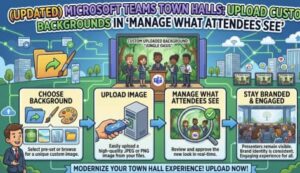
Microsoft Teams is giving organizations another way to make virtual town halls look more polished, professional and unmistakably on-brand. The company is rolling out support for custom background images inside the “Manage what attendees see” experience for Teams town halls, allowing eligible organizers and presenters to replace default visual backgrounds with their own branded designs.
The update is particularly relevant for organizations that use Teams town halls for executive announcements, company-wide meetings, product launches, internal communications and other large-scale events where presentation quality matters.
According to the updated Microsoft 365 roadmap information, associated with Roadmap ID 561493, the rollout began in early June 2026, with worldwide General Availability expected to complete by the end of August 2026. Microsoft updated the timeline on August 5, 2026, after previously planned dates shifted.
The change may look like a small visual enhancement, but for companies that regularly produce large virtual events, it addresses an important part of the attendee experience: what appears behind speakers and shared content while an event is live.
A More Professional Look for Teams Town Halls
Town halls are designed differently from ordinary Teams meetings. They are largely one-to-many experiences, with the focus placed on speakers, presentations and information rather than on an open conversation between everyone in the meeting.
Microsoft already provides production controls that allow organizers and presenters to decide who appears on screen, manage presenters and control the attendee-facing view. The new custom-background capability builds on that production model.
Instead of relying solely on Microsoft’s default backgrounds, eligible users will be able to upload an image directly within Manage what attendees see. That image can then appear behind presenters and shared content in supported town hall layouts.
For businesses, this opens the door to much stronger visual consistency.
A company could use its corporate logo, brand colors, a campaign graphic or a specially designed background for an annual employee meeting. A product team could create an event-specific backdrop for a product launch. An executive communications team could use a consistent visual identity across quarterly business updates.
The result is a town hall that feels less like a standard video meeting and more like a professionally produced digital event.
What Is Changing?
The central change is straightforward: custom background images can be uploaded within the Manage what attendees see experience.
The update includes several important details:
- The feature is intended for organizers and presenters of Teams town halls.
- Eligible users need a Teams Premium license.
- Custom backgrounds can be uploaded directly through the event production experience.
- JPEG and PNG images are supported.
- Microsoft provides recommended resolution guidance during the upload process.
- Uploaded images appear alongside existing background choices.
- Custom backgrounds are used behind presenters and shared content in supported layouts.
- The capability is enabled by default for eligible users.
- It applies only when Manage what attendees see is enabled.
- There is no corresponding change to standard Teams meetings or webinars.
That last point is worth emphasizing.
Organizations should not interpret the announcement as a general change to Teams meeting backgrounds. Microsoft is specifically adding the capability to the town hall production experience.
Standard Teams meetings already support users uploading their own backgrounds for their individual video feeds. The new town hall feature is different because it focuses on the event screen that attendees see, making it a production and branding capability rather than simply a personal camera-background feature.
Why This Matters for Corporate Events
Branding can sometimes seem like a cosmetic detail in virtual events, but it can have a significant effect on how professional an event feels.
Imagine an organization holding a company-wide leadership town hall for thousands of employees. Several executives appear throughout the event, presentations are shared and different speakers come and go.
Without a consistent visual design, the event can feel like a collection of separate video calls.
With a carefully designed event background, however, the entire production can have a unified visual identity.
Executive Communications
Leadership teams can maintain a consistent visual environment during company updates, strategy announcements, employee communications and other important internal broadcasts.
Product Launches
Marketing teams can create backgrounds that match a product campaign and reinforce the visual identity throughout the presentation.
Employee Events
HR and internal communications teams can create branded backgrounds for annual meetings, company celebrations and employee engagement events.
Customer-Facing Events
Organizations can create professional environments for presentations involving customers, partners or external audiences.
Recurring Town Halls
Companies holding monthly or quarterly town halls can establish a recognizable format that attendees immediately associate with the organization.
Microsoft has already been expanding Teams’ event customization capabilities. Town halls can include branded elements, while Teams’ broader meeting customization options provide organizations with additional ways to create a consistent visual identity.
The custom background capability extends that strategy deeper into the live production itself.
The Rollout Timeline Has Changed
Microsoft’s August 5 update is also important for IT and communications teams tracking the feature.
The rollout was originally expected on an earlier schedule, but Microsoft has now updated the timeline.
For Targeted Release, rollout began in early June 2026 and was expected to complete by early June.
For Worldwide General Availability, rollout began in early June 2026 and is expected to finish by the end of August 2026.
That means organizations that have not yet seen the capability should not necessarily assume something is wrong with their tenant. Feature availability can arrive progressively during Microsoft’s rollout windows.
As of August 13, 2026, organizations should therefore be approaching the end of the stated worldwide rollout window.
No Major Admin Work Is Required
One of the more convenient aspects of this update is that Microsoft does not require administrators to complete a special configuration before rollout.
For organizations already using Teams town halls and the Manage what attendees see functionality, the practical preparation is mostly about communication and design.
Microsoft recommends considering whether users who organize or present town halls should be notified about the new capability.
IT and communications teams can also prepare in advance by creating a small library of approved background images.
This is where organizations should think beyond simply putting a logo on a colored background.
A good event background should leave enough visual space for presenters and shared content. Text-heavy designs can become distracting or difficult to read when video feeds and presentations are placed over them. Brand teams should therefore consider creating templates specifically for live event production rather than simply adapting existing marketing artwork.
JPEG and PNG Support
The update supports common image formats, including JPEG and PNG.
Microsoft will also provide recommended resolution guidance during the upload process, which should make it easier for organizers to choose appropriate assets.
For companies, however, the technical format is only one part of the preparation.
A useful internal guideline could specify:
- Approved logo placement
- Brand colors
- Minimum image quality
- Safe areas for presenter video
- Backgrounds for different types of events
- Naming conventions for approved assets
- Who is responsible for maintaining the background library
Creating these standards ahead of time can prevent every presenter from uploading a completely different design.
What About Compliance and Data?
There is also a data-handling consideration.
According to the update information, uploaded custom background images are stored as part of the Teams town hall event configuration. The images are subsequently rendered behind presenters and shared content during the live event for attendees.
That means organizations should treat these backgrounds as part of their event configuration rather than as purely temporary local files.
For most organizations, this is unlikely to require a major compliance change. However, companies with strict branding, records-management or content-governance policies may want to consider whether background images should be included in their existing event-production documentation.
It is also sensible to avoid placing sensitive information, confidential material or unnecessary personal data into a background image.
What Organizations Should Do Now
Although Microsoft says no administrative action is required, there are several practical steps organizations can take.
First, tell your town hall organizers and presenters that the capability is arriving.
Second, work with marketing or brand teams to create a handful of approved background templates.
Third, update internal documentation for Teams town hall producers.
Fourth, run a test event before using the new design in an important executive or customer-facing broadcast.
Finally, make sure production teams understand that the feature depends on the Manage what attendees see experience.
This is especially useful for larger organizations where a dedicated communications or event-production team manages the live experience.
A Small Feature With a Bigger Impact
Microsoft Teams has increasingly moved beyond being simply a video-conferencing application. Its town hall functionality now includes production controls, presenter management, attendee engagement features, branding and other tools designed for large-scale events.
Custom backgrounds fit naturally into that evolution.
The feature does not fundamentally change how a town hall works. It does something more subtle: it gives organizations greater control over how the event looks.
For companies that run occasional internal meetings, that may be a minor improvement. For organizations that produce frequent executive broadcasts, company-wide town halls, customer events or major announcements, it could become an important part of their virtual event toolkit.
As the worldwide rollout approaches completion at the end of August 2026, Teams users with the required licensing should begin seeing the option in supported town halls.
Microsoft’s direction is clear: the virtual stage is becoming just as customizable as the physical one.
And for organizations that care about delivering a polished, consistent and branded digital experience, that can make a surprisingly big difference.
Extra posts:
 Microsoft Teams Introduces Private Chat for Organizers and Presenters: A Major Upgrade for Meetings, Webinars, and Town Halls
  Creating Custom Microsoft Teams Apps and Tabs
  Microsoft Teams Mobile Calendar to Require Latest App Update by October 2026: Microsoft Announces Critical Change for iOS and Android Users
  SharePoint Gets an AI Upgrade: New Copilot Citation Analytics Show Which Content Matters Most
  Microsoft Teams Introduces AI Meeting Recap Without Transcripts, Helping Organizations Balance Productivity and Compliance
  Microsoft Teams Rooms Gets Smarter: AI-Powered Facilitator Brings Real-Time Meeting Notes to Physical Meeting Rooms