
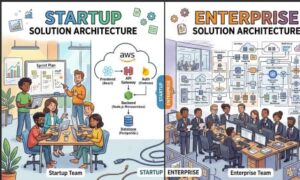
When people hear the term solution architecture, they often imagine complex diagrams, cloud infrastructure, technical documentation, and long meetings between developers and architects. But solution architecture is much more than drawing boxes and arrows.
The real purpose of solution architecture is to answer a fundamental question:
How should technology be designed so that it supports the business today without creating unnecessary problems tomorrow?
The answer to that question looks very different for a startup than it does for an enterprise.
A startup may need to launch a product quickly, validate an idea, keep costs under control, and adapt to changing customer requirements. An enterprise, on the other hand, may need to integrate decades-old systems, meet strict regulatory requirements, support thousands or millions of users, and coordinate technology decisions across multiple teams and business units.
The underlying principles of good architecture remain similar, but the priorities, constraints, risks, and decision-making processes can be dramatically different.
What Is Solution Architecture?
Solution architecture is the process of designing the structure of a technology solution to meet specific business and technical requirements.
A solution architect looks beyond individual pieces of technology and considers the bigger picture: applications, databases, APIs, integrations, cloud infrastructure, security, data flows, scalability, reliability, and operational requirements.
Most importantly, architecture connects business goals with technology decisions.
For example, if a startup wants to launch a new digital product within three months, the best architecture may prioritize speed, simplicity, and flexibility.
If a global enterprise wants to modernize a mission-critical platform used by millions of customers, the architecture may need to prioritize resilience, security, governance, compliance, and controlled migration.
Neither approach is automatically better.
The right architecture depends on the context.
Solution Architecture for Startups: Speed Is a Strategic Advantage
For startups, time is often one of the most valuable resources.
A startup usually operates with limited capital, a small engineering team, uncertain product-market fit, and constantly changing requirements. Building an elaborate architecture too early can consume resources that should instead be spent learning from customers and improving the product.
This is why startup architecture often emphasizes simplicity and speed.
1. Startups Need to Validate Before They Optimize
A startup may not know exactly what its product will look like six months from now.
Customers may request new features. The business model may change. A product that initially targets one market may eventually move into another.
Architecture needs to accommodate this uncertainty.
Instead of trying to design the perfect system from day one, startups generally benefit from building an architecture that is:
- Simple enough to understand
- Fast enough to develop
- Flexible enough to evolve
- Affordable enough to operate
- Reliable enough for the current stage of the business
This doesn’t mean startups should ignore architecture.
Quite the opposite.
Good architecture helps startups avoid expensive technical decisions that could slow down future growth. The key is knowing where to invest in architectural quality and where to keep things deliberately simple.
2. Cost Matters More
For a startup, infrastructure costs can directly affect runway.
Choosing a highly sophisticated architecture with numerous managed services, complex observability platforms, multiple databases, and unnecessary infrastructure can create significant operational expenses.
A startup architect therefore has to ask:
Do we really need this now?
That question can prevent both overengineering and unnecessary spending.
The goal isn’t the cheapest possible architecture. It’s the architecture that delivers the required business value at the right cost.
3. Teams Are Smaller
In many startups, one engineer may work across the application, infrastructure, database, APIs, and deployment pipeline.
That means architectural complexity has a direct impact on productivity.
A technically impressive architecture can become a liability if nobody has enough time or expertise to maintain it.
For startups, developer experience and operational simplicity are architectural concerns.
Solution Architecture for Enterprises: Complexity Becomes the Challenge
Enterprise architecture operates in a very different environment.
Large organizations often have multiple products, departments, technology teams, vendors, geographic regions, and regulatory obligations.
They may also have systems that have been running for ten, twenty, or even thirty years.
The challenge isn’t simply building something new.
It’s making the new solution work with everything that already exists.
1. Integration Is Often the Hardest Problem
Enterprise systems rarely operate in isolation.
A new application may need to communicate with CRM platforms, ERP systems, identity providers, data warehouses, payment systems, legacy applications, third-party services, and internal APIs.
This makes integration architecture extremely important.
An enterprise solution architect must understand not only the new technology but also the existing technology landscape.
A technically elegant new platform can still fail if it cannot integrate effectively with the organization’s existing systems.
2. Security and Compliance Are Core Requirements
For enterprises, security isn’t something added after development.
It is typically part of the architecture from the beginning.
Depending on the industry and geography, organizations may need to consider data protection, access controls, auditability, encryption, identity management, regulatory requirements, data residency, and business continuity.
These requirements can significantly influence architectural decisions.
A startup may decide to adopt a particular cloud service because it makes development faster.
An enterprise may need to ask additional questions:
Where is the data stored?
Who can access it?
How is access audited?
What happens if the provider becomes unavailable?
Can the solution meet regulatory requirements across different countries?
The architecture must account for these questions.
3. Scalability Means More Than More Users
Enterprise scalability isn’t simply about handling more traffic.
It can also mean supporting more teams, more products, more regions, more integrations, more data, and more organizational complexity.
An enterprise architecture may need clear standards for APIs, identity, observability, deployment, data management, and infrastructure.
Without these standards, every team may solve the same problem differently.
That can create technology fragmentation and long-term maintenance costs.
Startup vs. Enterprise: The Biggest Architectural Differences
The most important difference isn’t that startups use one technology and enterprises use another.
It’s about what the architecture is optimizing for.
A startup often optimizes for:
- Speed to market
- Product validation
- Cost efficiency
- Developer productivity
- Flexibility
- Rapid iteration
An enterprise often optimizes for:
- Reliability
- Security
- Governance
- Integration
- Scalability
- Compliance
- Operational consistency
- Long-term maintainability
This distinction is critical.
A startup that adopts enterprise-level complexity too early may slow itself down.
An enterprise that approaches architecture like a startup may create unacceptable security, operational, or scalability risks.
The Danger of Overengineering
One of the biggest architectural mistakes is assuming that more sophisticated architecture automatically means better architecture.
It doesn’t.
A startup doesn’t necessarily need dozens of microservices, event-driven architecture, multiple databases, Kubernetes, and an extensive platform engineering organization from day one.
Likewise, an enterprise can’t necessarily solve every problem with a simple monolithic application just because simplicity worked well for a startup.
Architecture should be proportional to the problem.
The right question isn’t:
“What’s the most advanced architecture we can build?”
The better question is:
“What’s the simplest architecture that can safely support our current business requirements and anticipated growth?”
Architecture Must Evolve With the Business
Perhaps the most important lesson is that architecture isn’t a one-time decision.
A startup may begin with a relatively simple application and gradually introduce additional services as the product grows.
An enterprise may begin a modernization program with a single business capability and progressively migrate legacy workloads.
In both situations, architecture should evolve.
This is where architectural thinking becomes especially valuable.
Instead of predicting every future requirement, architects can identify decisions that are difficult to reverse and make those decisions carefully while keeping other decisions flexible.
This approach allows organizations to move quickly without completely ignoring the future.
There Is No Universal “Best” Architecture
The best solution architecture depends on the organization’s goals, constraints, team capabilities, risk tolerance, budget, regulatory environment, existing technology landscape, and expected growth.
For startups, architecture should create momentum without creating unnecessary technical debt.
For enterprises, architecture should create consistency and resilience without preventing teams from moving quickly.
The sweet spot is different for every organization.
Ultimately, good solution architecture is not about choosing the most impressive technology stack. It’s about making intentional technology decisions that support business outcomes.
Whether you’re building your first product or modernizing a global enterprise platform, the architectural question remains the same:
What technology decisions will help the business succeed today while keeping tomorrow’s options open?
Understanding the differences between startup and enterprise architecture is the first step toward answering that question effectively.
Extra posts:
 What Is Solution Architecture and How Does It Differ from Software Architecture?
  Governance in Solution Architecture: Why It Matters and How to Get It Right
  How to Communicate Solution Architecture to Non-Technical Stakeholders
  The Cost of Poor Solution Architecture Decisions
  Microservice Architecture Drawbacks and How to Solve Them: A Solution Architect’s Perspective
  From Diagrams to Decisions: Using GitHub to Power Modern Solution Architecture