Skip to content

Centralized Logging in Azure Proven Observability Patterns for Modern Apps

As modern applications move to distributed and cloud-native architectures, observability becomes critical for ensuring system reliability, diagnosing issues, and improving performance. Among the three pillars of observability—logs, metrics, and traces—logs often form the foundation for… Centralized Logging in Azure Proven Observability Patterns for Modern Apps

Riding in Tandem Unlocking the Sidecar Pattern in Azure Microservices

In the world of cloud-native applications, microservices bring agility, scalability, and speed. But with this modular approach comes complexity: logging, monitoring, proxying, and configuration often become tricky. That’s where the Sidecar Pattern steps in —… Riding in Tandem Unlocking the Sidecar Pattern in Azure Microservices

How to Migrate Legacy Applications Using GitHub Copilot

Migrating legacy applications to modern platforms is one of the most challenging tasks in software development. Legacy systems often contain years of business logic, outdated frameworks, and dependencies that are no longer supported. At the… How to Migrate Legacy Applications Using GitHub Copilot

Service Discovery in Azure Dynamically Finding Service Instances

Modern cloud-native applications are built from microservices—independently deployable units that must communicate with each other to form a cohesive system. In dynamic environments like Azure Kubernetes Service (AKS), Azure App Service, or Azure Container Apps,… Service Discovery in Azure Dynamically Finding Service Instances

Service Mesh Architecture Pattern in Azure Handling Service-to-Service Communication, Security, and Observability

As organizations modernize applications using microservices and cloud-native architectures, managing how these services communicate becomes increasingly complex. Microservices often run across distributed environments, scaling dynamically, and interacting over the network. This is where the Service… Service Mesh Architecture Pattern in Azure Handling Service-to-Service Communication, Security, and Observability

Retrieval-Augmented Generation (RAG) in Azure AI A Step-by-Step Guide

What Is RAG & Why It Matters Retrieval-Augmented Generation (RAG) combines the power of information retrieval with generative AI. Instead of relying only on what the model learned during training, RAG fetches relevant data from… Retrieval-Augmented Generation (RAG) in Azure AI A Step-by-Step Guide

Detect Human Faces and Compare Similar Ones with Face API in Azure

Facial recognition is becoming an integral part of modern applications—from authentication systems and security cameras to customer experience personalization. Microsoft Azure’s Face API provides powerful cloud-based capabilities to detect human faces, extract facial features, and… Detect Human Faces and Compare Similar Ones with Face API in Azure

Unlocking the Power of AI with Azure Cognitive Services

Artificial Intelligence (AI) is no longer just a futuristic concept—it’s now a core part of how businesses enhance customer experiences, streamline operations, and gain insights from their data. Microsoft’s Azure Cognitive Services offers one of… Unlocking the Power of AI with Azure Cognitive Services

API Gateway Pattern in Azure Managing APIs and Routing Requests to Microservices

In the world of microservices, flexibility comes with complexity. Each service is autonomous, has its own database, and runs independently — but with that independence comes the challenge of how clients communicate with these services… API Gateway Pattern in Azure Managing APIs and Routing Requests to Microservices

Machine Learning in Azure A Beginner’s Guide to Building Intelligent Solutions

Artificial Intelligence (AI) is no longer a buzzword — it’s a core driver of modern applications, from predictive analytics to real-time personalization. Microsoft Azure provides a powerful, cloud-based platform to make machine learning (ML) accessible,… Machine Learning in Azure A Beginner’s Guide to Building Intelligent Solutions

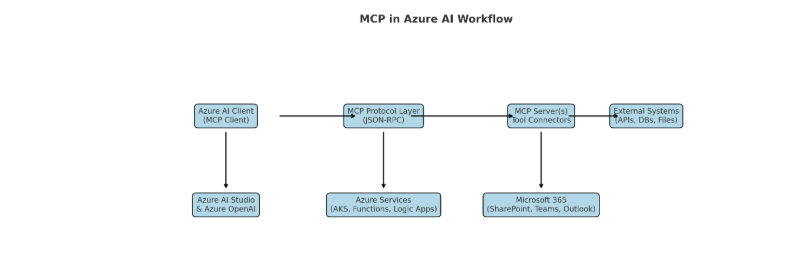
MCP & AI Unlocking Agentic Intelligence with a “USB-C Connector” for AI

What Is MCP? MCP, or Model Context Protocol, is an open-source standard introduced by Anthropic in November 2024. It’s designed to create a unified bridge between AI models—especially large language models (LLMs)—and external systems like… MCP & AI Unlocking Agentic Intelligence with a “USB-C Connector” for AI

Building Resilient Systems with Immutable Infrastructure on Azure

In modern DevOps and cloud-native architecture, immutable infrastructure has become a best practice for ensuring consistency, security, and reliability. This pattern means that once a virtual machine (VM), container, or other infrastructure component is provisioned,… Building Resilient Systems with Immutable Infrastructure on Azure