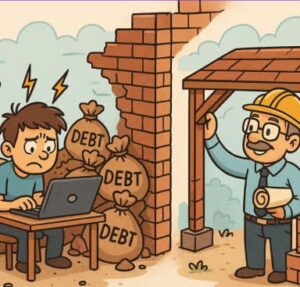
In the world of software engineering, technical debt is one of those invisible burdens that grows quietly but can eventually cripple a system’s scalability, performance, and maintainability. While it may seem like a developer’s buzzword, technical debt has deep architectural implications that influence business agility, innovation, and long-term costs.
This blog explores what technical debt is, how it impacts software architecture, and what strategies teams can use to manage and eliminate it effectively.
What is Technical Debt?
The term technical debt was coined by Ward Cunningham, one of the authors of the Agile Manifesto. He used the metaphor to describe how taking shortcuts during software development—like writing quick, unoptimized code—can lead to future costs, similar to paying interest on a financial loan.
In simple terms, technical debt refers to the implied cost of additional rework caused by choosing a faster, easier, or less optimal solution today instead of a better one that would take more time.
Technical debt isn’t always bad. Sometimes, teams intentionally incur it to meet deadlines, test ideas, or deliver value faster. However, problems arise when debt is unmanaged or ignored, leading to architectural degradation and increasing maintenance costs over time.
Types of Technical Debt
Understanding the different types of technical debt helps in identifying and prioritizing them effectively:
- Intentional Debt:
Taken knowingly for short-term gain, such as meeting a tight deadline or validating a business idea quickly. - Unintentional Debt:
Results from poor design, lack of knowledge, or unplanned architectural evolution. - Bit Rot or Code Decay:
Accumulates gradually as the system grows and new features interact with old ones, creating inconsistencies. - Environmental Debt:
Comes from outdated tools, libraries, frameworks, or infrastructure dependencies.
Architectural Impact of Technical Debt
Technical debt may start at the code level, but its real damage is architectural. Here’s how it affects the broader system:
1. Reduced Scalability
When shortcuts are taken, the architecture often lacks proper modularization or decoupling. As user demand grows, scaling becomes increasingly difficult, forcing teams to refactor core components under pressure.
2. Decreased Maintainability
Poorly structured architecture leads to tangled dependencies, making even small changes risky and time-consuming. Over time, this discourages innovation and slows down development cycles.
3. Performance Bottlenecks
Unoptimized architecture—whether in database design, caching strategy, or microservice communication—can cause significant latency and resource inefficiency.
4. Security Vulnerabilities
Legacy components and outdated frameworks, often part of accumulated technical debt, increase the risk of security breaches and compliance violations.
5. Team Productivity Decline
Developers spend more time understanding complex systems and fixing bugs instead of building new features. This not only affects morale but also increases turnover.
6. Business Agility Reduction
Organizations burdened with high technical debt find it harder to pivot or adopt new technologies quickly, putting them at a competitive disadvantage.
How Technical Debt Accumulates in Architecture
- Lack of architectural governance: When teams work in silos without alignment on design principles.
- Inadequate documentation: When system evolution isn’t properly recorded, causing future confusion.
- Rushed releases: Focusing on delivery speed over architectural integrity.
- Inconsistent technology stack: Using too many frameworks or patterns without coherence.
- Deferred refactoring: Ignoring early signs of code smell or design inefficiency.
Solutions to Manage and Reduce Technical Debt
Managing technical debt effectively requires a combination of architectural strategy, process discipline, and cultural alignment. Below are some proven approaches:
1. Architectural Refactoring
Refactoring the architecture means systematically improving design without changing its external behavior. Techniques include:
- Modularization to isolate services and minimize dependencies.
- Decoupling through APIs or event-driven design.
- Adopting microservices or domain-driven design (DDD) for better scalability.
Regular architecture reviews help identify outdated patterns early and guide teams toward sustainable solutions.
2. Automated Testing and Continuous Integration
Automation ensures that architectural changes don’t introduce new issues.
- Unit, integration, and regression tests detect defects quickly.
- Continuous Integration (CI) pipelines enforce quality gates before deployment.
3. Technical Debt Register
Maintain a visible log of all known technical debt items, their causes, and their business impact. This helps stakeholders understand the trade-offs and prioritize remediation tasks strategically.
4. Incremental Refactoring
Instead of large, risky rewrites, teams should fix small parts of the system continuously. Adopting the Boy Scout Rule—“Always leave the code cleaner than you found it”—can significantly reduce accumulated debt.
5. Architectural Decision Records (ADRs)
Documenting why certain architectural choices were made prevents “forgotten rationale.” Future developers can understand context, reducing the risk of redundant or conflicting decisions.
6. Invest in Developer Education
Often, technical debt arises from lack of knowledge or experience. Encouraging architectural training, design pattern workshops, and peer reviews improves long-term code health.
7. Set Architectural Guardrails
Define and enforce coding standards, architectural principles, and technology usage policies. Guardrails help teams stay aligned without stifling creativity.
8. Measure and Monitor
Use metrics such as code churn, cyclomatic complexity, build failures, and technical debt ratio to quantify and track architectural debt over time. Tools like SonarQube and CodeScene can help.
Long-Term Architectural Strategy
A sustainable architecture is one that balances innovation with maintenance. Here’s how organizations can build systems that remain adaptable:
- Embrace evolutionary architecture: Allow systems to evolve through small, controlled changes.
- Prioritize architecture in sprint planning: Allocate time for technical improvement in every release cycle.
- Adopt DevOps culture: Break silos between development and operations for faster feedback loops.
- Regular architecture audits: Treat architecture as a living entity that requires continuous assessment.
Technical debt is not just a developer issue—it’s a strategic concern with profound architectural and business implications. Ignoring it can lead to system fragility, high operational costs, and lost agility. However, with deliberate architectural governance, proactive refactoring, and a culture of continuous improvement, organizations can turn technical debt into an opportunity for sustainable growth and innovation.
By managing technical debt wisely, you ensure your software architecture remains resilient, scalable, and ready for the future.
Extra posts:
 How to Communicate Solution Architecture to Non-Technical Stakeholders
  Understanding Architectural Layers in Software Systems
  Common Architectural Styles and When to Use Them
  Patterns vs. Anti-Patterns: The Architectural Compass
  The Core Responsibilities of a Solution Architect
  Governance in Solution Architecture: Why It Matters and How to Get It Right