
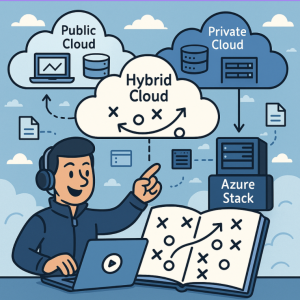
In today’s fast-paced digital landscape, organizations face a critical challenge: how to balance the agility and scalability of the public cloud with the control and compliance benefits of on-premises infrastructure. Enter Azure Stack, Microsoft’s hybrid cloud solution, designed to bring the power of Azure into your datacenter while enabling seamless integration with the public cloud.
This blog serves as your playbook for mastering Azure Stack, guiding you through key concepts, strategies, and best practices to help your organization thrive in a hybrid cloud environment.
Understanding Azure Stack
Azure Stack is an extension of Azure that allows enterprises to run services consistently across both the cloud and on-premises environments. With Azure Stack, businesses can:
- Maintain flexibility: Deploy workloads in the cloud, on-premises, or in a hybrid model depending on needs.
- Ensure compliance: Keep sensitive data on-premises while still benefiting from cloud innovations.
- Optimize performance: Run latency-sensitive applications closer to where the data is generated.
- Standardize operations: Use the same APIs, tools, and services across environments.
The ecosystem includes:
- Azure Stack Hub: Integrated systems for running services on-premises.
- Azure Stack HCI: Hyperconverged infrastructure for running virtualized workloads with Azure hybrid services.
- Azure Stack Edge: Hardware-as-a-service offering for edge computing and AI at the edge.
Key Benefits of Azure Stack
- Unified Development and Operations
Developers can build applications once and deploy them consistently across public Azure and Azure Stack. - Data Sovereignty and Compliance
Industries like finance, healthcare, and government can keep data on-premises to comply with regulations, without sacrificing innovation. - Edge and Disconnected Scenarios
Azure Stack enables cloud computing at the edge, supporting remote locations or disconnected environments like oil rigs, ships, or military bases. - Seamless Hybrid Services
Services such as AI, machine learning, and IoT can run across hybrid environments for greater flexibility and performance.
Key Technical Benefits of Azure Stack
- Consistent APIs and Tooling
Use ARM (Azure Resource Manager) templates, Bicep, and Terraform across environments. - Hybrid Networking
Establish secure connections via ExpressRoute or VPN Gateways for low latency and reliability. - Unified Identity and Access
Integrate Azure Active Directory (AAD) and on-premises Active Directory for hybrid identity. - Workload Flexibility
Deploy VMs, containers, and Kubernetes clusters (AKS on Azure Stack HCI) in hybrid mode.
Hybrid Cloud Reference Architecture
A typical Azure Stack hybrid architecture looks like this:

Strategies for Mastering Azure Stack
1. Align with Business Objectives
Before deploying Azure Stack, align your hybrid cloud strategy with your organization’s goals. Are you focusing on compliance? Latency reduction? Cost optimization? Clear goals will guide your implementation.
2. Standardize Governance
Use Azure Policy and Azure Blueprints to ensure consistent governance across both environments. This reduces risk and ensures compliance across all workloads.
3. Optimize Workload Placement
Evaluate which workloads should run in Azure, Azure Stack, or both. For example:
- Sensitive workloads → Azure Stack (on-premises)
- Scalable, dynamic workloads → Public Azure
- Edge processing → Azure Stack Edge
4. Leverage DevOps Practices
Automate deployments using tools like Azure DevOps and Terraform for consistent, repeatable infrastructure management across hybrid environments.
5. Focus on Security
Adopt a Zero Trust approach, ensuring identity, access, and network security policies are uniformly applied across hybrid infrastructure.
Best Practices for Success
- Invest in Skills: Train your IT teams on both Azure and Azure Stack to avoid knowledge silos.
- Monitor and Optimize: Use Azure Monitor and Log Analytics to gain insights into workloads across hybrid environments.
- Adopt Cloud-Native Architectures: Build applications with microservices, containers, and Kubernetes to maximize flexibility.
- Plan for Growth: Design your hybrid architecture with scalability in mind, anticipating future needs.
- Connectivity: Implement ExpressRoute for low-latency hybrid workloads.
- Monitoring: Use Azure Monitor, Log Analytics, and Azure Arc for unified monitoring.
- Security: Adopt Zero Trust principles with AAD Conditional Access and Just-In-Time VM access.
- Backup & DR: Integrate Azure Backup and Azure Site Recovery with Azure Stack workloads.
The hybrid cloud is no longer a transitional phase—it’s a long-term strategy for modern enterprises. By mastering Azure Stack, organizations can unlock the full potential of hybrid cloud, gaining agility, compliance, and resilience while future-proofing their IT investments.
Azure Stack isn’t just technology—it’s a bridge between today’s needs and tomorrow’s possibilities. With the right playbook in hand, you can lead your organization confidently into the hybrid cloud era.
Extra posts:
 Public vs Private vs Hybrid Cloud Models Explained
  Azure for Beginners How to Launch Your First Cloud Project in 30 Minutes
  Azure Enterprise-Scale Landing Zone Building a Future-Ready Cloud Foundation
  How Microsoft Azure Ensures Data Privacy and Global Compliance | Secure Cloud Solutions
  How Solution Architects Can Use Microsoft’s Azure Globe Experience to Design Smarter Cloud Architectures
  How Microsoft Keeps Your Data Safe in the Cloud – A Deep Dive into Cloud Security Practices