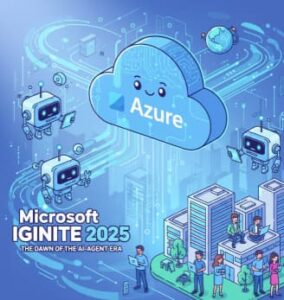
Microsoft Ignite 2025 wasn’t just another tech conference — it was a redefinition of the modern workplace. Instead of incremental upgrades and predictable product updates, Microsoft used the event to signal the beginning of a new era: an agent-driven, AI-first workplace where intelligent copilots, governed automation, and deeply connected data systems form the backbone of how organizations operate.
From massive transformations in Microsoft 365 to the emergence of fully governed AI agents with their own identities, Ignite 2025 delivered a bold roadmap. In this blog, we unpack the biggest announcements and explore why they matter — not just for IT leaders or developers, but for anyone who uses technology to get work done.
A New Foundation: AI as the Core of the Microsoft Ecosystem
Over the last few years, Microsoft has steadily integrated AI into its suite of products. But Ignite 2025 elevated AI from a “feature” into an “operating system layer.” The message was clear: AI is no longer a companion — it’s becoming a core fabric in the enterprise.
Microsoft introduced a series of “intelligence layers” that collectively form the new foundation for AI-powered work. These layers work together to provide context, reasoning, data, and memory to the agents and copilots across the Microsoft ecosystem.
Work IQ — Personal and Organizational Understanding
Work IQ allows AI agents and Copilot to understand how you work — your workflow patterns, the types of documents you create, the meetings you attend, your team structure, and your communication habits. Instead of generic suggestions, Copilot becomes personalized, offering more relevant assistance.
Fabric IQ — Data Intelligence for the Whole Enterprise
Fabric IQ brings together analytics, structured data, unstructured documents, time-series logs, and operational data into a unified intelligence system. This means that the AI agents can access, reason over, and make sense of enterprise data without extra engineering or manual data cleaning.
Foundry IQ — Knowledge, Reasoning, and Context
Foundry IQ acts as the knowledge brain for the enterprise. It organizes documents, files, communication, structured data, and external sources into an AI-ready knowledge base. It ensures that agents give grounded and accurate responses, reduce hallucinations, and operate with precision.
Taken together, these three layers form what Microsoft calls the IQ Stack — a holistic approach that helps AI agents understand users, understand data, and act responsibly.
Introducing AI Agents Everywhere: Intelligent Workflows Become Mainstream
The star of Ignite 2025 was the emergence of AI agents — autonomous, goal-driven assistants capable of completing workflows, coordinating tasks, retrieving information, and acting across applications.
Microsoft’s goal is for organizations to move from a “manual workflow culture” to a “human-led, agent-assisted” workplace.
Copilot Gets a Major Upgrade
Copilot in Microsoft 365 is becoming smarter and far more capable, thanks to deeper integration with the IQ Stack. It can:
- Create end-to-end documents with minimal direction
- Pull relevant files and data without being asked explicitly
- Ask clarifying questions when it doesn’t have enough context
- Manage multi-step workflows, not just single tasks
Even more exciting: Word, Excel, and PowerPoint now have their own dedicated AI agents, built directly into the application experience. These agents go beyond simple prompting — they work alongside you as intelligent co-creators, capable of drafting, editing, analyzing, designing, and even recommending improvements based on best practices.
Teams Becomes an AI Coordination Hub
Microsoft Teams is evolving from a communication tool into an intelligent orchestration center. AI agents can now work inside Teams to:
- Pull data from multiple apps
- Summarize project statuses
- Alert teams to risks or delays
- Help with next-step planning
- Coordinate handoffs
- Automate actions
Teams becomes a kind of “mission control” for agent activity, ensuring collaboration stays efficient and aligned.
Microsoft Foundry — The New Platform for Building and Deploying AI Agents
If the announcements around AI agents felt big, Microsoft went even further by unveiling Microsoft Foundry, a platform for building, managing, and deploying AI agents at scale.
This is where Ignite 2025 took a major leap forward.
What Foundry Enables:
- Agent creation without complex backend setup
- Agent-to-agent collaboration using orchestration tools
- Secure memory for long-term tasks
- MCP-based tool integration, making any internal system “AI-ready”
- Enterprise-grade hosting
- Built-in observability for tracking agent actions
In simpler terms: Foundry is the factory where companies can build their own agents — and deploy them safely across teams and departments.
Organizations no longer need massive engineering teams to create intelligent automation. Foundry democratizes AI agent creation the same way Power Apps democratized low-code app development.
Agent 365 — Governance, Identity & Control for AI Agents
One of the most groundbreaking announcements was Agent 365, a complete governance system that treats AI agents as first-class digital entities.
This was a missing piece in the AI landscape — and Microsoft delivered.
Why it matters:
As companies deploy more AI agents, a major risk emerges:
Who controls the agents? Who supervises them? What can they access? How are they audited?
Agent 365 solves this by giving each agent:
- A unique Entra Agent ID
- Fine-grained permissions
- Central visibility in a unified registry
- Compliance oversight
- Access logs
- Data-loss protection
- Risk scoring
With Agent 365, AI agents are no longer free-floating. They are governed just like users, apps, and devices — making enterprise AI dramatically safer and more manageable.
This will likely become a global standard in enterprise AI governance.
Productivity Gets Reimagined: Word, Excel, PowerPoint, Teams
While the infrastructure announcements were massive, Microsoft didn’t neglect the everyday tools people rely on.
Word:
Your Word agent can now:
- Draft reports with data included
- Analyze long documents
- Suggest structure and headings
- Rewrite sections in desired tone and length
Excel:
Excel’s agent has been trained to:
- Interpret complex datasets
- Build formulas from natural language
- Propose dashboards
- Identify anomalies
- Turn raw data into insights automatically
PowerPoint:
PowerPoint’s agent can:
- Generate a full slide deck from a short prompt
- Pull images, data, and brand elements
- Suggest alternative layouts
- Rewrite speaker notes
Teams:
Teams becomes the hub for:
- Coordinating agents
- Tracking multi-app workflows
- Managing cross-department processes
The overarching theme:
These apps are evolving from tools you use to agents that work with you.
Cloud & Data Enhancements Powering the Agent Era
Ignite also brought major updates to Microsoft Azure and Fabric, designed to support AI-heavy environments.
Key improvements:
- Faster AI model hosting
- More efficient data pipelines
- Unified data layers for analytics + AI
- Better governance across data sources
- Integration of enterprise apps with Fabric IQ
These updates ensure that AI agents have reliable, fast access to the data they need — without engineers stitching together fragile pipelines.
Security Takes Center Stage
With AI agents now managing sensitive workflows, security was a top priority at Ignite.
Microsoft unveiled new autonomous cybersecurity capabilities:
- Real-time anomaly detection across agent activity
- AI-powered threat hunting
- Autonomous risk scoring
- Micro-permissioning for agent access
- End-to-end compliance coverage
Security is no longer an afterthought — it’s foundational to the agent era.
The Bigger Picture: The Rise of the “Frontier Firm”
Microsoft used Ignite 2025 to introduce the concept of the Frontier Firm — organizations that combine human expertise with AI agents to reach new levels of productivity, creativity, and coordination.
A Frontier Firm is characterized by:
- Human-led decision making
- Agent-assisted execution
- Data-driven workflows
- Automated operations
- Continuous optimization
This represents a shift in how businesses function — from reactive workflows to proactive, dynamic systems supported by AI.
Ignite 2025 marks the moment when AI agents moved from hype to reality. Microsoft didn’t just introduce new AI features — it created a full ecosystem with identity, governance, data intelligence, orchestration, and productivity integration.
This year’s announcements set the stage for a future where:
- Workflows are automated
- Data is intelligently connected
- Collaboration is streamlined
- Security is enforced proactively
- Employees gain superpowers, not burdens
The message from Microsoft is clear:
AI agents are not the future — they are now.
Extra posts:
 Microsoft Ignite 2020 Registration Open
  Single Agent vs Multi-Agent Architectures: When Do You Need Each? (With Microsoft Technologies Explained)
  DevOps Meets Microsoft AI Accelerating Innovation in the Cloud Era Unleashing the Power of Microsoft Fabric and AI A New Era of Data-Driven Intelligence
  Microsoft 365 Weekly Update: May 4–10, 2025
  Microsoft’s Latest Updates issue 1 June 2025