
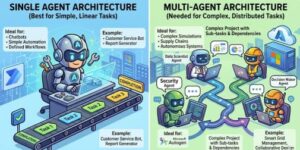
As artificial intelligence systems grow more sophisticated, the question of how to structure them becomes increasingly important. One of the most fundamental design decisions is whether to use a single-agent architecture or a multi-agent architecture. While both approaches can solve complex problems, they differ significantly in how they scale, adapt, and handle complexity.
Choosing the wrong architecture can lead to bottlenecks, inefficiencies, or unnecessary complexity. On the other hand, choosing the right one can unlock performance gains, resilience, and flexibility.
This article breaks down both approaches in practical terms and helps you decide when each one makes sense.
What Is a Single-Agent Architecture?
A single-agent architecture uses one central AI system to handle all reasoning, decision-making, and execution.
In the Microsoft ecosystem, this often looks like:
- A single orchestration layer using Semantic Kernel
- Connected to Azure OpenAI Service
- Possibly enhanced with tools like Azure Cognitive Services
Example (Microsoft Stack)
Imagine a customer support chatbot:
- Uses Azure OpenAI Service for responses
- Uses Azure AI Search for retrieving knowledge
- Managed by a single orchestrator in Semantic Kernel
Everything flows through one “brain.”
Why Microsoft Supports This Model
Microsoft’s tooling makes single-agent systems easy to build because:
- Semantic Kernel provides structured orchestration
- Built-in connectors reduce integration effort
- Azure services are tightly integrated
When It Works Best
- Internal enterprise copilots
- Knowledge assistants
- Workflow automation tools
- MVP AI applications
Microsoft-Specific Advantage
Using Azure OpenAI Service in a single-agent setup minimizes latency because all reasoning happens in one pipeline, without inter-agent messaging overhead.
What Is a Multi-Agent Architecture?
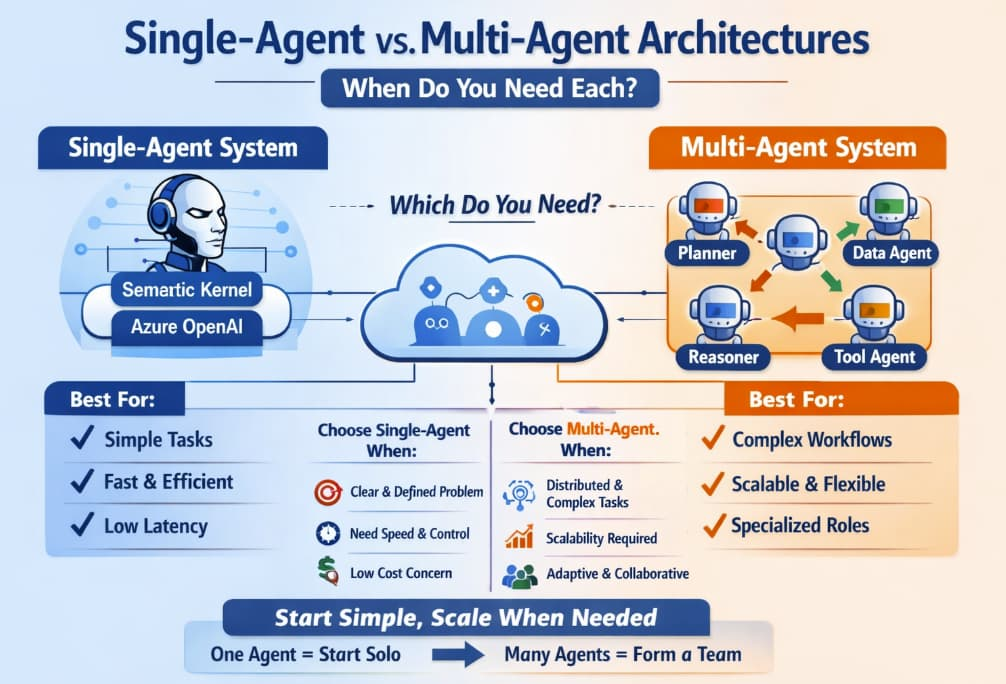
A multi-agent architecture involves multiple AI agents working together, each with a specialized role.
Microsoft has been heavily investing in this direction, especially with frameworks like AutoGen.
Example (Microsoft Stack)
A more advanced AI system might include:
- A Planner Agent (decides what to do)
- A Research Agent (queries data via Azure AI Search)
- A Reasoning Agent (uses Azure OpenAI Service)
- A Tool Agent (executes actions via APIs or Azure Functions)
These agents communicate and collaborate to solve tasks.
Microsoft’s Multi-Agent Vision
With AutoGen:
- Agents can chat with each other
- Tasks can be delegated dynamically
- Systems can exhibit emergent problem-solving behavior
This is a big shift from traditional architectures.
Key Microsoft Technologies for Each Approach
Single-Agent Stack (Microsoft)
- Semantic Kernel → Orchestration layer
- Azure OpenAI Service → Core intelligence
- Azure AI Search → Retrieval
- Azure Cognitive Services → Vision, speech, etc.
This setup is ideal for centralized systems.
Multi-Agent Stack (Microsoft)
- AutoGen → Multi-agent coordination
- Semantic Kernel → Can still act as orchestrator
- Azure Functions → Task execution
- Azure Service Bus → Agent communication
- Azure Kubernetes Service → Scaling agents
This setup enables distributed intelligence.
When Should You Use a Single-Agent Architecture? (Microsoft Context)
Choose a single-agent approach if:
1. You’re building with Semantic Kernel alone
If your logic can be handled through one orchestrator, adding agents is unnecessary.
2. Your Azure costs need to stay predictable
Multi-agent systems can increase token usage and compute costs.
3. You need tight control and governance
Enterprises using Azure OpenAI Service often prefer centralized control for compliance.
4. Latency is critical
No inter-agent communication means faster responses.
When Should You Use a Multi-Agent Architecture? (Microsoft Context)
Choose multi-agent when:
1. You are using AutoGen for complex workflows
AutoGen shines when tasks require collaboration.
2. Your system spans multiple Azure services
Agents can specialize:
- One for data
- One for reasoning
- One for execution
3. You need horizontal scalability
With Azure Kubernetes Service, you can scale agents independently.
4. Your workflows are dynamic and unpredictable
Multi-agent systems adapt better to changing conditions.
Real-World Microsoft Scenario
Scenario: Enterprise AI Copilot
A large enterprise builds an internal AI assistant:
Single-Agent Version:
- Built using Semantic Kernel
- Uses Azure OpenAI Service
- Handles all logic centrally
Multi-Agent Version:
- Uses AutoGen
- Separate agents:
- HR Agent
- Finance Agent
- IT Support Agent
- Communication via Azure Service Bus
Result:
- Single-agent = easier to deploy
- Multi-agent = more scalable and specialized
Hybrid Approach (Microsoft’s Recommended Direction)
Microsoft increasingly promotes hybrid architectures:
- Use Semantic Kernel as a central planner
- Delegate tasks to specialized agents via AutoGen
This gives you:
- Control + flexibility
- Simplicity + scalability
Common Mistakes (Microsoft Stack)
1. Overusing AutoGen too early
Not every app needs multi-agent orchestration.
2. Ignoring Azure messaging services
Without tools like Azure Service Bus, agent communication becomes messy.
3. Poor cost management
Multi-agent systems can multiply API calls in Azure OpenAI Service.
4. Lack of observability
Use Azure Monitor and logging tools to track agent interactions.
Microsoft’s ecosystem makes both architectures viable—but the decision depends on your problem, not the tools.
- Start with a single-agent system using Semantic Kernel and Azure OpenAI
- Move to multi-agent with AutoGen only when complexity demands it
- Use Azure infrastructure to scale intelligently
The real advantage of Microsoft’s approach is flexibility—you don’t have to commit upfront. You can evolve from one architecture to another as your system grows.
Extra posts:
 Multi-Agent Systems with Semantic Kernel: Beyond Single Copilots
  Designing Multi-Agent Systems in Copilot Studio
  Multi-Agent Orchestration in Copilot Redefining Intelligent Workflows
  Agent Optimizer in Foundry Agent Service: Building Smarter and More Efficient AI Agents
  MLOps Architectures Building Scalable AI Systems
  AI Terms Explained for Microsoft 365 Users