
Presenting a solution architecture to executives is not the same as presenting it to engineers. What excites a technical team, system components, integrations, APIs, and scalability patterns can overwhelm or even disengage senior leadership.
Executives don’t need to understand how everything works. They need to understand why it matters, what risks exist, how much it costs, and what outcomes they can expect.
If you’ve ever walked out of a leadership meeting thinking, “They didn’t get it,” this guide is for you. Let’s break down how to present a solution architecture to executives in a way that drives clarity, confidence, and approval.
1. Start with Business Context, Not Technology
The most common mistake architects make is starting with the system diagram.
Executives think in terms of:
- Revenue
- Cost savings
- Risk reduction
- Competitive advantage
- Time to market
- Customer experience
Your first few slides (or first five minutes) should answer:
- What problem are we solving?
- Why now?
- What happens if we don’t act?
- How does this align with strategic goals?
Instead of saying:
“We are proposing a microservices-based architecture with container orchestration.”
Say:
“To reduce customer churn and improve platform reliability, we’re proposing a modernized architecture that increases system uptime and allows us to release features 40% faster.”
Same solution. Very different framing.
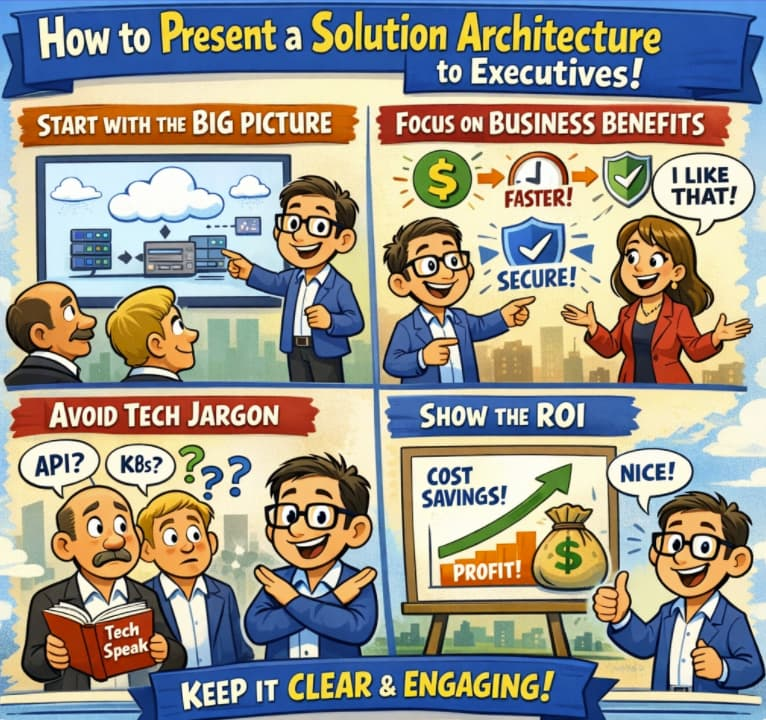
2. Translate Architecture into Business Value
Executives approve investments—not diagrams.
Every architectural decision should map to a business outcome.
For example:
| Technical Decision | Business Translation |
|---|---|
| Cloud migration | Reduces infrastructure costs and improves scalability |
| API-first design | Enables faster partner integrations |
| Data lake implementation | Improves analytics and decision-making |
| Automation & CI/CD | Shortens release cycles and reduces errors |
Make this translation explicit. Don’t assume leadership will connect the dots.
A helpful framing is:
“This design enables X, which results in Y, leading to Z business impact.”
Example:
“This architecture improves system resilience, which reduces downtime, leading to higher customer satisfaction and lower churn.”
3. Simplify the Visuals (Ruthlessly)
Executives do not need 12-box layered diagrams.
If your slide looks like it belongs in a developer wiki, it’s too detailed.
Instead:
- Use 5–7 major components max
- Remove internal service-level complexity
- Highlight flows, not implementation details
- Focus on value streams
A great executive-level architecture slide often shows:
- Users
- Core system blocks
- Key integrations
- Data flow
- Security layer
- Cloud/on-prem boundary (if relevant)
Think of it as a conceptual architecture, not a technical blueprint.
If they ask for more detail, that’s your invitation to go deeper.
4. Address Risk Before They Ask
Executives think in risk management mode.
If you don’t address risks, they will.
Proactively include:
- Technical risks
- Operational risks
- Financial risks
- Vendor risks
- Security risks
- Change management risks
And more importantly:
- Mitigation strategies
- Contingency plans
For example:
“The primary risk is migration downtime. To mitigate this, we propose a phased rollout with parallel systems for 60 days.”
When you acknowledge risk openly, you build credibility. When you pretend everything is smooth, you lose trust.
5. Be Clear on Cost and ROI
A solution architecture without financial context feels incomplete at the executive level.
Be ready to discuss:
- Initial investment
- Ongoing operational costs
- Expected savings
- Revenue impact
- Payback period
- ROI timeframe
You don’t need accounting-level precision, but you do need directional clarity.
Instead of:
“We’ll need additional infrastructure.”
Say:
“The estimated investment is $1.2M over 18 months, with projected operational savings of $600K annually starting in year two.”
Executives approve numbers, not aspirations.
6. Structure Your Executive Architecture Presentation
Here’s a practical structure that works well:
1. Executive Summary (1 slide)
- Problem
- Proposed solution
- Business impact
- Investment required
- Decision needed
2. Current State (1–2 slides)
- Key pain points
- Limitations
- Risks of doing nothing
3. Future State Architecture (1–2 slides)
- Simplified visual
- Core capabilities
- Key improvements
4. Business Impact (1–2 slides)
- Revenue
- Cost savings
- Risk reduction
- Performance metrics
5. Roadmap & Timeline (1 slide)
- Phases
- Milestones
- Dependencies
6. Risk & Mitigation (1 slide)
7. Financial Overview (1 slide)
8. Decision & Next Steps (1 slide)
Keep it tight. Most executive architecture presentations should be 20–30 minutes, not 90.
7. Speak in Strategic Language
Shift your vocabulary.
Instead of:
- API latency
- Kubernetes clusters
- Message queues
- Redundancy zones
Say:
- Performance improvement
- Scalability
- Reliability
- Resilience
- Agility
- Future-proofing
You’re not “dumbing it down.” You’re aligning to strategic language.
Executives care about:
- Growth
- Risk exposure
- Operational efficiency
- Customer impact
- Competitive positioning
Anchor your message there.
8. Anticipate Executive Questions
You can predict 80% of the questions.
Common ones include:
- Why this approach instead of alternatives?
- What’s the risk if we delay?
- Can we phase it?
- What happens if adoption is slow?
- How does this affect existing teams?
- Is this scalable for 3–5 years?
- Are we locked into a vendor?
Prepare crisp, direct answers. Avoid long technical justifications unless requested.
Confidence matters as much as content.
9. Show Trade-offs (Not Just the “Perfect” Option)
Executives respect balanced thinking.
Instead of presenting one “best” architecture, show that you evaluated options:
- Option A: Lower cost, higher risk
- Option B: Higher cost, faster implementation
- Option C: Phased modernization
Then explain why your recommendation is strategically aligned.
This positions you as a strategic advisor—not just a technical implementer.
10. End with a Clear Decision Ask
Never end with:
“That’s it.”
End with:
- “We’re requesting approval for Phase 1 funding.”
- “We’re seeking alignment on this strategic direction.”
- “We need a decision on vendor selection.”
Clarity drives action.
11. Remember: You Are Selling Confidence
At the executive level, architecture presentations are about confidence:
- Confidence in the plan
- Confidence in the numbers
- Confidence in the team
- Confidence in risk management
The real question executives ask internally is:
“Do I trust this will succeed?”
Your clarity, structure, and calm delivery matter just as much as the architecture itself.
Presenting a solution architecture to executives is less about technical depth and more about strategic storytelling.
When you:
- Lead with business value
- Simplify visuals
- Translate tech into outcomes
- Address risk proactively
- Present financial clarity
- Offer a structured decision path
—you transform from “the technical person” into a trusted strategic partner.
And that’s when architecture stops being just diagrams and starts becoming business transformation.
If you’re preparing your next executive architecture presentation, remember this simple principle:
Executives don’t fund systems. They fund outcomes.
Extra posts:
 What Is Solution Architecture and How Does It Differ from Software Architecture?
  Governance in Solution Architecture: Why It Matters and How to Get It Right
  Solution Architecture for Startups vs. Enterprises: What Really Changes?
  How to Communicate Solution Architecture to Non-Technical Stakeholders
  The Cost of Poor Solution Architecture Decisions
  From Diagrams to Decisions: Using GitHub to Power Modern Solution Architecture