
A business asks for a new customer portal. Six months later, the development team has a working application—but it does not integrate cleanly with the CRM, security requirements were interpreted differently by each team, and nobody is quite sure how the system will scale.
The problem may not be the code.
It may be the architecture.
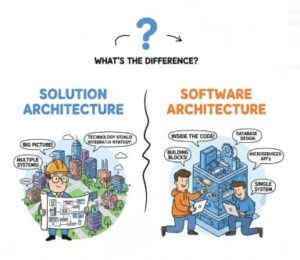
Solution architecture and software architecture both deal with designing systems before and during implementation, but they operate at different levels. One focuses on turning a business or organizational problem into a complete technical solution. The other focuses more deeply on the internal structure of a software system.
Understanding that distinction matters when you’re deciding who should own architectural decisions, what documentation you need, and how technical choices should connect back to business requirements.
What Is Solution Architecture?
Solution architecture is the process of defining the overall technical approach required to solve a specific business problem.
A solution architect looks beyond a single application. They consider the systems, integrations, infrastructure, data flows, security controls, users, operational requirements, and constraints that make up the complete solution.
For example, imagine a company wants to launch an online ordering platform. The solution might need:
- A web or mobile frontend
- An order-management application
- A payment provider
- An existing ERP system
- Customer identity and authentication
- Inventory services
- A data platform
- Monitoring and logging
- Cloud infrastructure
- Security and compliance controls
The solution architect’s responsibility is to determine how those pieces should work together.
That includes answering questions such as:
- Which systems should communicate directly?
- Where should business data be stored?
- Should the company build or buy a particular capability?
- Which integration pattern fits the existing environment?
- How will authentication and authorization work?
- What happens when a dependent service is unavailable?
- How will the solution scale as transaction volume grows?
- What are the operational and cost implications?
The result is not simply a diagram. It is a technical blueprint that connects business requirements to an implementable solution.
What Is Software Architecture?
Software architecture focuses more narrowly on the structure and behavior of a software system.
A software architect may decide how an application should be divided into components, how those components communicate, and which architectural patterns are appropriate.
Consider the order-management application from the previous example. Its internal architecture might include:
- API and presentation layers
- Order-processing services
- Customer and product modules
- Persistence components
- Event-handling mechanisms
- Caching
- Authentication middleware
- External-service adapters
The software architect is concerned with qualities such as maintainability, testability, scalability, performance, reliability, and separation of responsibilities.
They might evaluate whether the application should use a modular monolith, microservices, event-driven architecture, or another approach.
This is where decisions about design patterns, service boundaries, APIs, data access, concurrency, and application structure become particularly important.
Solution Architecture vs. Software Architecture
The simplest distinction is scope.
| Area | Solution Architecture | Software Architecture |
|---|---|---|
| Primary focus | Complete business/technical solution | Structure of a software system |
| Scope | Multiple systems, platforms, teams, and integrations | Application or software ecosystem |
| Main concern | How technology solves the business problem | How software components work together |
| Typical decisions | Cloud platform, integrations, security, vendors, data flows | Components, services, APIs, patterns, persistence |
| Stakeholders | Business leaders, product teams, IT, security, operations | Developers, engineering leads, technical teams |
| Key output | Solution architecture and integration views | Application architecture and technical design |
There is significant overlap. A solution architect needs to understand software architecture, while a software architect needs to understand the wider environment in which an application operates.
The difference is primarily one of perspective and scope, not a hard organizational boundary.
The Relationship Between the Two
Think of solution architecture as the wider map and software architecture as a detailed section of that map.
Suppose an organization is modernizing a legacy claims-processing platform.
At the solution-architecture level, the team may decide to:
- Introduce a cloud-based claims platform.
- Connect it to the existing customer database.
- Integrate with external payment and identity providers.
- Expose selected capabilities through APIs.
- Introduce centralized observability.
- Establish security and disaster-recovery requirements.
The software architecture for the new claims application then deals with questions such as:
- How should claims be represented in the domain model?
- Which modules or services should own claim processing?
- Should processing use synchronous APIs or asynchronous events?
- How should transaction boundaries be handled?
- Where should validation logic live?
- How should failures and retries work?
The second layer depends on the first.
A technically elegant application can still be a poor solution if it does not fit the organization’s integration, security, operational, or business requirements.
Key Responsibilities of a Solution Architect
A solution architect typically works across several technical and organizational boundaries.
1. Translating requirements into architecture
Business requirements are rarely written in architectural language.
“Customers should receive order updates immediately” could lead to decisions about event-driven messaging, notification services, API design, and monitoring.
The architect turns the requirement into technical constraints and design decisions.
2. Designing system integrations
Modern systems rarely operate alone.
Solution architects need to understand REST APIs, message brokers, event streams, integration platforms, identity providers, databases, and third-party services.
The goal is not simply to connect systems. It is to establish reliable, secure, and maintainable communication between them.
3. Evaluating technology choices
Technology selection should be tied to requirements.
For example, Kubernetes may be technically capable of running an application, but that does not automatically mean it is the right operational choice. The architect needs to consider team expertise, deployment complexity, availability requirements, cost, security, and expected workload.
4. Addressing non-functional requirements
Architecture is often shaped by requirements that users never see directly.
These include:
- Performance
- Availability
- Scalability
- Security
- Compliance
- Disaster recovery
- Observability
- Maintainability
- Cost
Ignoring these requirements early can create expensive redesigns later.
Common Tools and Artifacts
Architecture is not just about producing diagrams, but diagrams and documentation help teams communicate decisions.
Common artifacts include:
- Context diagrams: Show the system and its external actors.
- Container or component diagrams: Explain major application building blocks.
- Sequence diagrams: Show how systems or components interact over time.
- Data-flow diagrams: Describe how information moves between systems.
- Architecture Decision Records (ADRs): Capture important technical decisions and their reasoning.
- Deployment diagrams: Show how applications and infrastructure are deployed.
Tools such as Microsoft Visio, Lucidchart, diagrams.net, Structurizr, and architecture modeling platforms can support this work.
The tool matters less than the quality of the architectural reasoning behind the artifact.
When Do You Need Solution Architecture?
Solution architecture becomes particularly valuable when a project crosses boundaries.
That might mean:
- Multiple applications need to integrate.
- A legacy platform is being replaced or modernized.
- Cloud infrastructure is being introduced.
- Sensitive data crosses organizational systems.
- Several teams must coordinate implementation.
- A third-party platform becomes part of the core workflow.
- Security, compliance, availability, or disaster recovery requirements are significant.
For a small standalone application, a dedicated solution-architecture layer may add unnecessary overhead.
For a complex enterprise initiative, skipping it can create the opposite problem: disconnected technical decisions that only become visible when integration and operational work begins.
How Solution Architects and Software Architects Should Collaborate
The two roles should not operate as separate design silos.
A strong workflow is iterative.
The solution architect establishes the broader constraints and system relationships. The software architect develops the internal application structure. Feedback then moves in both directions.
For example, the solution architect may initially propose asynchronous communication between systems. During detailed software design, the engineering team might discover that one workflow requires transactional behavior that the original approach cannot provide efficiently.
That discovery should feed back into the broader solution.
Architecture is therefore less about creating a perfect diagram upfront and more about making important decisions visible early enough for teams to challenge and improve them.
Practical Takeaway: Start With the Problem, Then Set the Scope
The distinction between solution architecture and software architecture becomes much clearer when you start with the problem rather than the job title.
If the question is “How should this entire technology solution solve the business requirement?”, you are working primarily at the solution-architecture level.
If the question is “How should this application be structured so it remains reliable, maintainable, and scalable?”, you are working primarily at the software-architecture level.
In real projects, the two overlap constantly.
The practical next step is to establish the architectural scope before choosing technologies. Document the business requirements, system boundaries, integrations, non-functional requirements, and major technical decisions. Then make sure the application’s internal architecture supports that broader solution.
Good architecture does not exist to make diagrams look impressive. It exists to make important technical decisions explicit—and to give development teams a structure they can actually build and operate.
Extra posts:
 Why Software Architecture Matters More Than Ever
  What Is Software Architecture? A Practical Definition
  The Evolution of Software Architecture From Monoliths to Microservices
  Common Pitfalls in Software Architecture Design
  Software Architecture Frameworks A Guide to the Landscape and Their Differences
  Documenting Software Architecture Best Practices for Clarity and Scalability