
Artificial intelligence is rapidly transforming the way businesses automate tasks, improve customer experiences, and increase productivity. One of the most exciting platforms leading this transformation is Microsoft’s Copilot Studio, a low-code environment that enables organizations to create intelligent AI-powered assistants and workflows.
As businesses begin building AI agents inside Copilot Studio, two important concepts often create confusion: Declarative Agents and Autonomous Agents. While both are designed to help automate business processes and improve efficiency, they operate very differently.
Understanding the distinction between these two agent types is essential for developers, IT leaders, and business users who want to maximize the value of AI automation.
In this article, we’ll break down the differences between Declarative Agents and Autonomous Agents in Copilot Studio, explore their use cases, advantages, limitations, and help you determine which approach is best for your organization.
What Are AI Agents in Copilot Studio?
Before diving into the differences, it’s important to understand what an AI agent actually is in Copilot Studio.
An AI agent is a software-based assistant capable of interacting with users, understanding requests, accessing data, and performing actions automatically. These agents can integrate with applications such as Microsoft 365, Dynamics 365, Teams, SharePoint, and external systems through connectors and APIs.
Copilot Studio allows organizations to create these agents without heavy coding, making AI automation accessible to both technical and non-technical users.
However, not all agents behave the same way.
Some follow predefined instructions very strictly, while others can make decisions and act independently. This is where Declarative Agents and Autonomous Agents differ.
What Are Declarative Agents?
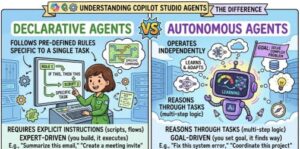
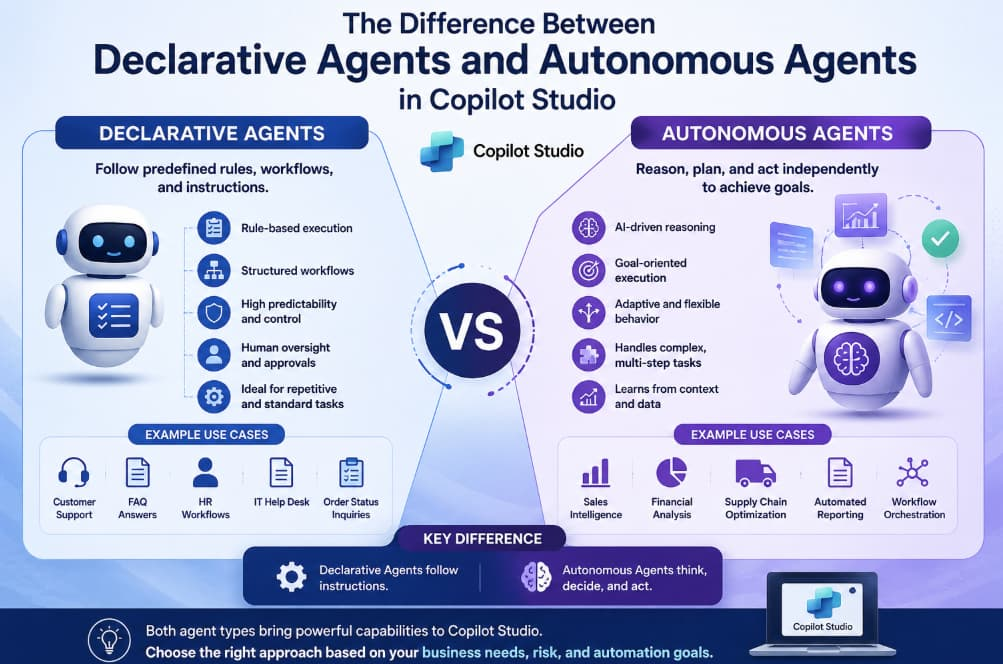
Declarative Agents are AI agents that operate based on predefined instructions, rules, and workflows created by the developer or business user.
In simple terms, these agents are told exactly what to do and how to do it.
They work similarly to traditional automation systems where outcomes are controlled, predictable, and rule-based.
Instead of making independent decisions, Declarative Agents rely on:
- Structured prompts
- Defined workflows
- Preconfigured triggers
- Business rules
- Explicit instructions
The word “declarative” means you declare the desired behavior, and the system follows it exactly.
How Declarative Agents Work
A Declarative Agent in Copilot Studio typically works through:
- User input or trigger
- Rule evaluation
- Workflow execution
- Response generation
For example:
A customer asks:
“What is the status of my order?”
The Declarative Agent may:
- Retrieve order data from a CRM
- Match the order ID
- Return a predefined response template
- Escalate if no data is found
The agent does not decide on its own what actions to take beyond what has already been configured.
Key Characteristics of Declarative Agents
Predictable Behavior
These agents behave consistently because they follow predefined instructions.
Easier Governance
Since workflows are controlled, businesses can manage compliance, security, and risk more effectively.
Lower Complexity
Declarative Agents are easier to build and maintain, especially for non-developers.
Process-Oriented
They are ideal for structured workflows and repetitive business tasks.
Human Oversight
Most actions still require clear rules or approvals.
Common Use Cases for Declarative Agents
Declarative Agents are commonly used for:
- Customer support chatbots
- FAQ systems
- IT help desk automation
- HR onboarding workflows
- Leave request approvals
- Document retrieval
- Order status inquiries
- Internal knowledge assistants
These scenarios require accuracy and consistency rather than independent reasoning.
What Are Autonomous Agents?
Autonomous Agents are far more advanced.
Instead of simply following predefined workflows, Autonomous Agents can independently reason, plan, decide, and execute actions to achieve goals.
These agents use AI models, memory, context awareness, and dynamic decision-making to operate with minimal human intervention.
In Copilot Studio, Autonomous Agents can:
- Analyze situations
- Determine next steps
- Adapt to changing inputs
- Interact with multiple systems
- Learn from context
- Complete multi-step tasks autonomously
Rather than being told every action, the agent understands the objective and figures out how to achieve it.
How Autonomous Agents Work
Autonomous Agents operate using:
- AI reasoning
- Goal-based execution
- Dynamic planning
- Tool usage
- Contextual understanding
- Continuous evaluation
For example:
A sales manager asks:
“Prepare a weekly sales performance report and notify underperforming regions.”
An Autonomous Agent may:
- Collect CRM sales data
- Analyze trends
- Compare KPIs
- Generate summaries
- Identify weak-performing areas
- Create visual reports
- Send notifications automatically
- Recommend next actions
All of this can happen with minimal predefined scripting.
Key Characteristics of Autonomous Agents
Independent Decision-Making
These agents can determine the best course of action without explicit step-by-step instructions.
Adaptive Behavior
They adjust based on changing environments, data, or user needs.
Goal-Oriented
Instead of following fixed workflows, they focus on achieving outcomes.
Multi-Step Task Execution
They can chain actions together intelligently.
Advanced AI Capabilities
Autonomous Agents rely heavily on large language models and contextual AI reasoning.
Common Use Cases for Autonomous Agents
Autonomous Agents are useful for:
- Advanced business process automation
- Sales intelligence
- Financial analysis
- Supply chain optimization
- Intelligent customer engagement
- Automated reporting
- Project management assistance
- Workflow orchestration
- Enterprise research assistants
These scenarios benefit from flexibility and intelligent reasoning.
Declarative Agents vs Autonomous Agents: The Core Difference
The primary difference comes down to control versus autonomy.
| Feature | Declarative Agents | Autonomous Agents |
|---|---|---|
| Decision Making | Rule-based | AI-driven |
| Flexibility | Limited | High |
| Complexity | Lower | Higher |
| Predictability | Very predictable | Dynamic |
| Human Oversight | High | Moderate |
| Workflow Type | Structured | Adaptive |
| Setup | Easier | More advanced |
| Risk Level | Lower | Higher |
| Learning Ability | Minimal | Context-aware |
| Best For | Repetitive tasks | Complex automation |
Declarative Agents excel in controlled environments where consistency matters.
Autonomous Agents shine in dynamic environments requiring intelligent adaptation.
Which One Should You Choose?
The right choice depends on your business goals.
Choose Declarative Agents If:
- You need predictable automation
- Compliance and governance are critical
- Your workflows are structured
- You want low-risk AI implementation
- Your team has limited AI expertise
Choose Autonomous Agents If:
- You need intelligent decision-making
- Workflows are complex or changing
- You want advanced productivity automation
- Your organization is AI-mature
- You need scalable enterprise AI solutions
In many organizations, both types work together.
For example:
- Declarative Agents handle customer FAQs
- Autonomous Agents manage strategic workflows and analytics
This hybrid approach often provides the best balance between control and innovation.
The Future of AI Agents in Copilot Studio
As AI technology evolves, the line between Declarative and Autonomous Agents will continue to blur.
Microsoft is investing heavily in AI orchestration, copilots, enterprise automation, and agentic AI capabilities. Future versions of Copilot Studio are expected to support even more advanced autonomous behaviors while still maintaining governance and security controls.
Organizations adopting AI today should focus not only on automation but also on responsible AI implementation.
Autonomous AI offers enormous opportunities, but businesses must balance innovation with transparency, compliance, and human oversight.
Declarative Agents and Autonomous Agents represent two different approaches to AI automation in Copilot Studio.
Declarative Agents provide structured, predictable, and rule-driven automation ideal for repetitive workflows and controlled environments.
Autonomous Agents deliver intelligent, adaptive, and goal-oriented automation capable of handling complex business processes with minimal human intervention.
Neither approach is universally better.
The best solution depends on your business needs, risk tolerance, technical maturity, and automation goals.
As organizations continue embracing AI-powered workflows, understanding these differences will become increasingly important for building scalable, secure, and effective AI solutions.
Businesses that successfully combine both approaches will likely gain the greatest competitive advantage in the evolving AI landscape.
Extra posts:
 Copilot Studio vs Azure AI Agents: What Should You Use?
  Copilot Studio vs. Power Virtual Agents What’s Changed?
  Cost Optimization for Copilot and AI Agents on Azure
  How to Introduce Copilot Agents Without Disrupting Your Organization
  Human-in-the-Loop: Where Copilot Agents Should (and Shouldn’t) Act Alone
  How Copilot Agents Think: Goals, Memory, Tools, and Autonomy