
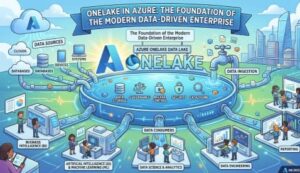
Data has become the core asset of every modern organization. Companies today generate massive amounts of information from applications, customer interactions, IoT devices, business systems, and operational platforms. But the real challenge is no longer collecting data — it is organizing, managing, securing, and turning that data into meaningful business value.
As a cloud architect, I have seen many organizations struggle with the same problem: data exists everywhere, but insights are difficult to achieve. Different teams create their own copies, build separate pipelines, and maintain isolated storage environments. Over time, this creates complexity, higher costs, and inconsistent business decisions.
This is where Microsoft OneLake in Azure introduces a major shift in the way enterprises think about data.
OneLake provides a unified data foundation designed to bring all organizational data together into a single logical data lake. It is a key capability within the Microsoft Fabric ecosystem and represents a move toward a simpler, governed, and scalable approach to enterprise analytics.
What is OneLake in Azure?
At a high level, OneLake is a single data lake for an entire organization.
Traditional data environments often look like multiple disconnected storage systems:
- One team stores data in Azure Data Lake Storage
- Another team uses SQL databases
- Analytics teams create copies for reporting
- Data scientists maintain their own datasets
- Business users depend on separate dashboards
This creates duplicated data, security challenges, and operational overhead.
OneLake changes this model by creating a centralized data foundation where different teams can access and work with data without unnecessary duplication.
Think of OneLake as the “OneDrive for enterprise data.” Just like OneDrive gives users one place to store and access files, OneLake gives organizations one place to store, discover, govern, and analyze data.
Why OneLake Matters for Modern Cloud Architecture
From an architecture perspective, OneLake addresses some of the biggest challenges in enterprise data platforms.
1. Eliminating Data Silos
One of the biggest problems in large organizations is fragmented data.
A sales team may have customer information in a CRM system. Finance may have transactional data in ERP platforms. Operations may have machine data from IoT systems.
Without a unified architecture, connecting these sources becomes complicated.
OneLake creates a shared data layer where information can be accessed across departments while maintaining proper governance and security.
This enables organizations to move closer to a true enterprise data platform instead of managing disconnected projects.
2. Supporting the Lakehouse Architecture
The traditional data warehouse was built for structured business reporting. The data lake was built for flexibility and large-scale storage.
Modern organizations need both.
The lakehouse architecture combines the strengths of:
- Data lakes
- Data warehouses
- Analytics platforms
- Machine learning environments
OneLake supports this approach by allowing organizations to store data in open formats while enabling analytics and reporting experiences on top of the same data.
This reduces the need for constant data movement and transformation between systems.
3. Simplifying Data Governance
Governance is one of the most important responsibilities of a cloud architect.
When data exists in hundreds of locations, controlling access and ensuring compliance becomes difficult.
OneLake helps organizations establish consistent governance practices by providing:
- Centralized data discovery
- Security controls
- Access management
- Data classification
- Monitoring capabilities
A well-designed OneLake implementation allows businesses to answer important questions:
Who owns this data?
Who can access it?
Where is it stored?
How is it being used?
These questions are critical for enterprise-scale cloud adoption.
4. Enabling Data Mesh Principles
Many organizations are adopting a data mesh approach, where business domains take ownership of their data while still following enterprise standards.
For example:
- Finance owns financial data
- Sales owns customer insights
- Operations owns operational datasets
The challenge is maintaining autonomy without creating chaos.
OneLake supports this model by allowing domain teams to manage their data while providing a shared organizational data foundation.
This creates a balance between decentralization and governance.
OneLake and the Role of the Cloud Architect
A cloud architect’s responsibility is not only selecting technology but designing systems that support business goals.
When implementing OneLake, architects need to consider several areas:
Data Strategy
Before moving data into OneLake, organizations need a clear understanding of:
- What data exists
- Who owns it
- Which data provides business value
- How data should be organized
Technology alone does not solve data problems. A strong strategy is required.
Security Design
Enterprise data requires strong security foundations.
Architects must define:
- Identity management
- Access policies
- Data protection
- Compliance requirements
The goal is to make data accessible to the right people while protecting sensitive information.
Cost Optimization
Cloud data platforms can grow quickly.
Without proper architecture, companies may pay for unnecessary storage, duplicated datasets, or inefficient processing.
OneLake can help reduce costs by minimizing unnecessary copies of data and simplifying data operations.
Real Business Benefits of OneLake
Organizations adopting OneLake can achieve several benefits:
Faster Analytics
Teams spend less time searching for data and preparing datasets. Analysts can focus more on generating insights.
Better Collaboration
Different departments can work from a shared source of truth.
Reduced Complexity
Fewer pipelines, fewer copies, and fewer disconnected systems mean easier management.
Improved AI Readiness
Modern AI solutions depend on high-quality, accessible data.
A unified data foundation makes it easier to prepare data for machine learning and AI workloads.
The Future of Enterprise Data with OneLake
The future of data architecture is moving toward simplicity.
Organizations no longer want hundreds of disconnected systems. They want platforms that provide flexibility, governance, scalability, and intelligence.
OneLake represents this evolution.
It is not just another storage service. It is a new way of thinking about enterprise data — where information becomes a shared business asset instead of isolated technical infrastructure.
For cloud architects, OneLake provides an opportunity to design platforms that are more scalable, secure, and aligned with business needs.
The companies that successfully manage their data will have a major advantage in the era of AI and digital transformation.

OneLake in Azure represents an important step toward the next generation of cloud data architecture.
By creating a unified data foundation, supporting lakehouse patterns, enabling governance, and reducing complexity, OneLake helps organizations transform scattered information into valuable insights.
For architects building modern enterprise platforms, OneLake is not just a data storage solution — it is the foundation for a smarter, connected, and data-driven future.
Extra posts:
 Azure Enterprise-Scale Landing Zone Building a Future-Ready Cloud Foundation
  Cache-Aside (Lazy Loading) Load Data into a Cache on Demand in Azure
  Accelerating Enterprise AI Innovation with Azure AI Foundry
  Unveiling Microsoft Fabric AI The Future of Data Intelligence
  Data Integration with Microsoft Fabric Unifying Your Data Universe
  Azure Functions vs. Azure Container Apps Choosing Your Serverless Compute