
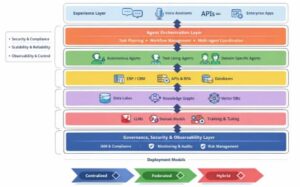
Enterprise IT is entering a new era where artificial intelligence is no longer just a passive tool that analyzes data or generates content. Instead, we are witnessing the rise of Agentic AI systems that can autonomously plan, reason, act, and continuously improve toward defined goals. For organizations aiming to scale this capability responsibly, a well-defined reference architecture becomes critical.
As a Solution Architect, I’ve seen firsthand how enterprises struggle when adopting AI without a structured blueprint. Agentic AI introduces additional complexity: orchestration, autonomy, governance, and integration across legacy and modern systems. This blog outlines a practical reference architecture that balances innovation with control, enabling enterprises to deploy Agentic AI systems at scale.
What is Agentic AI?
Agentic AI refers to AI systems designed to operate as autonomous agents. These agents can:
- Understand objectives
- Break them into tasks
- Execute actions across systems
- Learn from outcomes
- Iterate without constant human intervention
Unlike traditional AI models, which respond to prompts, agentic systems proactively drive workflows. Think of them as digital operators embedded into your enterprise ecosystem.
Why Enterprises Need a Reference Architecture
Without a clear architecture, organizations risk:
- Fragmented AI implementations
- Security vulnerabilities
- Lack of governance
- Poor scalability
- Unpredictable behavior from autonomous systems
A reference architecture provides:
- Standardization
- Reusability
- Governance frameworks
- Integration patterns
- Scalability guidelines

Core Layers of Agentic AI Reference Architecture
A robust architecture can be broken down into seven key layers:
1. Experience Layer (User & System Interaction)
This is where humans and systems interact with AI agents.
Components:
- Chat interfaces
- APIs
- Voice assistants
- Enterprise applications (ERP, CRM, ITSM)
Key Considerations:
- Multi-channel support
- Personalization
- Context awareness
This layer ensures that Agentic AI is accessible and usable across the enterprise.
2. Agent Orchestration Layer
This is the brain of the system, responsible for managing agents and workflows.
Responsibilities:
- Task decomposition
- Planning and reasoning
- Agent collaboration
- Workflow orchestration
Key Capabilities:
- Multi-agent coordination
- Dynamic decision-making
- Retry and fallback mechanisms
Think of this layer as the conductor of an orchestra, ensuring all agents work harmoniously.
3. Agent Runtime Layer
This is where agents actually execute tasks.
Components:
- Autonomous agents
- Tool-using agents
- Domain-specific agents (Finance, HR, IT)
Capabilities:
- Memory (short-term and long-term)
- Tool invocation
- State management
Each agent operates with a defined scope but can collaborate with others when needed.
4. Tools & Integration Layer
Agents must interact with enterprise systems to perform meaningful work.
Examples:
- ERP systems
- CRM platforms
- Databases
- External APIs
- RPA tools
Key Patterns:
- API-first integration
- Event-driven architecture
- Secure connectors
This layer ensures agents can take real actions—not just generate insights.
5. Data & Knowledge Layer
Agentic AI thrives on data. This layer provides structured and unstructured knowledge.
Components:
- Data lakes and warehouses
- Knowledge graphs
- Vector databases
- Document repositories
Capabilities:
- Retrieval-Augmented Generation (RAG)
- Semantic search
- Context enrichment
Data quality and governance are critical here to ensure reliable outputs.
6. AI/ML Model Layer
This layer powers the intelligence behind agents.
Includes:
- Large Language Models (LLMs)
- Domain-specific models
- Fine-tuned enterprise models
Key Considerations:
- Model selection strategy
- Cost optimization
- Latency management
- Model versioning
Enterprises often adopt a hybrid approach—combining open-source and proprietary models.
7. Governance, Security & Observability Layer
This is arguably the most critical layer for enterprise adoption.
Key Functions:
- Identity and access management (IAM)
- Data privacy controls
- Audit trails
- Monitoring and logging
- Bias and risk detection
Observability includes:
- Agent decision tracking
- Performance metrics
- Cost monitoring
- Error analysis
Without governance, Agentic AI can quickly become a liability.
Cross-Cutting Concerns
Across all layers, several concerns must be addressed:
1. Security by Design
- Zero-trust architecture
- Secure API gateways
- Data encryption
2. Scalability
- Cloud-native infrastructure
- Containerization (e.g., Kubernetes)
- Auto-scaling agents
3. Reliability
- Fault tolerance
- Circuit breakers
- Graceful degradation
4. Compliance
- Regulatory adherence (GDPR, HIPAA, etc.)
- Data residency controls
Deployment Models
Enterprises can deploy Agentic AI in several ways:
1. Centralized Model
- Single platform managing all agents
- Easier governance
- Limited flexibility
2. Federated Model
- Domain-specific agent ecosystems
- Greater autonomy for business units
- Requires strong governance
3. Hybrid Model (Recommended)
- Central governance + decentralized execution
- Best balance of control and agility
Real-World Use Cases
Agentic AI can transform multiple enterprise functions:
IT Operations
- Automated incident resolution
- Root cause analysis
- Self-healing systems
Finance
- Autonomous invoice processing
- Fraud detection agents
- Financial forecasting
Customer Support
- Multi-step issue resolution
- Personalized interactions
- Ticket triaging
HR
- Employee onboarding automation
- Policy query handling
- Talent analytics
Challenges to Address
While promising, Agentic AI introduces challenges:
- Trust: Can we rely on autonomous decisions?
- Explainability: Why did the agent act a certain way?
- Control: How do we override or stop agents?
- Cost: Continuous execution can be expensive
- Ethics: Ensuring fairness and accountability
Architectural design must proactively address these.
Best Practices for Implementation
From a Solution Architect’s perspective:
- Start Small
- Pilot with a single use case
- Validate ROI before scaling
- Design for Observability
- Log every decision
- Enable traceability
- Use Modular Architecture
- Avoid monolithic agent systems
- Promote reusability
- Establish Governance Early
- Define policies before deployment
- Include legal and compliance teams
- Human-in-the-Loop
- Maintain oversight for critical decisions
- Gradually increase autonomy
The Future of Agentic AI in Enterprise IT
Agentic AI will redefine how enterprises operate. Instead of static workflows, organizations will rely on adaptive, intelligent systems that continuously optimize themselves.
In the near future, we can expect:
- Fully autonomous IT operations
- AI-driven enterprise decision-making
- Self-optimizing business processes
However, success will depend on how well enterprises architect these systems today.
Agentic AI is not just another technology trend—it’s a paradigm shift. Enterprises that adopt it without a structured approach risk chaos, while those that implement a strong reference architecture will unlock unprecedented efficiency and innovation.
As Solution Architects, our role is to bridge vision and execution—designing systems that are not only powerful but also secure, scalable, and responsible.
A well-defined reference architecture is the foundation for making Agentic AI a sustainable competitive advantage.
Extra posts:
 Enterprise AI Agent Architecture Patterns Using Copilot Studio
  Exploring IBM Architect AI Transforming Enterprise Architecture with AI
  Data Boundaries and Permissions in an Agentic Copilot World
  Common Mistakes Orgs Make When Adopting Agentic AI
  Real Use Cases: 5 Agentic AI Workflows That Actually Save Time
  What Is Agentic AI in Microsoft Ecosystem? A Deep Technical Explainer