
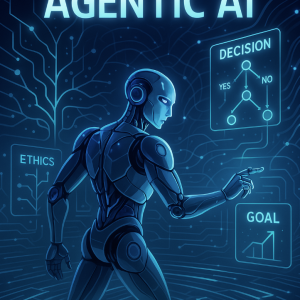
As the AI landscape rapidly evolves, we’re seeing a shift from passive AI models to more autonomous and proactive systems. This transformation is best embodied by Agentic AI — a new class of intelligent systems designed not just to generate content but to act with purpose, autonomy, and context awareness.
In this blog, we’ll explore what Agentic AI is, how it differs from traditional Generative AI, and how it unlocks new possibilities for solution architects designing intelligent, enterprise-grade systems.
🔍 What Is Agentic AI?
Agentic AI refers to artificial intelligence systems that can make decisions, take actions, and pursue goals autonomously, often coordinating multiple steps or tasks in a dynamic environment. Think of them as intelligent agents that:
- Understand high-level goals
- Break them down into subtasks
- Choose appropriate tools or APIs
- Monitor outcomes and adapt accordingly
Unlike traditional models that respond passively to prompts, Agentic AI acts. It doesn’t just answer a question — it might book a meeting, analyze a dataset, generate a report, and email it to stakeholders — all without being explicitly told each step.
⚙️ Generative AI vs. Agentic AI: Key Differences
| Feature | Generative AI | Agentic AI |
|---|---|---|
| Goal | Generate content based on a prompt | Achieve objectives by reasoning, planning, and executing |
| Autonomy | Reactive | Proactive & autonomous |
| Task Handling | Single-step or chained via external logic | Multi-step, self-managed |
| Memory | Often stateless or short-term | Long-term memory, context-aware |
| Orchestration | Requires manual orchestration (e.g., prompts or APIs) | Self-orchestrates actions using tools, APIs, memory |
| Examples | ChatGPT, DALL·E, GitHub Copilot | AutoGPT, BabyAGI, Microsoft Copilot Agents |
🧠 Why Agentic AI Matters for Solution Architects
As a solution architect, you’re tasked with designing robust, scalable systems that solve business problems. Agentic AI opens new doors in enterprise automation, intelligent workflows, and digital experience design.
Here’s how it adds strategic value:
- Autonomous Workflows
Instead of building rigid automation scripts, you can implement Agentic AI that adapts based on real-time context. Example: An AI agent that monitors system performance and auto-escalates issues, proposes resolutions, and applies patches. - Dynamic Orchestration
Traditionally, we orchestrate workflows through BPM tools or custom code. Agentic AI can evaluate context, invoke APIs, call services, and update systems on its own, reducing development complexity. - Long-Term Memory and Learning
With memory-aware agents, enterprise solutions can become “self-improving”. Imagine an agent that tracks business metrics over time and adapts its actions based on what worked best historically. - Multi-System Coordination
Agentic AI can act as a “brain” across disconnected systems, initiating actions across SaaS, ERP, CRM, and custom APIs. For instance, automating a lead-to-cash process spanning Salesforce, SAP, and Power BI. - Cost Optimization
Smart agents can continuously analyze usage patterns, suggest and even implement cost-saving changes — e.g., downgrading unused cloud resources or identifying license inefficiencies.
🛠️ Example Use Cases from an Architect’s Lens
- Enterprise IT Agent
- Goal: Reduce ticket resolution time.
- Actions: Auto-classify tickets, gather diagnostics, run scripts, escalate to human if needed.
- Value: Lower operational cost, better SLA adherence.
- Finance Workflow Automation Agent
- Goal: Automate monthly close process.
- Actions: Pull financial data, reconcile discrepancies, notify stakeholders, generate compliance reports.
- Value: Reduces manual effort and errors.
- Sales AI Agent
- Goal: Increase sales pipeline efficiency.
- Actions: Scan CRM for stalled opportunities, auto-send emails, suggest next best actions, sync with calendar for follow-ups.
- Value: Higher sales velocity and conversion.
- Security Monitoring Agent
- Goal: Proactively detect and remediate threats.
- Actions: Analyze logs, isolate compromised accounts, trigger alerts, initiate incident response playbooks.
- Value: Enhanced security posture with minimal human intervention.
🧭 Design Considerations for Solution Architects
When building Agentic AI-powered systems, keep in mind:
- Tool Use: Agentic AI must interface with external systems via APIs, SDKs, or RPA tools.
- Memory/Context: Decide how much memory and history your agent should retain.
- Ethical Boundaries: Define what agents are not allowed to do autonomously.
- Fallback Mechanisms: Always include human-in-the-loop options for sensitive tasks.
- Security & Access Control: Ensure agents respect RBAC, auditing, and compliance standards.
Agentic AI is not just an evolution of Generative AI — it’s a paradigm shift that enables systems to act, not just respond. For solution architects, this means rethinking automation, workflows, and user experiences through the lens of intelligent agents.
As tools like Microsoft Copilot Studio, AutoGen, LangChain, and OpenAI’s function-calling mature, the real challenge isn’t just building agents — it’s designing safe, scalable, and reliable agentic ecosystems that deliver measurable value to the business.
Have you started architecting with agents yet? The age of reactive bots is ending — it’s time to build solutions that think, adapt, and act.
Extra posts:
 How Amazon Q Helps Solution Architects in Their Day-to-Day Tasks
  From Requirements to High-Level Design in Minutes with Copilot for Solution Architects
  Unlocking the Power of the Azure Well-Architected Tool with AI A Game-Changer for Solution Architects
  How Solution Architects Can Use Microsoft’s Azure Globe Experience to Design Smarter Cloud Architectures
  Understanding AWS Generative AI Fundamentals
  Generative AI in Azure A Practical Guide to Getting Started