
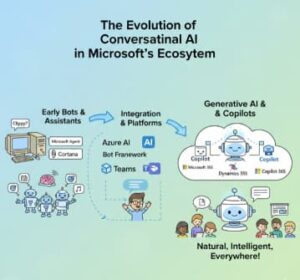
Over the past two decades, conversational AI has shifted from a futuristic curiosity to a core part of how we interact with technology. And while many companies have shaped this field, one of the most influential players has consistently been Microsoft. From the early days of clippy (yes, that Clippy) to the cutting-edge Copilot ecosystem today, Microsoft’s journey mirrors the broader evolution of conversational AI itself. It’s a story of ambition, experimentation, setbacks, breakthroughs, and ultimately, transformation.
In this blog, we’ll explore how conversational AI has developed within Microsoft’s ecosystem—how it started, the key milestones along the way, and where it’s all heading next.
The Humble Beginnings: Early Attempts at Interaction
When people think of Microsoft’s earliest conversational assistant, they often remember the quirky animated paperclip that popped up in Office during the late ’90s and early 2000s. While Clippy is usually remembered with equal parts affection and frustration, it represented one of the first mainstream attempts to create software that could understand users rather than simply respond to direct commands.
Clippy wasn’t truly conversational AI—its “intelligence” was rule-based and heavily dependent on fixed templates. But it laid critical groundwork by highlighting the idea that software could be proactive, friendly, and “chatty.” Unfortunately, it also demonstrated how easily users lose patience when the assistant doesn’t feel genuinely helpful. In many ways, Microsoft’s later AI projects would be shaped by the lessons learned from Clippy’s shortcomings: helpfulness must come before personality, and intelligence must be contextual.
The Rise of Azure and the Era of Cognitive Services
The major turning point came in the mid-2010s with the launch of Azure Cognitive Services, Microsoft’s first serious, large-scale investment in cloud-based AI. Instead of offering rigid, prebuilt assistants, Microsoft focused on exposing a toolbox of AI capabilities—natural language understanding, speech recognition, knowledge extraction, and more—that developers could use to build their own intelligent applications.
This era enabled:
- Custom chatbots through the Azure Bot Framework
- Machine learning and NLP pipelines accessible through cloud APIs
- Enterprise-grade conversational interfaces for customer support, HR, finance, and IT
Instead of being the sole creator of conversational AI experiences, Microsoft positioned itself as an enabler. Businesses could design bots tailored to their own workflows, feeding domain-specific data and creating highly personalized experiences. This strategy helped Microsoft dominate the enterprise AI landscape, where reliability, scalability, and security mattered just as much as raw intelligence.
Cortana: The Consumer AI That Didn’t Quite Stick
While Azure-based tools thrived in the enterprise world, Microsoft also pursued a consumer-focused conversational assistant in Cortana, introduced with Windows Phone and later integrated into Windows 10.
Cortana showed promising ambition:
- Natural spoken interaction
- Integration with system settings, reminders, calendars
- Search and productivity features
- A growing ecosystem of third-party “skills”
But despite its capabilities, Cortana struggled against more popular competitors like Amazon Alexa and Google Assistant. Part of the challenge was timing—Microsoft was late to the mobile AI race, and the decline of Windows Phone made it difficult for Cortana to gain a foothold. Additionally, consumer expectations for voice assistants were rapidly evolving, and the early versions of Cortana simply weren’t equipped for conversational depth.
Eventually, Microsoft reimagined Cortana not as a consumer assistant but as a productivity-focused AI integrated into Microsoft 365 tools. This shift signaled a broader reality: Microsoft’s main strength was not competing for consumer mindshare, but building powerful intelligent tools for work, creativity, and enterprise applications.
Breakthrough Moment: Microsoft + OpenAI Collaboration
Everything changed when Microsoft partnered with OpenAI, gaining access to GPT-based large language models years before they became universally recognized. This partnership fundamentally altered Microsoft’s conversational AI strategy.
Suddenly, instead of template-based bots or limited assistants, Microsoft could integrate true generative AI—systems capable of reasoning, planning, creating, and maintaining context over long conversations.
This new wave of AI transformed the entire Microsoft ecosystem:
1. Copilot for Microsoft 365
Instead of a single assistant like Cortana, Copilot became an AI layer across apps:
- Writing emails in Outlook
- Drafting documents in Word
- Analyzing data in Excel
- Summarizing meetings in Teams
It wasn’t just conversational—it was collaborative.
2. Copilot Studio
Companies could build custom conversational workflows using natural language instead of complex coding. This was the next evolution of the Azure Bot Framework, now turbocharged with generative AI and advanced orchestration tools.
3. Azure OpenAI Service
Enterprises gained secure, private access to GPT models through the Azure cloud. For many businesses, this became the safest and most reliable way to integrate conversational AI into products and internal systems.
Copilot Everywhere: The New Era of Ambient Intelligence
Today, Microsoft’s approach is no longer about one assistant or one platform. Instead, conversational AI is woven into nearly every corner of the ecosystem:
- Windows Copilot helps users control settings and navigate their computer using natural language.
- GitHub Copilot revolutionizes software development by allowing developers to “talk” to code.
- Dynamics 365 Copilot assists with customer insights, CRM tasks, and sales workflows.
- Security Copilot helps analysts detect threats and take action through conversational prompts.
This new generation of AI doesn’t just answer questions—it performs tasks, automates workflows, and collaborates side-by-side with users. It’s the most seamless, natural, and human-like interaction layer Microsoft has ever built.
The evolution of conversational AI within Microsoft’s ecosystem is a story of continual reinvention. Each chapter—Clippy, Cortana, Azure Cognitive Services, the OpenAI partnership, and the rise of Copilot—reflects Microsoft’s willingness to learn, adapt, and push the boundaries of how humans and machines communicate.
Today, Microsoft stands at the forefront of conversational AI because it ultimately embraced what truly matters: not just making software that talks, but making software that understands, collaborates, and empowers people to do more.
As AI continues to mature, Microsoft’s ecosystem will likely remain one of its most influential playgrounds—shaping how we work, create, and interact for years to come.
Extra posts:
 Comparing Copilot Studio with Dialogflow and IBM Watson Assistant: Which Conversational AI Platform Is Best in 2025?
  How Microsoft Copilot Studio Fits Into the Power Platform Ecosystem
  Agentic AI in IT: Self-Healing Systems and Smart Incident Response (Microsoft Ecosystem Perspective)
  Unlocking the Power of Conversational AI with Azure Bot Service
  Agentic AI The Next Evolution Beyond Generative AI for Solution Architects
  How MCP Works in Microsoft’s AI Ecosystem