
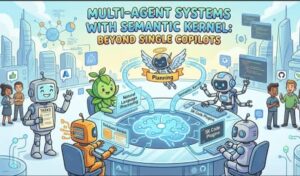
The AI landscape is moving beyond the era of single assistants. Early AI applications focused on creating one powerful copilot that could answer questions, generate content, write code, and automate tasks. But as real-world use cases become more complex, a new architecture is emerging: multi-agent systems.
Instead of one AI agent trying to solve every problem, developers are now building systems where multiple specialized agents collaborate, communicate, and coordinate actions.
With Semantic Kernel, developers can create AI applications where agents behave less like chatbots and more like distributed intelligent systems — capable of planning, delegating, using tools, accessing memory, and working together to complete complex objectives.
From Single Copilots to Agent Networks
A traditional copilot architecture looks like:
User → AI Model → Response
The model receives input, generates output, and completes the interaction.
This works for simple workflows, but enterprise scenarios often require multiple capabilities at the same time.
A single request might require:
- Understanding user intent
- Searching internal knowledge
- Executing business logic
- Calling APIs
- Writing code
- Validating results
- Making decisions
A single agent can become difficult to maintain because every capability gets packed into one system.
Multi-agent architectures change the model:
User → Orchestrator Agent → Specialized Agents → Final Result
Each agent focuses on a specific responsibility.
For example, an AI software engineering platform could include:
- Architect Agent: Designs system structure and technical approach
- Developer Agent: Generates implementation code
- Testing Agent: Creates automated tests and validates behavior
- Security Agent: Performs vulnerability analysis
- DevOps Agent: Handles deployment workflows
- Review Agent: Checks quality and consistency
The result is a collaborative AI engineering team.
How Semantic Kernel Enables Multi-Agent Architectures
Semantic Kernel provides building blocks for creating AI-powered applications by combining language models with traditional software components.
The core idea is orchestration.
Semantic Kernel allows developers to connect:
- AI models
- Plugins and functions
- Memory systems
- Planning workflows
- External services
- Agent communication patterns
Instead of treating AI as only a text generator, Semantic Kernel allows developers to build structured systems around models.
An agent can have:
- A system role
- Specialized instructions
- Available tools
- Context memory
- Reasoning strategies
- Collaboration rules
This creates a foundation for intelligent agent ecosystems.
Agents Talking to Agents
One of the biggest changes in AI engineering is moving from human-to-AI interaction toward AI-to-AI collaboration.
Agents can exchange information, request actions, challenge decisions, and provide feedback.
Consider a business analytics workflow.
A user asks:
“Analyze last quarter’s performance and recommend improvements.”
A multi-agent system might activate:
Data Agent
- Connects to databases
- Retrieves business metrics
- Cleans and structures data
Analysis Agent
- Finds trends
- Detects anomalies
- Generates insights
Strategy Agent
- Converts insights into recommendations
- Evaluates possible actions
Presentation Agent
- Creates reports and visual summaries
Each agent contributes a specialized capability.
The final answer is created through collaboration rather than one model response.
Task Delegation and Agent Orchestration
The most important design pattern in multi-agent systems is delegation.
Instead of manually controlling every step, developers can create an orchestrator that decides:
- Which agent should handle a task
- What information should be passed
- When another agent should be involved
- How results should be combined
A simplified workflow:
- User submits a goal
- Orchestrator analyzes the request
- Tasks are generated
- Specialized agents receive assignments
- Agents execute actions
- Results are validated
- Final response is created
This resembles distributed computing, where different services handle different responsibilities.
In practice, agents may communicate through:
- Shared memory
- Event systems
- Message queues
- Function calls
- Agent protocols
The goal is not just automation.
The goal is coordination.
Memory and Context Sharing Between Agents
A major challenge in multi-agent systems is managing context.
Each agent may need different information.
A research agent may need:
- Documents
- Search results
- Historical data
A coding agent may need:
- Existing code
- Architecture decisions
- Technical requirements
A review agent may need:
- Previous outputs
- Validation rules
Semantic Kernel helps developers manage context by connecting agents with memory and knowledge sources.
This allows agents to maintain awareness without sending unnecessary information between every interaction.
Emergent Behavior: Intelligence Through Interaction
Emergent behavior is one of the most interesting concepts in multi-agent AI.
A single agent may have limited capabilities.
But when multiple agents interact, unexpected capabilities can appear.
For example:
A planning agent creates a solution.
A critic agent identifies weaknesses.
A research agent finds missing information.
A refinement agent improves the result.
The system becomes more capable because of the interaction pattern.
This is similar to how teams work in the real world.
The final outcome is not created by one participant alone, but by the relationship between multiple contributors.
Multi-Agent AI Challenges
Building agent systems also introduces new engineering problems.
Agent Coordination
More agents mean more communication paths.
Developers need rules for:
- Agent responsibilities
- Message formats
- Decision ownership
- Failure handling
Without clear boundaries, agents may duplicate work or produce conflicting outputs.
Observability
Debugging a single AI response is already challenging.
Debugging ten interacting agents is much harder.
Production systems need visibility into:
- Agent decisions
- Tool usage
- Execution paths
- Latency
- Errors
Agent tracing becomes an essential part of AI engineering.
Cost Optimization
Every agent interaction may trigger model calls.
Poorly designed systems can become expensive.
Developers need strategies like:
- Using smaller models for simple tasks
- Limiting unnecessary agent calls
- Caching results
- Creating efficient routing logic

The Future of AI Development
The next generation of AI applications will likely look less like individual assistants and more like intelligent ecosystems.
Behind a simple chat interface, there may be:
- Research agents
- Planning agents
- Execution agents
- Verification agents
- Monitoring agents
The future enterprise application may not have “an AI assistant.”
It may have an AI workforce.
Multi-agent systems with Semantic Kernel provide a practical foundation for building these experiences.
The shift is happening from:
One model answering questions
to:
Multiple agents collaborating to solve problems.
Extra posts:
 Single Agent vs Multi-Agent Architectures: When Do You Need Each? (With Microsoft Technologies Explained)
  Designing Multi-Agent Systems in Copilot Studio
  Multi-Turn Conversations and Context Management in Copilot Studio
  Multi-Agent Orchestration in Copilot Redefining Intelligent Workflows
  How to Build Your First AI Agent in Copilot Studio in 15 Minutes
  Enterprise AI Agent Architecture Patterns Using Copilot Studio